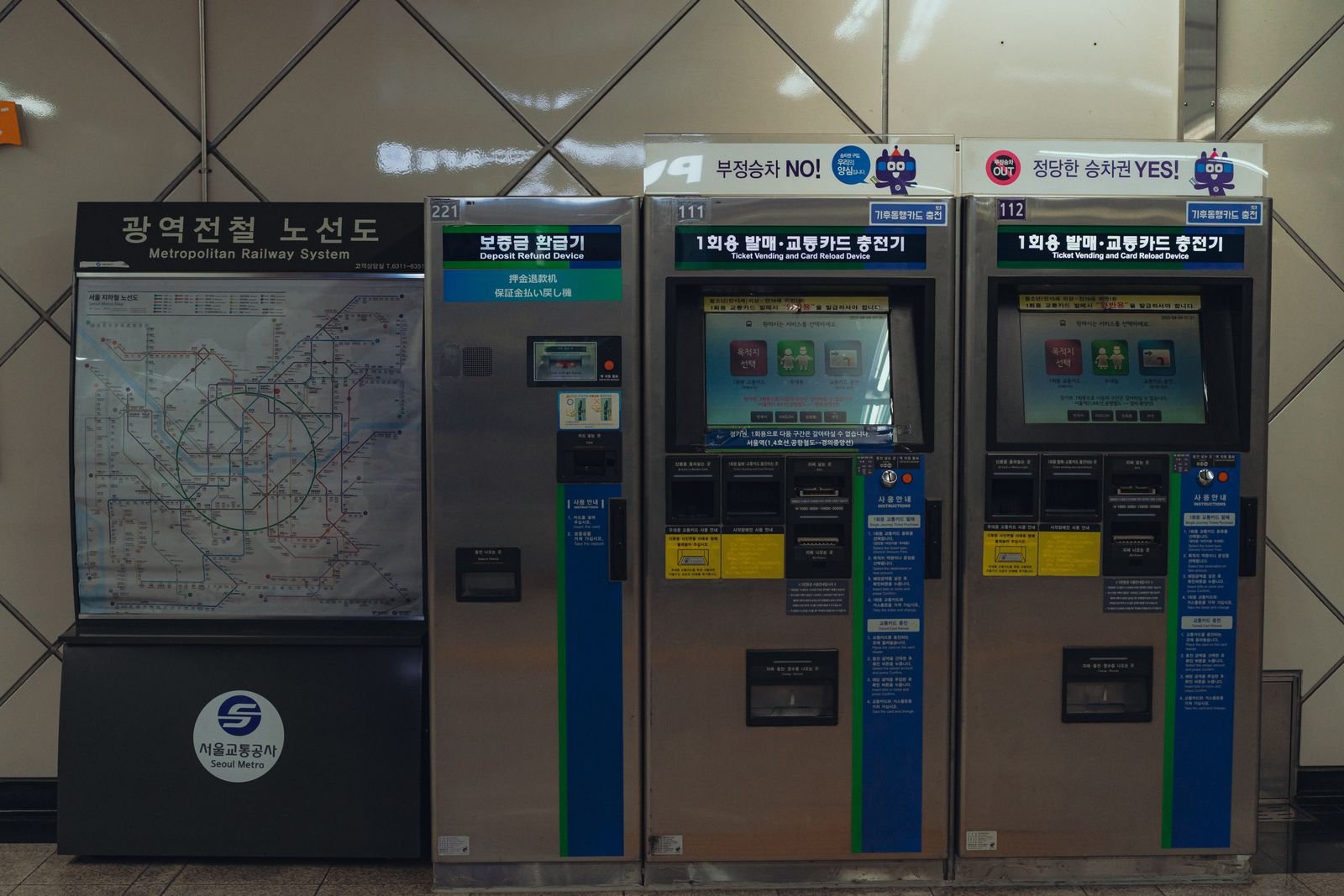
Seoul has one of the densest, cleanest and best-signed public transport networks in Asia, and you can do an entire trip without a taxi. This guide covers the navigation side: which subway lines matter, how exits work, the map apps that behave, how the airports connect, and what to do after the last train. For the card itself (where to buy it, how to top up, and how it compares with the alternatives), see our T-money card guide.
From the Airports to Central Seoul
Incheon (ICN) is about 50 km from the centre, and most arrivals use the Airport Railroad (AREX): the non-stop express to Seoul Station takes roughly 45 minutes, and the all-stop train takes around an hour and connects to Lines 1, 2, 5, 6 and 9 at several stations. Limousine buses and taxis are covered in full on our Incheon Airport to Seoul guide. If you land late at night, with heavy bags or in a group of three or more, a pre-booked private airport transfer is often the less stressful choice.
Gimpo Airport (GMP), used for domestic flights and some short-haul routes, is much closer: Line 5, Line 9 and AREX all stop there, and the ride to central Seoul takes 30 to 45 minutes.
The Subway at a Glance
Seoul’s network has more than 20 lines when you include the regional and light-rail lines, but visitors can ignore most of them. Each line has a number, a colour and a station number, so you can follow “Line 3, towards Daehwa” without reading Korean.
| Line | Colour | Why tourists use it |
|---|---|---|
| Line 1 | Dark blue | Seoul Station, City Hall, Jongno 3-ga, Dongdaemun |
| Line 2 | Green (loop) | Hongdae (Hongik Univ.), Euljiro, Seongsu, Gangnam |
| Line 3 | Orange | Gyeongbokgung, Anguk (Bukchon, Insadong), Apgujeong |
| Line 4 | Light blue | Myeongdong, Dongdaemun, Seoul Station |
| Line 6 | Brown | Itaewon area, Hangang-jin |
| Line 9 | Gold | Gimpo Airport, Yeouido, Gangnam; express trains skip stops |
| AREX | Light blue | Incheon and Gimpo airports, Hongdae, Seoul Station |
Line 2 is a circle, so the direction is “inner” or “outer” loop, which is the one part that confuses first-timers. Pick the direction that reaches your station first in the map app, and note that rush hours (roughly 07:30 to 09:30 and 17:30 to 20:00) on Lines 2, 4 and 9 are packed.
Reading a Station
- Platform signs show the next stations in English and Korean, plus the last station on the line. Match the final destination name, not just the colour.
- Transfers are signposted by line colour and number on floor and ceiling signs. Some interchanges, such as Seoul Station, Dongdaemun History and Culture Park, and Gongdeok, can mean a long walk of five to ten minutes between lines.
- Exit numbers matter more than anything else. Large stations have eight to fifteen exits and the wrong one can add a kilometre of walking. Search for the exit in your map app, and note that Gyeongbokgung Station exit 5 leads to the palace gate and Hongik Univ. Station exit 9 is the usual way into Hongdae. Our Seoul palaces guide lists the closest stations for each palace.
- Elevators and escalators exist at nearly every station, which helps with luggage, though some older stations need a few stairs.
Apps That Work
Google Maps is weak for walking and transit directions in Korea (the reason is covered on our essential apps page). Use these instead:
- Naver Map gives the most accurate transit, bus and walking directions, with English mode and exit numbers.
- Kakao Map is a close alternative, with live bus arrivals.
- Kakao T is the main taxi-hailing app. Check payment options before you rely on it.
You need data on your phone to use them, so set up an eSIM before you land. Our Korea SIM and eSIM guide compares the options, and you can buy one in advance through Airalo.
Buses, Night Buses and Taxis
Buses reach places the subway does not, such as hillside neighbourhoods and some palaces’ back gates. Tap your card when boarding and again when exiting. Colour-coded routes (blue, green, red, yellow) and their fares are in our T-money guide, so we will not repeat the table here.
After the last train: the network stops shortly after midnight. Seoul’s “N” night buses (Owl buses) run on set routes through the small hours from roughly 23:30 until around 05:00 and cost about KRW 2,500 as of 2026. Look for the “N” prefix on route numbers, such as N26 or N37, in your map app. Taxis are plentiful, and a late-night surcharge applies, roughly 20 to 40 percent between about 22:00 and 04:00. A short ride in central Seoul often costs KRW 5,000 to 9,000 by day and more in traffic or at night.
Taxi tips: orange and silver taxis are standard, “deluxe” black taxis cost more, and “international” taxis have English-speaking drivers. Show the destination on your phone, because drivers cannot always read romanised addresses. Tipping is not expected.
Etiquette on the Subway
- Stand to the right on escalators and let people pass on the left.
- Priority seats (pink for pregnant women, other colours for seniors and the less mobile) should stay empty if someone who needs them is nearby.
- Keep calls and speakers quiet. Phones on silent is the norm.
- Let passengers off before boarding and move away from the doors on crowded trains.
- Eating and drinking are not forbidden, but strong-smelling food is frowned upon.
Sample Day Routes
- Palaces and old town: Line 3 to Gyeongbokgung, walk to Bukchon, then Anguk and Insadong. See our Insadong guide.
- Hongdae and cafés: Line 2 or AREX to Hongik Univ., then Line 2 to Seongsu for roasteries, as in our Seongsu coffee shops guide.
- Shopping and night views: Line 4 to Myeongdong, then walk or take a bus up to Namsan.
A guided day tour handles transport for you when time is tight, and you can browse Seoul tours and day trips if you want that. The Seoul Metro operator publishes official maps and station information at seoulmetro.co.kr and Visit Seoul has visitor transport information at english.visitseoul.net.
Where to Base Yourself
Staying near a Line 2 or Line 3 station gives you the most flexibility, with Hongdae, Myeongdong and Jongno the usual choices. Our Seoul hotels guide and best hotels in Seoul are organised by area, and you can compare current prices through Booking.com. Back to the Seoul city guide for everything else.