You don’t need to leave Seoul for good autumn foliage. The city’s mountain parks, palace gardens, and riverside promenades offer colour from mid-October to early November — in some cases rivalling the national parks. This guide covers the best spots, when they peak, and how to reach them by public transport.
Seoul’s autumn colour moves through three overlapping stages: mountain parks first (mid-October), palace grounds and city parks in the middle (late October), and ginkgo-lined avenues last (late October to early November). Combining two or three spots across these stages in a single day is straightforward by subway.
Bukhansan National Park
Best for: dramatic mountain foliage with granite backdrop
Peak: mid-October to late October
Subway: Bukhansan Ui Line to Ui Station (northern entrance) or Line 3 to Gupabal (western entrance)
Bukhansan National Park sits within the Seoul city boundaries — the nearest trailheads are 30 minutes from Gwanghwamun by subway. The park covers 80 square kilometres of forest and granite ridge, with 130km of trails. In mid-October, the mixed deciduous forest turns deep orange and gold below the park’s exposed granite summits.
Dobongsan section (Line 1 or 7 to Dobongsan Station): the most accessible approach for colour with less crowd than the main Bukhansan area. The lower trails through the valley (1.5–3km from the station) are lined with mature oaks and maples that peak around October 15–20. The Dobongsan valley is easier terrain than the granite-heavy Bukhansan ridges, making it well suited for a foliage walk without committing to a full summit attempt.
Bukhansan Ui entrance (Bukhansan Ui Line): gives access to Baegundae (836m), the highest peak. The upper trails above 500m show colour earliest. The Satgat trail from the Ui entrance (4km to the summit area, 2–3 hours one way) passes through the densest colour zone around 300–450m elevation. Trail entry is free; no permit required for standard Bukhansan trails (unlike peak-season Daecheongbong at Seoraksan).
Jingwan-dong entrance on the western side (Bus 7211 from Gupabal Station) is consistently the least crowded approach to the park and has particularly good colour on the Hyangnobong trail in late October.
Namsan and N Seoul Tower
Best for: accessible city-centre foliage with panoramic views
Peak: late October to early November
Subway: Line 4 to Myeongdong, then cable car or 20-minute walk up the hill
Namsan (262m) is the forested hill at Seoul’s geographic centre, topped by N Seoul Tower. The mountain is not wild in the way Bukhansan is — it’s a manicured urban park with paved circular paths — but the tree coverage is dense and the autumn colour against the city skyline is striking.
The Namsan circular trail runs 4km around the hillside at mid-elevation and is entirely flat to gently inclined. The south-facing slopes tend to colour slightly later than the north-facing sections, giving a longer peak window than most Seoul locations. Ginkgo trees along the approach roads from Myeongdong turn vivid yellow in late October and early November.
The cable car (Namsan Cable Car, KRW 15,000 return for adults as of 2026) runs from the lower station near Myeongdong up to the summit area near the tower. Views from the observation deck during clear autumn weather — golden tree cover across the city below — are worth the fare.
Entry to Namsan itself is free; N Seoul Tower observation deck charges separately (KRW 21,000 adults).
Changdeokgung and the Secret Garden
Best for: royal garden autumn colour, most culturally layered foliage experience
Peak: late October to early November (last week of October is optimal)
Subway: Line 3 to Anguk Station, 10-minute walk
Changdeokgung Palace is a UNESCO World Heritage Site, but the attached Secret Garden (Huwon, 후원) is the autumn foliage highlight. The garden covers 78 acres of hillside behind the palace and contains 400-year-old trees, stone pavilions, lotus ponds, and a network of paths through forest that hasn’t changed significantly since the Joseon Dynasty.
Access to Huwon is by guided tour only, with tour slots running every 30 minutes. Tours in English depart at fixed times (typically 11:30 and 14:30, subject to staffing) — check the Cultural Heritage Administration website (cha.go.kr) for current schedules. Korean-language tours run more frequently. Admission: KRW 8,000 per adult (includes palace grounds).
Book in advance during peak autumn weeks. Slots for the last two weeks of October fill days ahead; online booking is available through the Changdeokgung reservation system. Walk-up tickets are sold if capacity allows, but during peak foliage they often don’t.
The Buyongjeong Pavilion and its adjacent lotus pond — with a pavilion on the water’s edge and old trees overhead — is the most photographed spot inside the garden. The Gyujanggak area further into the garden is quieter and has the park’s oldest trees.
Combine Changdeokgung with a walk through Bukchon Hanok Village (15 minutes’ walk south), where ginkgo trees line the main approach paths and turn gold through late October.
Gyeongbokgung Palace
Best for: golden ginkgo avenues and palace framing
Peak: late October to early November
Subway: Line 3 to Gyeongbokgung Station
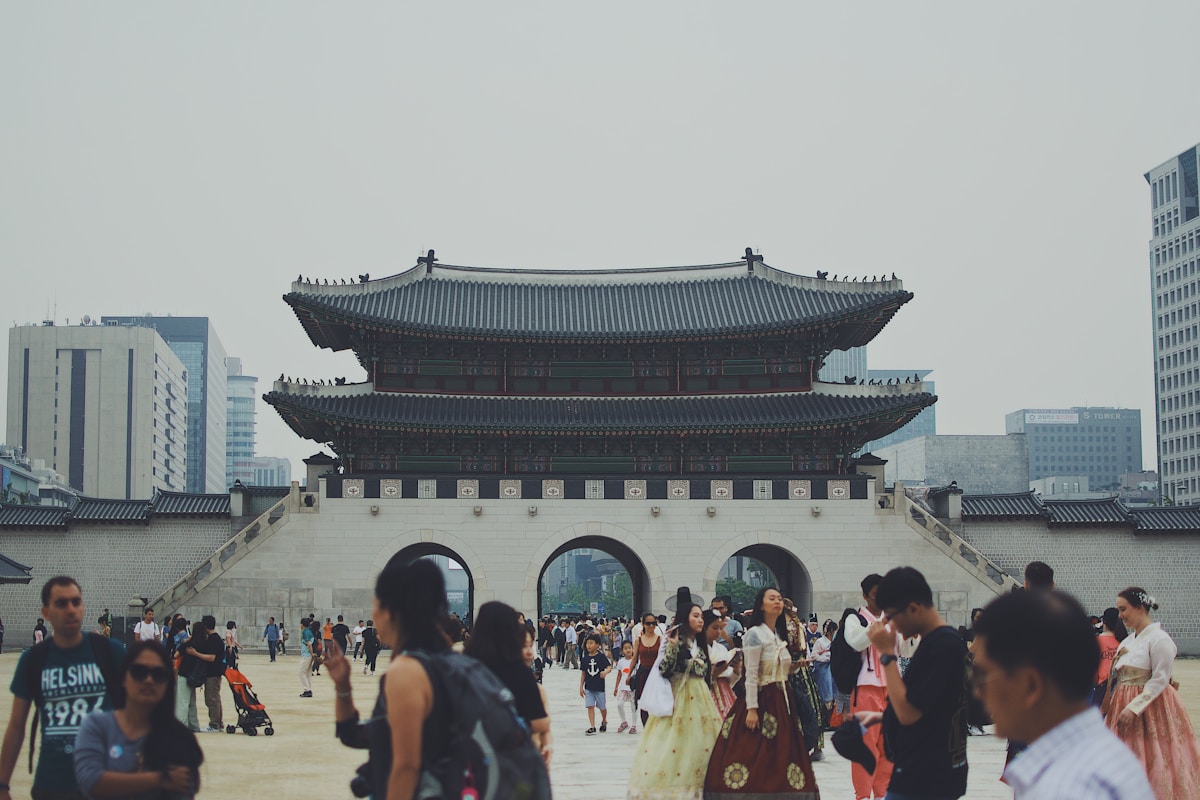
Gyeongbokgung Palace’s grounds are less wooded than Changdeokgung’s Secret Garden but the ginkgo-lined approach along Sejong-daero turns a corridor of vivid yellow in late October. Inside the palace grounds, the National Folk Museum garden has mature trees around a traditional courtyard structure.
Entry fee: KRW 3,000 per adult. The palace is open daily except Tuesdays, 09:00–18:00 (extended hours in summer). Evening illumination events occur in spring and autumn — check the palace website for exact 2026 dates.
The walk north from Gyeongbokgung through Cheong Wa Dae (the former presidential residence, now open to the public) and Bugaksan adds elevation and forest colour to the palace grounds visit without requiring a separate park entry.
Cheonggyecheon Stream
Best for: easy flat walk, city ginkgos, no hiking
Peak: late October to early November
Access: free; multiple subway stations along its length
The 11km urban stream running through central Seoul has ginkgo trees planted along sections of its bank that turn gold in late October. The stream itself is below street level, accessible via staircases from the road. It runs from Gwanghwamun east through Dongdaemun and is entirely flat.
The section between Gwanghwamun and Euljiro (3km) has the most consistent ginkgo canopy. It’s an easy 45-minute one-way walk and can be done as a standalone afternoon activity or linked to a Gyeongbokgung visit earlier in the day.
Day-Trip Option: Nami Island
For those who want to combine Seoul’s city foliage with a more dramatic rural setting, Nami Island (Namiseom) in Gapyeong is 75 minutes from central Seoul by ITX-Cheongchun train (from Cheongnyangni Station, KRW 3,600). The island’s ginkgo-lined paths and Italian poplar avenue peak between late October and early November.
Nami Island can be combined with Garden of Morning Calm (10 minutes by taxi, entry from KRW 11,000) for a full autumn day trip from Seoul. Day trip tours combining Nami Island and the Garden of Morning Calm handle the logistics if you prefer a guided option.
Seoul Autumn Foliage: Timing Summary
| Spot | Peak Window | Getting There | Entry Cost |
|---|---|---|---|
| Bukhansan (Dobongsan) | Oct 15–22 | Line 1/7 to Dobongsan | Free |
| Bukhansan (Ui entrance) | Oct 18–26 | Bukhansan Ui Line | Free |
| Namsan | Oct 25 – Nov 5 | Line 4 to Myeongdong | Free (cable car KRW 15,000) |
| Changdeokgung Secret Garden | Oct 25 – Nov 5 | Line 3 to Anguk | KRW 8,000 |
| Gyeongbokgung | Oct 25 – Nov 7 | Line 3 to Gyeongbokgung | KRW 3,000 |
| Cheonggyecheon | Oct 27 – Nov 7 | Multiple stations | Free |
| Nami Island (day trip) | Oct 25 – Nov 5 | ITX from Cheongnyangni | KRW 18,000 incl. entry |
For the full Korea autumn foliage picture — Seoraksan, Naejangsan, and Gyeongju alongside Seoul — see the South Korea autumn foliage guide.