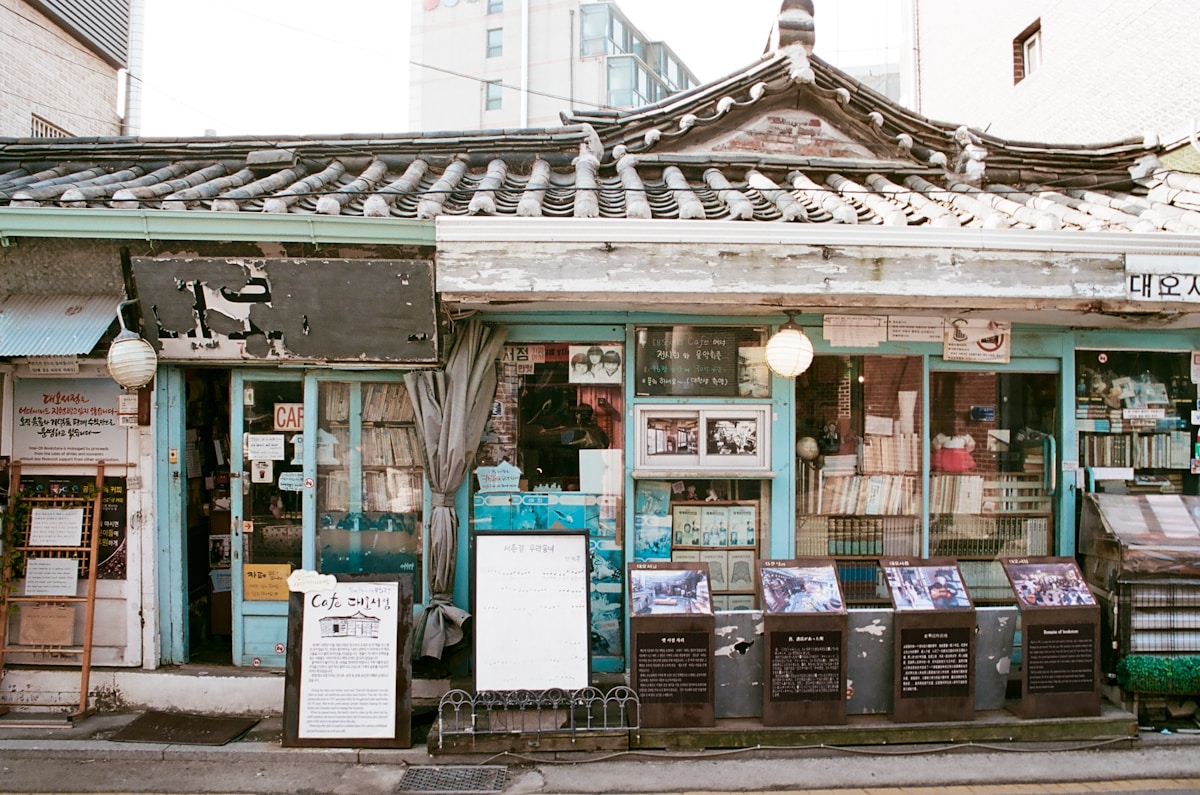
Few cities take cafe culture as seriously as Seoul. The numbers alone hint at the scale: South Korea consumes more coffee per capita than any other country in East Asia, and Seoul has an estimated 17,000 cafes within city limits - more cafes per square kilometre than any city in the world, according to various market analyses. But the raw volume understates what makes Seoul’s scene genuinely distinctive: these spaces function as a form of popular design, where the interior concept and visual identity matter as much as the drink in the cup.
This guide covers the neighbourhoods worth exploring and the themed cafes that go furthest with their concepts. For specialty coffee roasters, dessert cafes, pricing, and cafe etiquette, see our Seoul cafe culture food guide.
Seongsu-dong: Seoul’s Industrial Cafe District
Seongsu-dong was, until the early 2010s, a working-class neighbourhood of shoe factories and small metalworking shops east of the Han River. That industrial past is now the aesthetic foundation for what is arguably Seoul’s most photographed cafe district.
The area’s signature look is raw concrete, factory skylights, exposed steel beams, and original brick walls - preserved rather than renovated, with coffee equipment and hand-drip bars positioned inside structures that still feel like workshops. This contrasts deliberately with the polished minimalism common to Seoul cafes elsewhere.
Key Cafes in Seongsu-dong
Daelim Changgo occupies a former warehouse near Seoul Forest and remains one of the neighbourhood’s most architecturally striking spaces. The main room is a vast atrium with a corrugated iron roof. The coffee is solid, the desserts are excellent (look for the seasonal tarts), and queue times on weekends can reach 30–45 minutes.
Cafe Onion Seongsu is arguably the most Instagrammed interior in Seoul - a multi-storey converted factory with rooftop seating overlooking the neighbourhood. The baked goods, particularly the soboro bread, are genuinely good. Arrive before 10:00 to avoid the queue.
LCDC Seoul is a retail complex plus cafe in Seongsu that brings together independent Korean fashion labels, book shops, and a ground-floor cafe in one building. Worth visiting even if you are not there primarily for coffee - the curation of the retail tenants is thoughtful.
Getting there: Seoul Forest Station (Bundang Line) or Seongsu Station (Line 2). The main cafe cluster is a 10–15 minute walk from either station, with Seoul Forest itself worth combining with the visit.
Ikseon-dong: Hanok Alley Cafes
Ikseon-dong sits within the Jongno district just north of Cheonggyecheon Stream, wedged between older residential blocks. Unlike Seongsu-dong, the built environment here is not industrial - it is a dense cluster of 1930s-era hanok houses with narrow alleyways that the city declined to redevelop in the 1980s and 1990s, largely due to the scale of subdivision.
That urban accident has produced a neighbourhood unlike anywhere else in Seoul: a compact, walkable grid of one and two-storey traditional buildings now housing cafes, restaurants, craft beer bars, and small galleries. The alleyways are less than two metres wide in places, and the experience is closer to stumbling through an old neighbourhood than doing planned tourism.
Key Cafes in Ikseon-dong
Ikseon Hot Bar (not a bar - the name references Korean fish cake hot bars that used to line the street) serves Korean traditional teas and desserts. The interior uses original wooden beams and features floor seating in a raised inner room. The mugwort latte and injeolmi (toasted rice powder) drinks are standout.
Cafe Sukkara focuses on traditional Korean confectionery alongside espresso drinks. The menu changes seasonally. The space is small - capacity around 20 - and fills quickly on weekends.
Cafe Onion Ikseon (the same operator as Seongsu-dong, different concept) serves its baked goods within a converted two-storey hanok. The rooftop offers a view across the traditional rooftiles that makes a strong case for arriving at sunset.
Getting there: Jongno-3-ga Station (Lines 1, 3, 5), Exit 4. The alleyways of Ikseon-dong begin approximately 5 minutes north of the station.
Themed Cafes: Where Concept Goes Furthest
Seoul’s themed cafe scene ranges from the charming to the genuinely strange. A few categories stand out:
Animal Cafes
Cat cafes are the most established format. The original concept imported from Japan has evolved in Seoul into a more polished experience - cleaner spaces, better-socialised cats, more focus on the coffee. Hongdae Cat Cafe (near Hongik University Station) is among the longer-running operators; admission is typically KRW 8,000–12,000 for 60 minutes, with drinks included or available at extra cost.
Dog cafes operate under similar models. Bau House in Hongdae was among the first and remains reliable.
Sheep cafes (most notably Thanks Nature Cafe near Hongik University) let visitors interact with Barbados Blackbelly sheep in an outdoor pen while ordering drinks. The concept has expanded to other animals including raccoons and meerkats - check current ethical ratings and visitor reviews before visiting any unfamiliar animal cafe.
Retro and Nostalgia Cafes
A strong thread running through Seoul cafe culture is recreated Korean retro interiors - 1970s and 1980s aesthetics with dial telephones, analogue TVs playing old variety shows, vintage school desks, and the colour palette of an earlier era. This format is particularly common in Ikseon-dong and Mangwon-dong.
Mangwon Cafe Alley (near Mangwon Station, Line 6) has developed its own cluster of retro and minimalist cafes that are somewhat less crowded than Seongsu-dong equivalents, and the neighbourhood warrants a longer visit for its weekend market and independent shops.
Art Gallery Cafes
Several of Seoul’s most-visited museum and gallery spaces have invested significantly in their cafe annexes. The National Museum of Korea cafe (free to enter without museum admission) has a good espresso program and faces the main courtyard. The Seoul Museum of Art (SeMA) in Deoksugung has a terrace cafe with a view of the palace walls.
Bukchon and Anguk: Traditional Tearooms
If you want a break from espresso culture, the streets around Bukchon Hanok Village and Anguk Station have Seoul’s best concentration of traditional Korean tea houses. These spaces serve boricha (barley tea), omija (five-flavour berry) drinks, yuja-cha (citron tea), and ssanghwa-cha (a medicinal blend), often alongside traditional tteok or hangwa confectionery.
Cha Masineun Tteul (The Garden of Morning Tea) near Bukchon is a genuine hanok tea house with a garden courtyard. Prices are higher than standard cafes (expect KRW 12,000–18,000 per drink), but the setting and preparation are commensurate.
Hongdae: Student District Cafes
Hongdae (short for Hongik University area) is Seoul’s student and nightlife district, and its cafe scene reflects this: more casual, quirkier, more themed, and open later than most other neighbourhoods. It is the best area for themed concept cafes, whether you want a Hello Kitty cafe, a space designed around specific anime, or a cafe where the decor is made entirely from recycled materials.
Cafe Bora (known for its purple taro soft-serve cone) operates in Insadong as well as Hongdae and has become one of the most photographed food items in South Korea - the line for the cone runs 20–40 minutes on weekends.
Book guided tours and activities in Seoul through GetYourGuide.
Pick up an eSIM for South Korea to stay connected throughout your trip - Airalo offers easy top-up plans.
Practical Tips for Cafe-Hopping in Seoul
Best days: Weekday mornings (Tuesday through Thursday, before 11:00) are when Seoul’s most popular cafes are at their quietest. Saturday afternoon is peak time across all neighbourhoods.
Payment: Nearly all Seoul cafes accept card payment, including foreign Visa and Mastercard. Some smaller independent cafes in Ikseon-dong are cash-preferred - check the door.
No time limits: Koreans treat cafes as extended-stay spaces, and most independent cafes do not impose time limits. Do not feel pressured to leave after one drink.
Seasonal menus: Seoul cafe menus change more frequently than in most countries - spring brings cherry blossom and strawberry drinks, summer favours cold brew and yuzu, autumn moves to pumpkin and persimmon. The most interesting drinks are often the seasonal ones, not the year-round menu.
Naver Maps over Google Maps: Google Maps coverage in Seoul is limited by Korean mapping regulations. Use Naver Map (available in English through the app) for accurate directions, opening hours, and up-to-date crowd information on specific cafes.
For the full picture of Seoul’s specialty coffee scene including top roasters, third-wave shops, and bingsu cafes, see the dedicated Seoul café culture food guide. For broader Seoul sightseeing beyond cafes, the Seoul things to do guide covers palaces, markets, and night activities across the city. The Seoul food guide rounds out the picture with restaurants, street food, and markets.