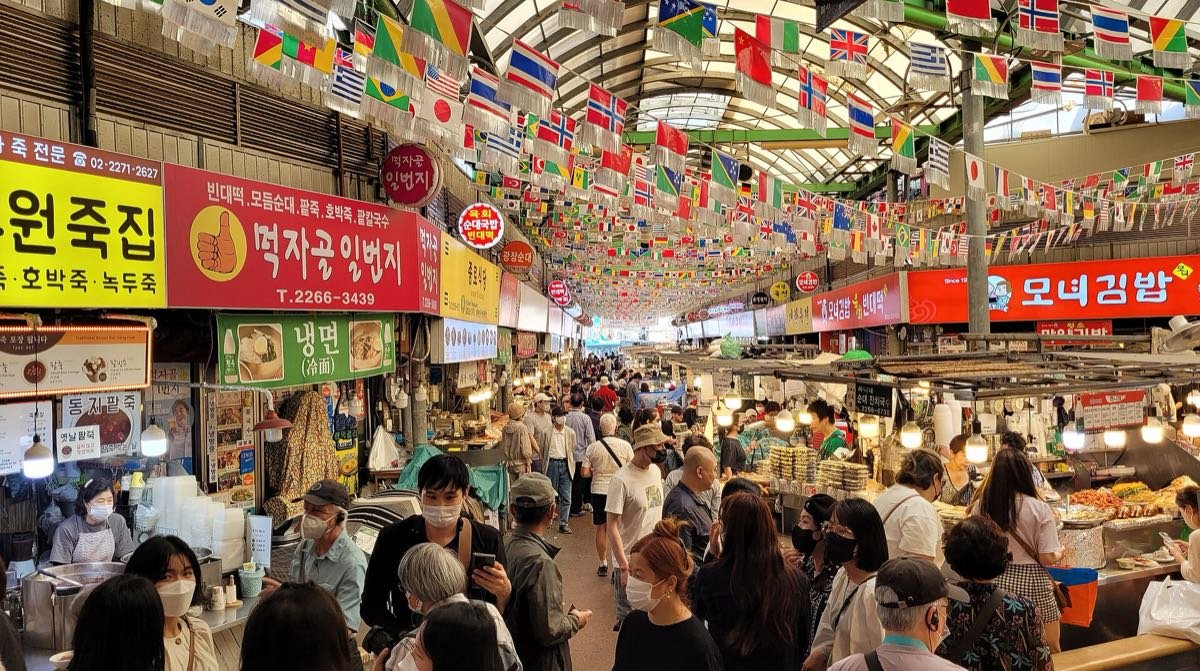
Gwangjang Market (광장시장) in Jongno has traded since 1905, which makes it Seoul’s oldest continuously operating traditional market. It started as a general goods market, and fabric, hanbok silk and bedding are still sold on the upper floors. Today most visitors come for the covered food aisles, where rows of stalls with shared counter seating each cook one or two dishes. This page covers the single market: how to reach it, when to go and what to order. For the wider picture of dishes across the country, see our Korean street food guide and the Seoul food guide.
Getting there and opening hours
Take Seoul Metro Line 1 to Jongno 5-ga Station and follow the market signs; the entrance is a short walk from the exits. Euljiro 4-ga (Lines 2 and 5) is about 10 minutes away on foot, and Dongdaemun is a similar distance. Use a T-money card for the metro; our T-money guide has the fares.
Hours vary by section. General shops run from roughly 08:30 to 18:00. The food aisles open later, often from 10:00 or 11:00, and trade until about 22:00 or 23:00. Some vendors close one day a week, usually Sunday or Monday, and the market thins out on public holidays such as Seollal and Chuseok. Prices and hours change, so treat what follows as a guide as of 2026.
What to order
Bindaetteok (빈대떡). Mung bean pancakes fried in oil on a round griddle, crisp outside and soft inside. Expect approximately KRW 6,000-8,000 a pancake as of 2026. Two stalls long cited as the best known, Soonheenae and Bakganae, sit back to back near the entrance to the bindaetteok lane, though stall names and ownership shift, so confirm before you queue. Other stalls cook the same dish for less.
Mayak gimbap (마약김밥). Mini rice rolls with carrot, pickled radish and spinach, served with a mustard-soy dip. The name means “narcotic gimbap” for how addictive they are. A tray is about KRW 3,000-6,000, depending on the stall.
Yukhoe alley (육회골목). A short row of counters serving raw beef tartare with pear, sesame oil and egg yolk, plus live octopus (sannakji) at some. Plates run approximately KRW 15,000-25,000. Choose a stall with a steady local crowd, and eat it at once.
Noodles and soup. Hand-cut kalguksu, mandu and janchi guksu are the warm options on a cold day, usually KRW 7,000-10,000 a bowl. Gohyang Kalguksu is among the better-known knife-noodle stalls in the market, according to recent visitor guides. Pair it with makgeolli, poured from a kettle for about KRW 6,000-9,000.
Cash is welcome and some stalls prefer it, though card terminals are now common. Stalls usually quote prices in a photo menu, so pointing works fine.
How to do it: a 90-minute route
- Arrive just before lunch, around 11:00, when stalls are open and queues are short.
- Start with bindaetteok at one of the lane stalls and share a plate of mayak gimbap.
- Walk the central aisles, then try one yukhoe or noodle counter.
- Finish with a walk upstairs for the fabric floors, or continue 10 minutes to the Insadong craft shops and teahouses.
Weekday evenings after 20:00 feel livelier, but weekend queues at the popular bindaetteok stalls can run to 10-15 minutes.
Guided food tour
Ordering in a crowded market is easier with a guide, who can explain each dish and skip the queues you would otherwise wait in. Browse Seoul food tours on GetYourGuide, or read our Seoul food tour comparison for evening and daytime formats. If you only have time for one market, pair it with the Myeongdong street food strip for a different style.
Where to stay nearby
Jongno and Dongdaemun put you within a short ride of Gwangjang. For a fuller list, see our best hotels in Seoul guide or check current rates through Booking.com.
Official visitor information is at Visit Seoul.