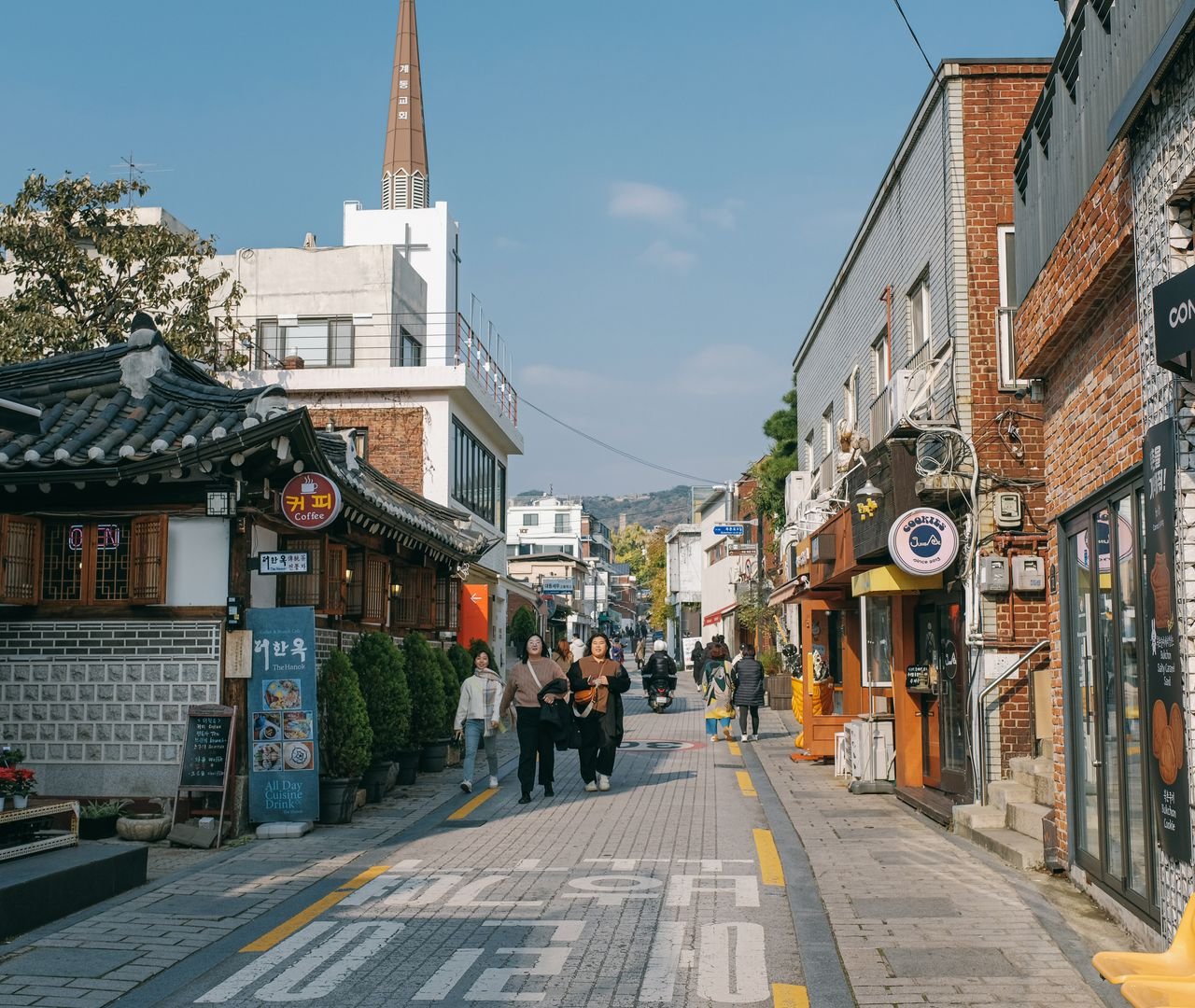
Bukchon Hanok Village (북촌한옥마을) is a hillside district between Gyeongbokgung and Changdeokgung palaces, where several hundred traditional Korean houses (hanok) still stand beside everyday homes. Its name means “northern village”, because under the Joseon dynasty it sat north of Cheonggyecheon stream and housed court officials. It is also a place where people live, which is why the rules for visiting changed in 2025. Read the rules below before you go.
Visiting rules: the red zone (verify before you go)
To curb overtourism and noise, Jongno-gu introduced a “red zone” covering the busiest lanes around Bukchon-ro 11-gil, an area of roughly 34,000 square metres. As reported by Seoul and Korean media:
- Restricted hours: tourists may not enter from 5:00pm to 10:00am. Daytime visits (10:00 to 17:00) are unaffected.
- Fine: KRW 100,000 for visitors who go in during the restricted hours. A guidance period ran through 2025 before fines were applied, and the sources we found disagree on exact start dates, so treat this as the rule in force and confirm the latest wording with Jongno-gu or Visit Seoul.
- Exemptions: residents and their guests, shop and cafe customers, people working in the zone, and overnight guests of hanok stays.
- Behaviour: keep your voice down, do not open gates or photograph into windows, and avoid blocking doorways. Chartered tour buses face separate restrictions, so arrive by subway.
In practice this means Bukchon is a morning-and-afternoon visit, not a sunset one. For golden-hour photos, plan the nearby palaces instead.
Getting there
Subway: Anguk Station (Line 3), exit 2, then walk north-west for about 10 minutes uphill along Bukchon-ro. This is the best route, and also the way to Insadong, which is next door.
Bus and walking: From Gyeongbokgung Station (Line 3, exit 5), allow about 15 minutes on foot east past the National Folk Museum. See our Seoul getting-around guide for passes and T-money.
The Bukchon 8 views walking route
Seoul’s official walking course, the “Bukchon 8 Views” (북촌8경), links eight photo viewpoints through the district, starting near Anguk Station and finishing in the Samcheong-dong direction. Viewpoint markers and signage change, so follow the numbered markers on site rather than a fixed list. A practical 90-minute loop:
- Start at Anguk Station exit 2 and walk north-west uphill along Bukchon-ro.
- Gahoe-dong lanes: the best-known view across hanok rooflines toward the Namsan and city skyline. This stretch is the most regulated and the most residential, so keep quiet and move on after photos.
- Bukchon-ro 11-gil: the stepped lane with the wide roof view. It sits inside the red zone, so only walk it between 10am and 5pm.
- Gyedong and Samcheong-dong side lanes: less crowded, with small cafes and craft studios.
- Finish at Samcheong-dong, where galleries, tea cafes and the palace wall make an easy transition to Gyeongbokgung.
The route is hilly with steep paved lanes, so wear flat shoes.
What to do in Bukchon
- Hanok cultural centres and workshops: several small centres offer knotting, dyeing and tea sessions, typically KRW 10,000-30,000 as of 2026; booking ahead is wise.
- Teahouses and cafes: Bukchon and Samcheong-dong have many hanok-style cafes. A drink typically costs KRW 6,000-10,000.
- Hanbok: renting hanbok in nearby rental shops lets you enter Gyeongbokgung and Changdeokgung free. Book the voucher via Hanbok rental near Gyeongbokgung or see our hanbok rental guide.
Combine with Gyeongbokgung and Changdeokgung
Bukchon sits directly between the two main palaces. A clear half-day: Gyeongbokgung in the morning (entry approximately KRW 3,000 as of 2026, closed Tuesdays), then walk through Samcheong-dong into Bukchon around midday. Changdeokgung, a UNESCO World Heritage site, is a further 15-20 minutes east, with the Secret Garden on a timed guided ticket and closed on Mondays. Our Seoul palaces guide has hours and fees. For a guided option that explains the architecture and history, browse Seoul tours.
Hanok stays in Bukchon
Staying in a hanok means sleeping on a floor mattress with heated ondol floors, often around a small courtyard. Expect smaller rooms and shared or compact bathrooms. Overnight guests are exempt from the red zone, so you can walk the lanes in the evening. Compare current hanok availability and prices for Seoul stays on Booking.com, and see our Seoul hotel guide and best hotels in Seoul. Hanok rooms book out around cherry blossom season and autumn foliage, so reserve early.
Tips
- Go on a weekday morning, ideally before 11:00, when the lanes are quieter.
- Respect “quiet zone” signs; residents live here.
- If you want a fuller view of neighbourhood food, Myeongdong is the street food counterpart, and the Seoul city guide shows how the districts fit together.