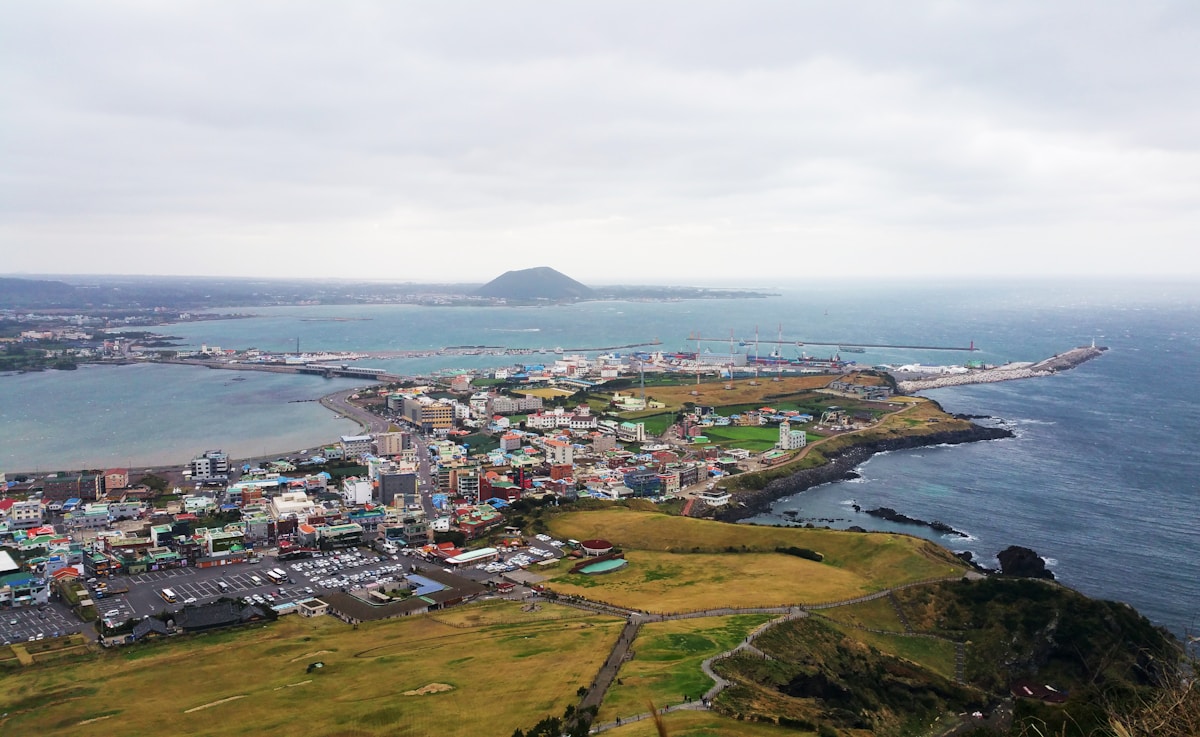
Jeju Island sits 80 km off South Korea’s southern coast - a volcanic island with a 1,950-metre peak, lava tubes, black sand beaches, tangerine orchards, and a food culture distinct from the mainland. It is South Korea’s primary holiday destination and a UNESCO Global Geopark.
Four days allows a full circuit of the island: one day for the central mountain, one day each for the east and south coasts, and one for the west. The island is roughly circular and approximately 73 km across - driving times between sights rarely exceed 45 minutes.
A rental car is the practical choice. Pick up at Jeju Airport on arrival and return it on departure. International driving permits are accepted by most agencies. Expect to pay approximately KRW 40,000–60,000 (USD 29–44) per day for a compact car as of 2026. Fuel costs are moderate - a full tank lasts most of the island circuit.
Where to Stay
Base yourself in Seogwipo on the south coast for the best central position. Most sights are within a 40-minute drive.
Mid-range: Seogwipo KAL Hotel - from approximately KRW 110,000 (USD 81) per night as of 2026. Clean rooms, ocean views from higher floors, and walking distance to Cheonjiyeon Waterfall and the Seogwipo daily olle market.
Upper mid-range: Jeju Shinhwa World Marriott - from approximately KRW 200,000 (USD 147) per night. Resort-style with pools, located near Jungmun on the south coast. Good for families.
Budget: Guesthouse Baume in Seogwipo - from approximately KRW 50,000 (USD 37) per night. Simple but well-located, with a shared kitchen useful for breakfast.
For Day 1 (Hallasan hike), consider staying one night near Jeju City on the north coast if your flight arrives late - Maison Glad Jeju from approximately KRW 130,000 (USD 96) per night. Then move to Seogwipo for the remaining three nights.
Day 1: Hallasan National Park
Hallasan is the highest mountain in South Korea and the reason Jeju exists - a shield volcano that forms the island’s centre. The summit, Baengnokdam, is a crater lake at 1,947 metres. Two main trails reach it.
Seongpanak Trail (Recommended)
Start point: Seongpanak trailhead on the eastern slope, approximately 30 minutes by car from Jeju City. The trail is 9.6 km one way with an elevation gain of approximately 1,100 metres. Allow 4–5 hours up and 3–4 hours down. The path is well-maintained with wooden boardwalks through the upper sections. Start by 07:00 at the latest - summit access closes at 12:00 (summer) or 12:30 (spring/autumn) to ensure hikers return before dark.
Gwaneumsa Trail (Steeper Alternative)
Start from the north side - 8.7 km to the summit with steeper grades and more exposure. Allow the same total time. This trail is better for experienced hikers and has fewer crowds.
Entry: Free. No reservation needed for Seongpanak; Gwaneumsa may require an online reservation in peak season - check the Hallasan National Park website. Both trails have restrooms and shelters but no food vendors above the base. Bring lunch, 2+ litres of water, and rain gear regardless of the forecast - conditions change rapidly above 1,500 metres.
Lunch: Pack onigiri or kimbap from a convenience store at the trailhead area (approximately KRW 2,000 / USD 1.50 each).
Evening
Drive to Seogwipo and check in. For dinner, Haemul Ttukbaegi near Seogwipo port serves haemul-tang (seafood hot pot) with local crab and abalone from approximately KRW 15,000 (USD 11) per person. The Seogwipo Maeil Olle Market (daily market) has street food stalls open until approximately 21:00 - grilled skewers, mandu, and hallabong (Jeju tangerine) juice.
Day 2: East Coast - Seongsan, Manjanggul, and Haenyeo Divers
Morning: Seongsan Ilchulbong (Sunrise Peak)
Drive east from Seogwipo - approximately 40 minutes. Seongsan Ilchulbong is a tuff cone that erupted from the sea floor approximately 5,000 years ago. The crater rim hike takes 25 minutes up a paved stairway and the views - ocean on three sides, Hallasan to the west - are the best single viewpoint on the island. Entry is KRW 5,000 (USD 3.70) as of 2026. Open from sunrise; arrive by 07:30 to avoid tour groups.
At the harbour below, haenyeo (women free-divers) work daily, diving for abalone, sea urchins, and conch. They have been doing this for centuries - the tradition is a UNESCO Intangible Cultural Heritage. You can watch from the harbour wall. Some haenyeo sell fresh catch directly; a plate of raw sea urchin costs approximately KRW 10,000 (USD 7).
Late Morning: Manjanggul Lava Tube
Drive 20 minutes north to Manjanggul Cave - one of the longest lava tubes in the world at 7.4 km (approximately 1 km is open to visitors). The interior temperature stays at approximately 11–13°C year-round - bring a layer. The highlight is the 7.6-metre lava column at the end of the accessible section, the tallest known lava column globally. Entry is KRW 4,000 (USD 2.90). Open 09:00–18:00, closed the first Wednesday of each month.
The walk through the tube takes approximately 40 minutes one way on a flat path. The lighting is atmospheric but not bright - watch your footing on wet sections.
Lunch
Myeongjin Jeonbok near Seongsan - abalone porridge (jeonbok-juk), a Jeju speciality. A bowl costs approximately KRW 15,000 (USD 11). The porridge is rich, savoury, and made with local abalone - this is one of the dishes worth travelling for.
Afternoon: Seopjikoji
Drive 10 minutes south from Seongsan to Seopjikoji - a coastal promontory with a lighthouse, canola fields (blooming March–April), and basalt cliff walks. Free entry. The walking loop takes approximately 30 minutes. This was a filming location for several Korean dramas and has clean coastal views without crowds.
Evening
Return to Seogwipo. Dinner at Dombe Garden - Jeju black pork BBQ (heuk-dwaeji). Jeju’s black pigs are a local breed with a distinct flavour. A full BBQ set for two costs approximately KRW 40,000–50,000 (USD 29–37). Pair it with hallabong makgeolli (tangerine rice wine, approximately KRW 7,000 / USD 5.15 per bottle).
Day 3: South Coast - Jungmun, Waterfalls, and Museums
Morning: Cheonjiyeon Waterfall
A 10-minute walk from central Seogwipo through subtropical forest to a 22-metre waterfall dropping into a deep pool. The surrounding forest has Jeju’s distinctive warm-climate plants - camellia trees and evergreen oaks. Entry is KRW 2,500 (USD 1.80) as of 2026. Allow 30–45 minutes.
For a longer waterfall walk, Jeongbang Waterfall is 15 minutes east along the coast - one of the few waterfalls in Asia that drops directly into the ocean. Entry KRW 2,000 (USD 1.50).
Late Morning: Jungmun Area
Drive west to the Jungmun Tourist Complex - approximately 25 minutes from Seogwipo. Jungmun Saekdal Beach has dark volcanic sand, columnar basalt formations at the cliff edges, and clear water. Swimming is seasonal (lifeguards operate July–August).
Teddy Bear Museum in Jungmun - entry KRW 14,000 (USD 10) as of 2026. More interesting than the name suggests - it tracks modern history and world culture through diorama displays. Popular with families and couples. Allow 60 minutes.
Alternatively, the Yeomiji Botanical Garden across the road is one of Asia’s largest indoor gardens - entry KRW 12,000 (USD 8.80). The observation tower gives good views of the Jungmun coastline.
Lunch
Jungmun Saekdal Raw Fish Town - a cluster of restaurants near the beach serving freshly caught fish. A raw fish platter for two costs approximately KRW 35,000–50,000 (USD 26–37) depending on the catch.
Afternoon: Jusangjeolli Cliff
A 10-minute drive west from Jungmun. Jusangjeolli is a formation of hexagonal basalt columns rising from the sea - formed when lava from Hallasan cooled rapidly as it reached the ocean. The viewing platform is small but the geology is striking. Entry KRW 2,000 (USD 1.50).
Evening
Return to Seogwipo. Walk through the Seogwipo Maeil Olle Market for a casual dinner - grilled mackerel, tteokbokki, and fresh fruit. Budget approximately KRW 10,000–15,000 (USD 7–11) for a full meal from the market stalls.
Day 4: West Coast - Tea Fields, Beaches, and Hallim Park
Morning: O’sulloc Tea Museum
Drive west from Seogwipo - approximately 40 minutes. O’sulloc is Korea’s most famous green tea brand, and this museum sits within their Jeju tea plantations. Entry is free. Walk through the terraced tea fields (photogenic in any season), browse the tea history exhibits, and visit the tasting room. The matcha roll cake (approximately KRW 8,000 / USD 5.90) and matcha soft serve (approximately KRW 6,000 / USD 4.40) are worth the stop.
Next door, the Innisfree Jeju House operates a small cosmetics shop and garden walk - also free entry. Together, the two sites take approximately 60–90 minutes.
Late Morning: Hyeopjae Beach
Drive 15 minutes north to Hyeopjae Beach - white coral sand, shallow turquoise water, and views of Biyangdo Island offshore. This is Jeju’s most photogenic beach and swimmable from June through September. Facilities include changing rooms and a parking area.
For a quieter alternative, Geumneung Beach is 500 metres west - same sand quality, fewer people.
Lunch
Olle Market Hallim Branch or a local restaurant in Hallim town. Hallim Makguksu serves Jeju-style buckwheat noodles from approximately KRW 9,000 (USD 6.60) - a cold noodle dish suited to warm-weather days.
Afternoon: Hallim Park
Entry KRW 12,000 (USD 8.80) as of 2026. Hallim Park combines a subtropical botanical garden, two lava caves (Hyeopjae Cave and Ssangyong Cave - accessible within the park), a folk village recreation, and bonsai gardens. Allow 90 minutes to 2 hours. The lava caves here are smaller than Manjanggul but atmospheric and uncrowded.
Late Afternoon: Departure
Drive back to Jeju Airport - approximately 40 minutes from Hallim. Return the rental car. Flights to Seoul Gimpo depart frequently throughout the evening, with the last flight typically around 21:00. Flight time is approximately 1 hour 10 minutes, with fares from approximately KRW 50,000 (USD 37) one way on budget carriers as of 2026.
Budget Summary (Per Person, 4 Days)
| Category | Budget | Mid-Range |
|---|---|---|
| Accommodation (3 nights) | KRW 150,000 (USD 110) | KRW 360,000 (USD 265) |
| Food | KRW 120,000 (USD 88) | KRW 200,000 (USD 147) |
| Car rental (4 days, split 2 people) | KRW 80,000 (USD 59) | KRW 100,000 (USD 74) |
| Fuel | KRW 30,000 (USD 22) | KRW 30,000 (USD 22) |
| Attractions | KRW 45,000 (USD 33) | KRW 60,000 (USD 44) |
| Total | KRW 425,000 (USD 312) | KRW 750,000 (USD 552) |
Jeju Driving Tips
Jeju roads are well-maintained and signposted in Korean and English. Speed cameras are frequent - the limit is 60 km/h in towns and 80 km/h on main roads. The coastal road (Route 1132) circles the entire island and is a scenic drive in itself. Google Maps works for navigation but Naver Map and Kakao Map have more accurate Korean road data - download one before arrival.
Parking is straightforward at all major sights. Most have free lots. Hallasan trailhead parking can fill early on weekends - arrive before 07:00 in peak season.
Fuel stations are easy to find. Most accept credit cards. A full tank for a compact car costs approximately KRW 60,000–70,000 (USD 44–52) and covers 400+ km - more than enough for the full island circuit.
Book tours and activities in Jeju through GetYourGuide.
Get an eSIM for South Korea with Airalo so you have data from the moment you land.
Book trains and buses between cities through the KORAIL website or at station ticket counters.
Explore Jeju in More Depth
The Jeju Island guide covers all the sites in this itinerary with entry fees, opening times, and seasonal notes. Staying in the south of the island? The Seogwipo travel guide covers the Jungmun area, Hallasan access from the south side, and the best food near the waterfalls. For accommodation planning, the best hotels on Jeju breaks down options by area and budget. Planning to combine Jeju with Busan? The Busan vs Jeju comparison helps decide how to split your time.
Book Your Trip
- Flights - Find the best fares to South Korea
- Travel Insurance - Get covered before you go
- eSIM - Stay connected from landing
- Airport Transfers - Pre-book your transfer from Incheon International Airport
- Car Rental - Compare prices across providers
- Tours & Activities - Browse South Korea tours on GetYourGuide