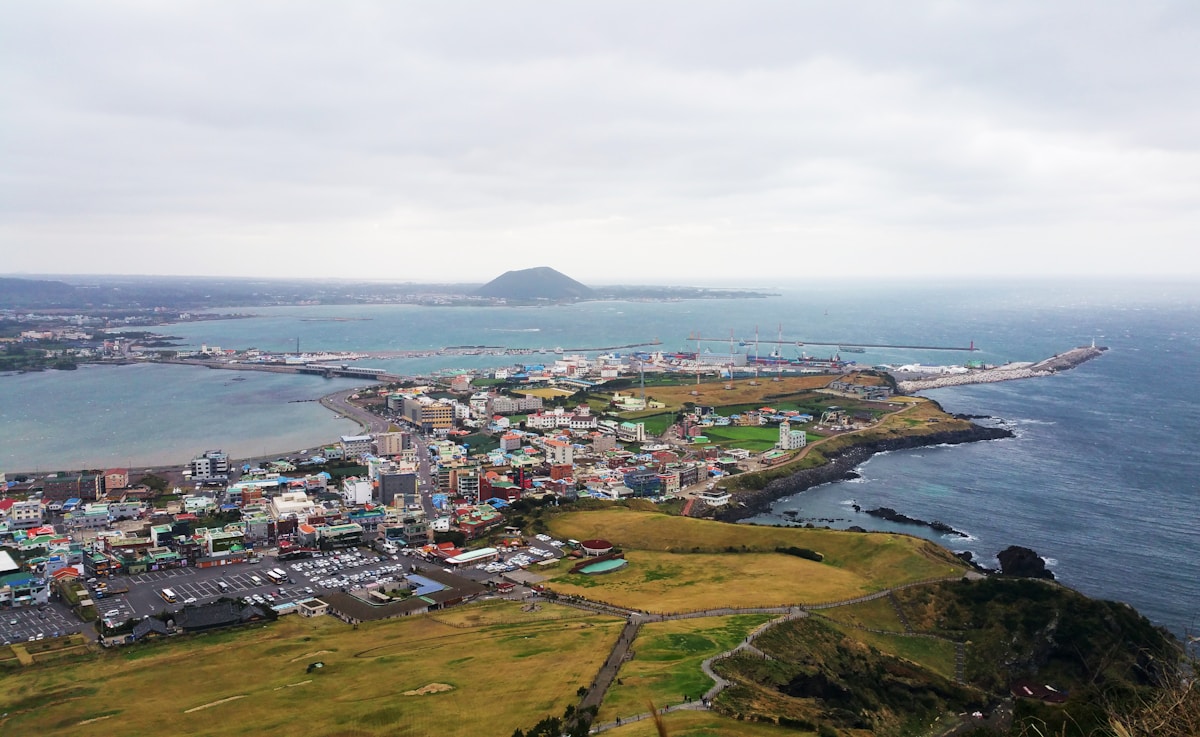
Three days on Jeju is enough to see the island’s defining landscapes: the volcanic east coast, the underground lava tube system, the mountain’s mid-slopes, and the waterfall-lined south coast. You will not see everything — Jeju rewards longer visits — but you will understand the island.
A rental car is the practical choice. Pick it up at Jeju International Airport (CJU) on arrival and return it on departure. The island is approximately 73 km across at its widest point — driving between most sights takes 30–45 minutes.
Where to Stay
Base yourself in Seogwipo on the south coast. It is the island’s second city, closest to the mid-point between east and west, and a short drive from Day 2’s waterfall sights.
Budget: Guesthouse Baume in Seogwipo — from approximately KRW 45,000 (USD 33) per night as of 2026. Clean rooms, friendly hosts, shared kitchen useful for morning coffee before early starts.
Mid-range: Seogwipo KAL Hotel — from approximately KRW 110,000 (USD 81) per night. Ocean views from upper-floor rooms, walking distance to Cheonjiyeon Waterfall and the Seogwipo daily market.
Upper mid-range: Jeju Shinhwa World Marriott — from approximately KRW 200,000 (USD 147) per night. Resort-style with pools, near Jungmun on the south coast. Best for families or travellers who want a resort base.
Day 1: East Coast — Seongsan and the Lava Tube
The east coast holds two of Jeju’s most distinctive sights: a 5,000-year-old volcanic tuff cone at the sea’s edge, and one of the longest lava tubes in the world.
Morning: Seongsan Ilchulbong
Drive or taxi to Seongsan Ilchulbong (Sunrise Peak) for the morning. The name references the sunrise views from the summit, but the site is worth visiting at any time of day — the volcanic crater rises 182m above the sea and the path to the rim takes about 20 minutes.
Entry: KRW 2,000 (approximately USD 1.50) per adult as of 2026. Hours: 07:00–20:00 (last entry 19:00).
From the rim, the crater bowl drops 90m below, and the surrounding coastline stretches north toward Udo Island and south along Jeju’s eastern shore. Haenyeo (traditional women divers) give demonstrations at the base of the peak — check signboards near the entrance for scheduled times, usually mid-morning.
If you prefer to join a guided group, GetYourGuide lists several well-reviewed Jeju tours that include Seongsan, the lava tube, and south coast stops — useful for first-time visitors who want to cover the highlights without navigating between sites independently.
Getting there from Seogwipo: Approximately 40 minutes by car via Route 1132 (Coastal Road) or Route 11. Follow signs for 성산일출봉.
Afternoon: Manjanggul Lava Tube
Head west from Seongsan to Manjanggul Lava Tube in Gimnyeong — approximately 25 minutes by car.
Manjanggul is 7.4 km long, one of the longest lava tube systems in the world and a UNESCO World Natural Heritage site. The accessible section open to visitors is approximately 1 km of the tube — a wide, cathedral-scale underground passage with a seven-metre-high lava column at the far end.
Entry: KRW 4,000 (approximately USD 3) per adult as of 2026. Hours: 09:00–18:00 (last entry 17:00); closed Tuesdays.
Bring or borrow a light layer — the tube interior sits at a constant 11–13°C year-round regardless of outside temperatures.
Evening: Dinner in Seogwipo
Return south to Seogwipo. Dinner: Heukdwaeji Street (Black Pork Street) near the main road through Seogwipo has a strip of restaurants specialising in Jeju’s black pork (heukdwaeji). The breed is a local heritage variety distinct from mainland Korean pork — richer fat and deeper flavour. A 200g samgyeopsal (pork belly) serving costs approximately KRW 15,000–18,000 (USD 11–13) per person as of 2026. Donsadon and Heukdwaeji Sikdang are reliable options on the street.
Day 2: Hallasan National Park
Dedicate Day 2 to Hallasan — South Korea’s highest mountain at 1,950m. You have two options depending on your fitness level and how early you booked.
Option A: Summit Trail (Full Day)
The Seongpanak Trail (9.6 km one-way, approximately 5 hours up) reaches the crater rim at Baengnokdam. This requires advance online reservation via hallasan.go.kr — book at least 3–7 days ahead, more in peak season. Guided Hallasan hiking tours from Seogwipo are also available through GetYourGuide for travellers who prefer a guide on the summit trails. The entry cutoff for Seongpanak is 12:00; start by 07:00 for a comfortable timeline.
The trail climbs through temperate forest and transitions to low shrub below the summit. The final kilometre to the crater is above the cloud line on clear days. The crater lake Baengnokdam holds water after heavy rain and appears as wet ground in dry periods.
Bring water (2L minimum — no on-trail vendors), snacks, and a warm layer for the summit (temperature drops approximately 6°C per 1,000m of elevation gain). Return via the same route or the steeper Gwaneumsa Trail (8.7 km, different end point requiring a taxi back).
Entry: Free as of 2026, but reservation required for summit trails.
Option B: Eorimok Trail (Half Day)
If summit reservations are unavailable, or you prefer a less strenuous option, the Eorimok Trail (5.1 km return, approximately 2–3 hours) reaches Windy Hill (Mansebuldong) at 1,698m through a beautiful subalpine plateau of royal azaleas (in bloom late May to early June). No reservation required; walk up from the Eorimok trailhead.
Afternoon (Option B only): Head to Jungmun Tourist Complex on the south-west coast — approximately 20 minutes from the Eorimok trailhead. The complex includes Cheonjeyeon Waterfall (three tiers; entry KRW 2,500 as of 2026), Jeju Teddy Bear Museum, and a strip of restaurants and cafes on the coast.
Evening
Dinner at Olle Market (Jeju Maeil Olle Market) in Seogwipo — open daily from 07:00 to 21:00. The covered market on Jeju-daero has a food court section on the upper level with affordable local dishes: haemul pajeon (seafood pancake, approximately KRW 12,000), fried gamgyul (Jeju tangerine) chicken, and fresh abalone porridge (jeonbokjuk, approximately KRW 15,000 as of 2026).
Day 3: South Coast Waterfalls, Beaches, and Departure
Morning: Cheonjiyeon Waterfall and Seogwipo City
Start the morning in Seogwipo with Cheonjiyeon Waterfall if you missed it on Day 2 — a 22m drop over volcanic basalt into a pool that empties into the sea. Entry KRW 2,000 (approximately USD 1.50) as of 2026; a short 10-minute walk from the car park.
Walk the adjacent Seogwipo Olle Market (separate from Jeju Maeil Olle Market) for fresh tangerines, dried seafood snacks, and local produce — a good place to pick up Jeju specialities to bring home.
Midday: Hamdeok or Woljeong Beach
If time and season allow, head to the north-east coast for Hamdeok Beach (Hamdeok Seoubong Beach) — considered one of Jeju’s best swimming beaches with turquoise water sheltered by a natural offshore reef. Approximately 45 minutes from Seogwipo. Beach cafes on the strip serve acai bowls and Korean-style smoothies; the area has multiple Instagram-popular cafe stops.
Alternative (cooler months or non-swimmers): Drive the Bijarim Forest Road — a 570-metre path through a grove of nutmeg yew trees (bija trees), some reportedly 800 years old. Entry KRW 1,500 as of 2026; located inland near Gujwa-eup on the north-east coast.
Afternoon: Return to Jeju Airport
Allow sufficient time to drop the rental car before your flight. Most car rental desks at Jeju Airport prefer a 2-hour buffer for processing and fuelling (or waive the fuelling fee for an additional charge). Jeju Airport is small enough that check-in and security rarely take more than 30 minutes.
Departure snack: The airport departure area has a Jeju tangerine gift shop (Gamgulhui) selling boxed hallabong and Jeju green tea products — convenient if you want to bring something back.
Budget Summary (Per Person, Excluding Flights)
| Category | Budget | Mid-Range | Luxury |
|---|---|---|---|
| Accommodation (2 nights) | KRW 90,000 | KRW 220,000 | KRW 400,000+ |
| Car hire (2 days shared) | KRW 50,000 | KRW 60,000 | KRW 80,000 |
| Entry fees (all sites) | KRW 20,000 | KRW 20,000 | KRW 20,000 |
| Meals (3 days) | KRW 80,000 | KRW 140,000 | KRW 250,000 |
| Total (approx.) | KRW 240,000 | KRW 440,000 | KRW 750,000+ |
As of 2026; approximately USD 175 / USD 325 / USD 550+ at current exchange rates.