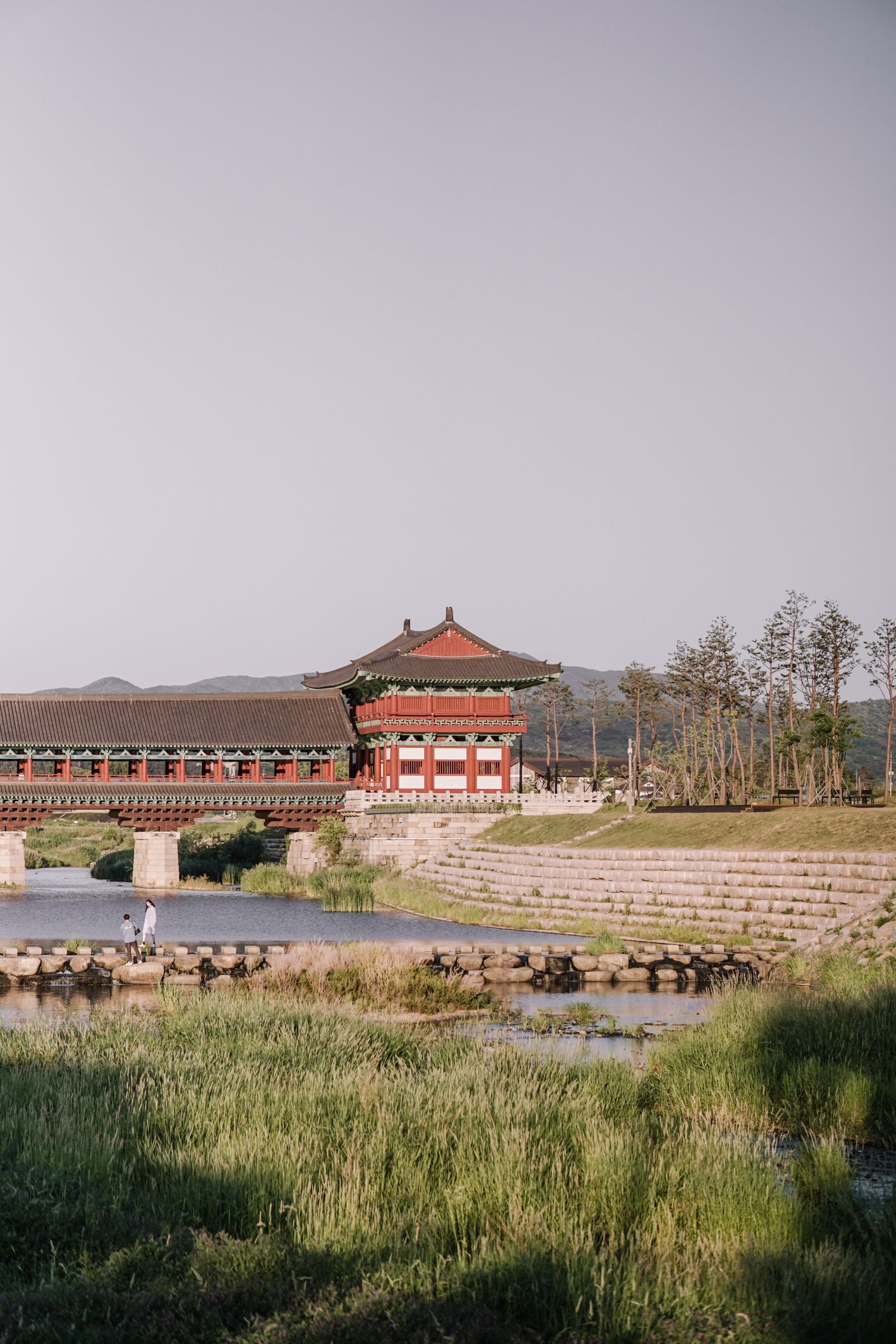
Five historical sites show South Korea’s past best: Gyeongbokgung and Changdeokgung for the Joseon palaces in Seoul, Bulguksa and Seokguram for Silla Buddhist art in Gyeongju, Hahoe Folk Village for living clan heritage, Hwaseong Fortress in Suwon for 18th-century military design, and the DMZ for the Korean War legacy.
We picked five that cover different eras and regions, from Silla in the 7th and 8th centuries to the 1953 armistice. Entry fees and travel costs are approximate as of 2026. Check opening days before you go, since several sites close one day a week.
1. Gyeongbokgung and Changdeokgung Palaces, Seoul
Gyeongbokgung was built in 1395 as the main palace of the Joseon dynasty and is the largest of Seoul’s five royal palaces, covering about 410,000 square metres. Most of what you see is a reconstruction after destruction in the Japanese invasions and the colonial period, and the throne hall Geunjeongjeon and the pond pavilion Gyeonghoeru are the highlights. Admission is KRW 3,000, and it is closed on Tuesdays.
Changdeokgung is a UNESCO World Heritage Site and was a preferred residence of Joseon kings. Its buildings follow the hillside, and the rear Secret Garden (Huwon) is entered on timed guided tours of about 70 minutes in English for an extra approximately KRW 5,000. It is closed on Mondays.
How to get there: Gyeongbokgung Station (Line 3, Exit 5) and Anguk Station (Line 3, Exit 3).
Best time: Weekday morning before 09:00 for Gyeongbokgung, autumn for the Secret Garden.
Local tip: Book the Secret Garden slot early in cherry blossom and foliage season, when popular times fill. See our Seoul palaces guide for the other three palaces, and rent a hanbok to enter free.
2. Bulguksa Temple and Seokguram Grotto, Gyeongju
Gyeongju was the capital of the Silla Kingdom from 57 BCE to 935 CE, and Bulguksa and Seokguram on Tohamsan mountain are the high point of unified Silla Buddhist art. Both are UNESCO World Heritage Sites about 16 km east of the city centre. Bulguksa costs approximately KRW 6,000, Seokguram approximately KRW 5,000, or KRW 10,000 for a combined ticket.
How to get there: Bus 10 or 11 from Gyeongju Intercity Bus Terminal takes 35 to 40 minutes (about KRW 1,400), then bus 12 or a taxi up to Seokguram.
Best time: Late March to early May and late October to mid-November, on weekday mornings before the crowds.
Local tip: Visit Bulguksa first (allow 1 to 1.5 hours), then go up to Seokguram. A forest trail connects them in 40 to 50 minutes on foot if you prefer to walk, which avoids the bus timetable on the way down. Our Bulguksa and Seokguram guide has the detail, the Gyeongju day trip itinerary shows how to fit in the royal tombs, and Gyeongju tours are an option if you want a guide.
3. Hahoe Folk Village, near Andong
Hahoe sits in a bend of the Nakdong River about 25 km from Andong’s city centre, and members of the Ryu clan have lived here since the 14th century. Around 170 households still live in the village, so you see laundry on the line beside houses that are 200 to 300 years old. It is a UNESCO World Heritage Site, with aristocratic tiled-roof homes and commoner thatched houses. Entry is approximately KRW 5,000.
How to get there: Bus 46 from Andong Bus Terminal roughly every 30 to 60 minutes, or a taxi at about KRW 12,000 to 15,000 one way.
Best time: Late September to October, when the mask dance festival and autumn colour overlap.
Local tip: Take the ferry to Buyongdae Cliff for the most dramatic view of the river bend. Byeongsan Seowon is 5 km away, free, and reachable by taxi for around KRW 6,000 to 8,000. See our Hahoe Village guide, the Andong city guide and Andong tours.
4. Hwaseong Fortress, Suwon
King Jeongjo built Hwaseong Fortress between 1794 and 1796, and its 5.7 km of walls enclose the old city centre of Suwon with gates, watchtowers, command posts and a water gate. It is a UNESCO World Heritage Site and one of the best-preserved examples of late Joseon military architecture. Entry costs approximately KRW 1,500, and the full circuit takes 2 to 3 hours.
How to get there: Suwon is about 30 km south of Seoul, so it works as a half-day or full-day trip by metro or train.
Best time: Spring and autumn for the walk, and weekends for historical re-enactments at Haenggung Palace.
Local tip: A tourist train runs sections of the circuit from April to October if you do not want to walk the whole wall. The walls are hilly around Hwaseomun Gate and the Seojangdae command post, so wear proper shoes. Our Suwon things to do guide lists Haenggung Palace and the museum, and Suwon tours are available.
5. The DMZ and Panmunjom
The Demilitarized Zone is where the 1953 armistice froze the Korean War front line. Standard tours visit Imjingak Peace Park, the 3rd Infiltration Tunnel (1,635 m long, 73 m underground, discovered in 1978), Dora Observatory and Dorasan Station. A JSA tour adds Panmunjom, where the armistice was signed and the only point on the border accessible to civilians.
How to get there: Guided tours depart from central Seoul. You cannot enter independently.
Best time: Any time of year, but book ahead in spring and autumn.
Local tip: JSA tours require passport details at booking, and late submissions are declined, so book at least two weeks ahead. Photography is restricted to designated areas at the JSA. Standard DMZ tours start from approximately KRW 90,000, and our DMZ day trip guide compares operators and sites. You can also browse Seoul tours for current departures.
How to Combine These Sites
A first-time history route can run Seoul for two days (Gyeongbokgung and Changdeokgung), a half day in Suwon, then KTX and bus to Gyeongju and Andong. Our 10 days in South Korea itinerary shows how to link them, and the 1 week itinerary works if you have less time. For official information, see Visit Korea and the UNESCO World Heritage listings for South Korea.