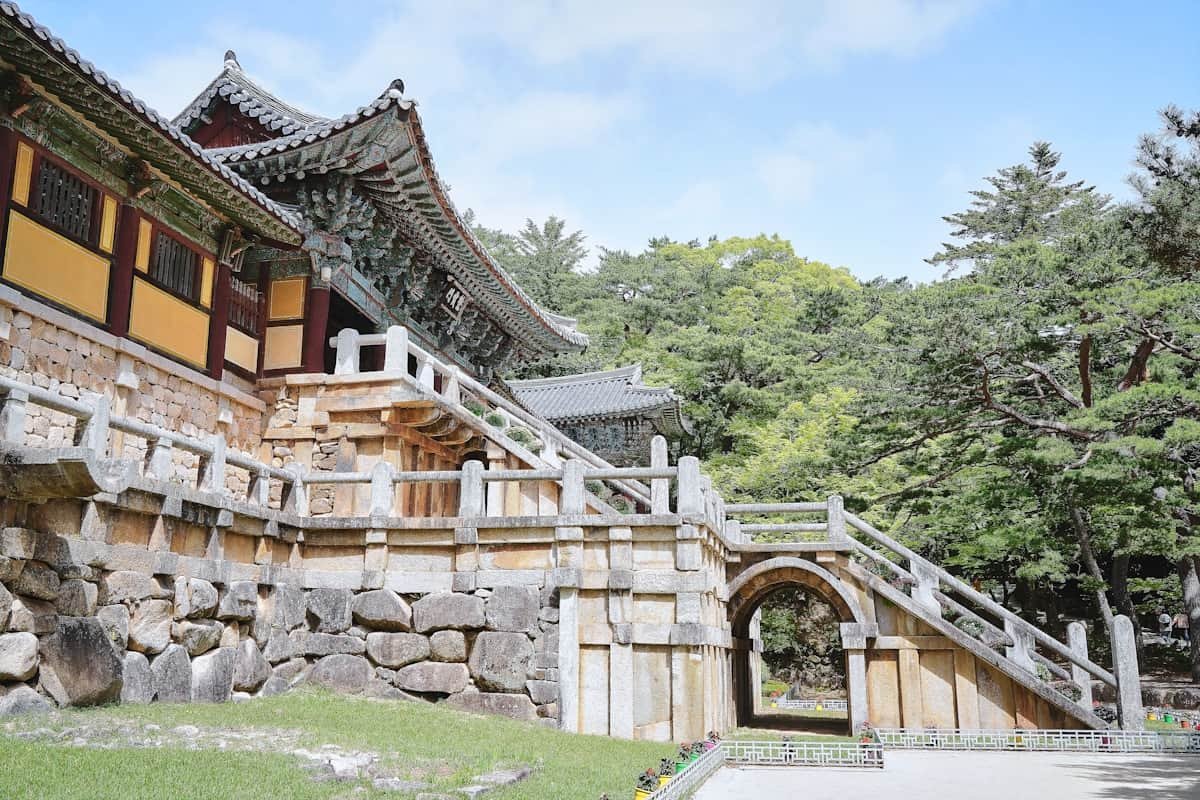
Bulguksa Temple and Seokguram Grotto sit 16km east of central Gyeongju in the mountains of Tohamsan. Both are UNESCO World Heritage Sites and together represent the high point of unified Silla Buddhist art. Most visitors combine the two in a single half-day trip: Bulguksa first for its architecture and stone pagodas, then Seokguram for the sculpted granite Buddha cave high on the mountain above.
For a full day plan including these sites alongside the central Gyeongju heritage zone, see our Gyeongju day trip guide.
Bulguksa Temple
Bulguksa was first established in 528 CE and substantially rebuilt in 751 CE under King Gyeongdeok’s court minister Kim Dae-seong, who is said to have commissioned both Bulguksa and Seokguram simultaneously. The complex was expanded over subsequent centuries, burned during the Japanese invasions of the 1590s, partially rebuilt in the 17th century, and comprehensively restored in the 1970s.
The stone stairways
The most photographed element of Bulguksa is the pair of stone staircases leading from the lower courtyard to the main gate building (Jahamun):
- Cheongunggyo and Baengunggyo (Blue Cloud and White Cloud Bridges): the 33-step ceremonial staircase on the left, symbolising the ascent from the mortal world to the Buddhist realm. These stairs are not open to walk on — visitors enter via a path to the side.
- Yeonhwa and Chilbo Bridges: the smaller ceremonial staircase to the right, leading to the Anyangmun gate.
Both stone stairways are National Treasure No. 23 and No. 22 respectively and date from the original 8th-century construction.
The stone pagodas
In the main courtyard behind the gate stand two stone pagodas, both exceptional examples of Silla-era stonework:
Dabotap (Many-Treasure Pagoda) is the more ornate of the two — a multi-tiered structure with decorative stonework at each level. It appears on the 10-won coin. It was built in 751 CE and is National Treasure No. 20.
Seokgatap (Stone Shakyamuni Pagoda) is plainer and more classical in form: a three-storey granite pagoda of restrained elegance. During a restoration in 1966, a Silla-era reliquary and the world’s oldest known woodblock-printed document were discovered inside. National Treasure No. 21.
The main halls
Beyond the stone pagodas, the upper complex contains the main worship halls arranged up the hillside:
- Daeungjeon (Main Hall): houses a gilded seated Buddha and is the active heart of the temple. Remove shoes before entering.
- Birojeon: smaller hall containing a seated Vairocana Buddha, designated National Treasure No. 26.
- Gwaneumjeon: the highest hall on the site, dedicated to the Bodhisattva of Compassion (Gwaneum in Korean), with views back over the lower courtyards.
The forested hillside setting — particularly in spring with cherry blossoms or in autumn with maple foliage — frames the buildings at their most picturesque.
Entry fee: approximately KRW 6,000 for adults (as of 2026) Opening hours: 07:30-18:00 (April-October); 08:00-17:00 (November-March). The gift shop and teahouse inside the complex close earlier. Time needed: 1-1.5 hours
Getting from Bulguksa to Seokguram
By bus: Bus 12 departs from the Bulguksa bus stop and climbs to the Seokguram parking area in approximately 15 minutes (approximately KRW 1,400 as of 2026). Check the timetable at the bus stop — frequency drops in the late afternoon.
By taxi: A taxi from the Bulguksa entrance costs approximately KRW 8,000-10,000 one way. Taxis are available at the stand outside the temple entrance; you may need to wait or call one via KakaoTaxi.
On foot: A forest hiking trail connects Bulguksa to Seokguram in approximately 40-50 minutes, passing through Tohamsan forest. This is a pleasant option in good weather and avoids the bus schedule issue on the return.
Seokguram Grotto
Seokguram was built between 751 and 774 CE, commissioned alongside Bulguksa by Kim Dae-seong. Where Bulguksa expresses Silla Buddhist artistry through architecture, Seokguram does so through sculpture.
The Buddha
The main chamber contains a 3.4-metre seated stone Buddha carved from white granite, facing east toward the sea. The figure is regarded as one of the finest examples of Buddhist sculpture anywhere in East Asia — the proportions, facial expression, and surface treatment show a level of technical refinement unusual for the period. The seated posture is bhumisparsha mudra (earth-touching gesture), symbolising the moment of the Buddha’s enlightenment.
The chamber is enclosed in glass to control humidity and prevent deterioration — a decision made after earlier restoration attempts caused moisture damage to the stonework. Photography through the glass is possible but results vary.
Around the main chamber walls, 40 relief carvings depict bodhisattvas, guardian figures, and disciples. The two-tiered antechamber leading to the main rotunda contains additional sculpted figures, including the eight-armed Bodhisattva of Compassion, which stands as a separate masterwork in itself.
The setting
Seokguram sits on the eastern face of Tohamsan at approximately 565 metres elevation. On a clear day, the view from the grotto forecourt extends to the East Sea (Sea of Japan). Sunrise from Seokguram is considered one of the most celebrated in Korea — the grotto was deliberately oriented to align with the sunrise on the equinox.
Entry fee: approximately KRW 5,000 for adults (as of 2026), or KRW 10,000 combined with Bulguksa Opening hours: 06:30-18:00 (April-October); 07:00-17:00 (November-March) Time needed: 30-45 minutes
Practical Information
Getting to Bulguksa from Gyeongju
By bus: Bus 10 or 11 from Gyeongju Intercity Bus Terminal, approximately 35-40 minutes, KRW 1,400 as of 2026. Buses depart roughly every 30 minutes.
By taxi: Approximately KRW 12,000-15,000 and 20 minutes from central Gyeongju.
By tour: Several guided half-day tours from Gyeongju cover both Bulguksa and Seokguram, which simplifies transport logistics considerably. See the GetYourGuide widget below for available departures.
Return journey
From the Seokguram parking area, bus 12 returns to Bulguksa. From Bulguksa, bus 10 or 11 returns to Gyeongju Bus Terminal. The combined return journey takes approximately 45-55 minutes.
If you are heading directly to Singyeongju KTX station, take a taxi from Bulguksa (approximately KRW 15,000-18,000) rather than returning to central Gyeongju first.
What to bring
- Comfortable walking shoes (paths are paved but include steps and some gradient)
- A layer for Seokguram even in summer — the mountain is cooler than the city
- Cash for bus fares (T-Money card works on local Gyeongju buses)
For the full overview of Gyeongju, including the central sites, see our things to do in Gyeongju guide.
Where to Stay
This page is part of our Gyeongju travel guide, and our guides to day trips from Gyeongju and getting around Gyeongju pair well with it.
Planning a trip around this? Browse hotels in Gyeongju on Booking.com and compare areas, prices and cancellation terms before you book.
Bulguksa and Seokguram also appear in our list of 5 historical sites in South Korea, alongside palaces, Hahoe and the DMZ.