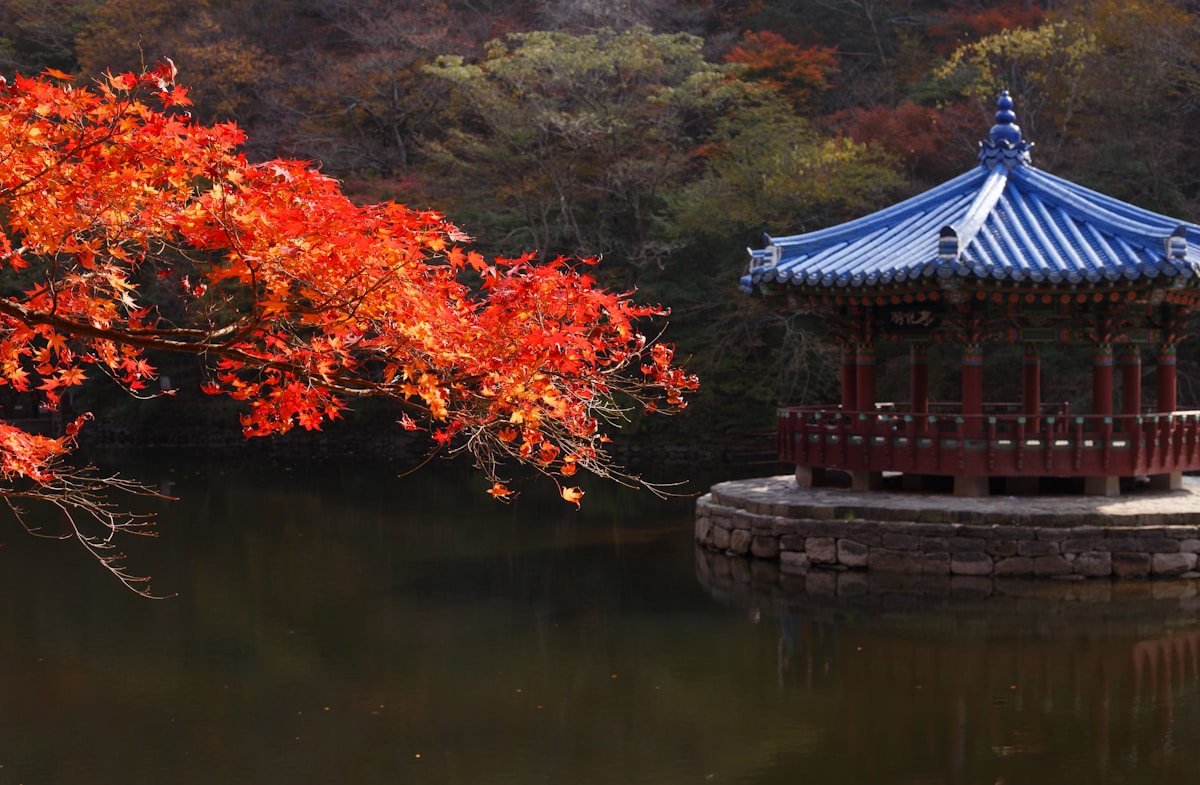
Korea’s autumn colour runs from late September to mid-November and ranks among the best in East Asia - comparable to Japan’s momiji season but with far fewer foreign crowds. The country’s forested mountain ranges (nearly 70% of Korea is mountains) turn gold, crimson, and deep orange in a wave that moves steadily south over six weeks.
This guide covers the 2026 autumn foliage season: forecast dates by region, the top destinations, and practical detail for day trips and overnight stays.
2026 Regional Foliage Forecast
Leaves change north-to-south, with elevation and temperature determining the exact peak. The 2026 forecast is based on KMA historical averages - official predictions are published in September once early weather data is available. Warm autumn years can advance dates by 1–2 weeks; cool years can delay them.
| Region / Spot | 2026 Peak Window | Notes |
|---|---|---|
| Seoraksan (Gangwon-do, NE Korea) | Late Sep – mid-Oct | First colour nationally; inner trails peak before outer; arrives around Chuseok |
| Bukhansan / Seoul mountains | Mid-Oct – late Oct | Best after a cold snap; accessible by subway from central Seoul |
| Nami Island (Gapyeong, Gyeonggi) | Mid-Oct – early Nov | Ginkgo avenue peaks around last week of October |
| Naejangsan (North Jeolla) | Early Nov – mid-Nov | Latest peak in the country; maple tunnel and pavilion lake |
| Gyeongju (North Gyeongsang) | Late Oct – early Nov | Bulguksa temple grounds and Bomun Lake ginkgos |
| Hallasan / Jeju Island | Late Oct – mid-Nov | Summit tracks; cable car not operational, hiking required |
Top Autumn Foliage Spots
1. Seoraksan National Park - The Earliest Colour
Seoraksan in Gangwon-do is typically the first major park to turn each year, with peaks arriving from around September 28 to October 10. The inner Seoraksan (내설악) area, accessed via Baekdamsa Temple, shows colour before the outer Seoraksan (outer Sokcho trailheads).
The Ulsanbawi Rock trail (6km round trip from the park entrance at Sogongwon) passes through mixed forest that blazes orange and red against the grey granite. The Seoraksan Cable Car (설악케이블카, KRW 11,000 adults one way / KRW 16,000 return as of 2026) runs up to Gwongeumseong Fortress for panoramic valley colour without the 4km climb. Queues for the cable car can run 30–60 minutes on peak weekends in early October - arrive before 9am.
Getting there: 3–3.5 hours by express bus from Seoul Dong Seoul Terminal (KRW 19,300 one way). Sokcho Express Bus Terminal is the main arrival point; local buses run to the Seoraksan entrance.
Entry fee: KRW 3,500 (Seoraksan National Park entrance fee as of 2026).
2. Naejangsan National Park - The Maple Tunnel
Naejangsan in North Jeolla Province is Korea’s most celebrated autumn destination specifically for its maples. The maple tunnel (단풍 터널) along the main valley path from the park entrance is the defining image of Korean autumn - a half-kilometre corridor where the canopy meets overhead in a blaze of red and orange.
At the far end of the tunnel sits Uhwajeong Pavilion, a traditional wooden structure on the bank of a reservoir. The pavilion reflected in still water with red maples overhead is one of Korea’s most-photographed autumn scenes - and genuinely earns its reputation.
Peak colour at Naejangsan arrives later than Seoraksan, typically from late October to mid-November. The park gets extremely busy on autumn weekends - a shuttle bus runs from the main parking area to the trail entrance (KRW 1,000). Going on a Tuesday or Wednesday in early November avoids the worst of the weekend crush.
Getting there: Naejangsan station is on the Honam Line. KTX from Seoul to Jeongeup takes about 1 hour 30 minutes (from approximately KRW 35,000); local buses connect Jeongeup station to the park in 30 minutes (KRW 1,200).
Entry fee: KRW 3,000 as of 2026.
3. Nami Island - The Ginkgo Avenue
Nami Island (남이섬) is less a foliage spot than a full autumn atmosphere - 430,000 square metres of river island in Gapyeong, about 75 minutes from Seoul, with three colour stages across October and early November.
The main ginkgo tree-lined path (메타세쿼이아길) turns from deep green to vivid gold between late October and the first week of November. A second path lined with Italian poplars offers a contrasting russet orange. The island’s maples peak slightly earlier, in mid-to-late October.
Getting there is simple: take the ITX-Cheongchun train from Seoul Cheongnyangni station to Gapyeong station (approximately KRW 3,600, 70–80 minutes), then a local bus to the Gapyeong wharf (KRW 1,100), and the ferry to the island (KRW 18,000 including entry as of 2026). The ferry runs every 30 minutes.
Nami Island pairs well with a day trip that also includes Petite France (a French-themed cultural village 10 minutes away) or Garden of Morning Calm (a botanical garden with its own foliage displays, entry from KRW 11,000). For a full day trip from Seoul combining all three, a day trip tour via GetYourGuide saves the routing logistics.
4. Gyeongju - Temple Grounds and Bomun Lake
Gyeongju’s autumn is different in character from the mountain parks - here the foliage frames ancient Silla-era structures rather than valley trails. The Bulguksa Temple grounds turn golden and red in late October and early November, with the reflection pools and stone-paved approach especially atmospheric. Entry costs KRW 6,000 as of 2026; the temple is 15 minutes from Gyeongju station by local bus.
Bomun Lake (보문호), 8km east of Gyeongju city, is lined with ginkgo trees that peak around early November. The lakeside path is 4km and level - easily done in an hour. The nearby Gyeongju resort area has coffee shops with full lake views, making this a gentler alternative to the mountain parks.
The Tumuli Royal Tombs (Daereungwon) are surrounded by old trees that colour in mid-October - the grounds are free to walk through (entry KRW 3,000 for the interior tombs) and are spectacular at golden hour in autumn.
Getting there: KTX from Seoul takes approximately 2 hours (from KRW 47,000). Gyeongju is a natural overnight stop on a Gyeongbokgung–Gyeongju–Busan autumn route.
5. Bukhansan - Seoul’s Day-Trip Mountain
You don’t need to leave Seoul for good autumn colour. Bukhansan National Park, 30 minutes from central Seoul by subway, holds 130km of trails through mixed deciduous forest that peaks in mid-to-late October.
The Dobongsan section (accessible from Dobongsan station, Line 1 or 7) offers gentler terrain than the Bukhansan granites and tends to colour earlier. The main Bukhansan Ui entrance (Ui-dong station, Bukhansan UI Line) gives access to Baegundae (the highest peak, 836m) - the upper sections show colour before the lower trails.
Trails are free; the park gets busy on October weekends. The Jingwan-dong entrance on the western side is the least crowded approach.
Autumn Festivals
- Naejangsan Autumn Foliage Festival (내장산 단풍축제): Held in late October to early November at Naejangsan. Traditional performances, food markets, and night illumination of the maple tunnel (evening entry separate from day ticket). Check the Jeongeup city website for exact dates each year.
- Seoraksan Autumn Foliage Festival (설악문화제): Held in Sokcho in late September / early October. Street performances and local food stalls tied to the start of the foliage season.
- Gyeongju Culture Expo: Autumn sessions of the Gyeongju Culture Expo (typically October–November) include traditional performances and heritage site tours - timing sometimes overlaps with peak foliage.
Photography Tips
- Golden hour is essential. Midday light flattens colours and kills contrast. The first 90 minutes after sunrise and the last hour before sunset produce the richest reds and deeper shadows.
- After rain is ideal. Wet leaves saturate colour and stillwater reflections come alive. Naejangsan’s pavilion lake is most striking after a morning rain.
- Go on weekdays if you can. Korean autumn weekends at popular parks (especially Naejangsan, Seoraksan) are genuinely crowded - the trails are beautiful but your photos will have company.
- Combine mountains and temples. Colour against stone architecture (Bulguksa, Seoraksan’s Sinheungsa Temple) gives layered composition that just red-foliage-on-trees doesn’t.
- Account for elevation. Seoraksan’s mid-elevation trails may already be past peak while the valley floor is still turning. Check trail-specific forecasts via the Korea National Park Service website.
When to Plan Your Trip
October is the sweet spot for combining multiple destinations in one trip. See the full South Korea in October guide for a month-by-month weather breakdown and event calendar.
A north-to-south sweep - starting in Gangwon-do (Seoraksan) in early October, moving to Seoul and Nami Island in mid-October, then Gyeongju and Naejangsan in late October to early November - catches each region close to its peak without backtracking.
For guided foliage day trips from Seoul covering multiple parks, GetYourGuide’s Seoul autumn tours list small-group options from around KRW 80,000–120,000 per person, including transport. Booking ahead is advisable in October.