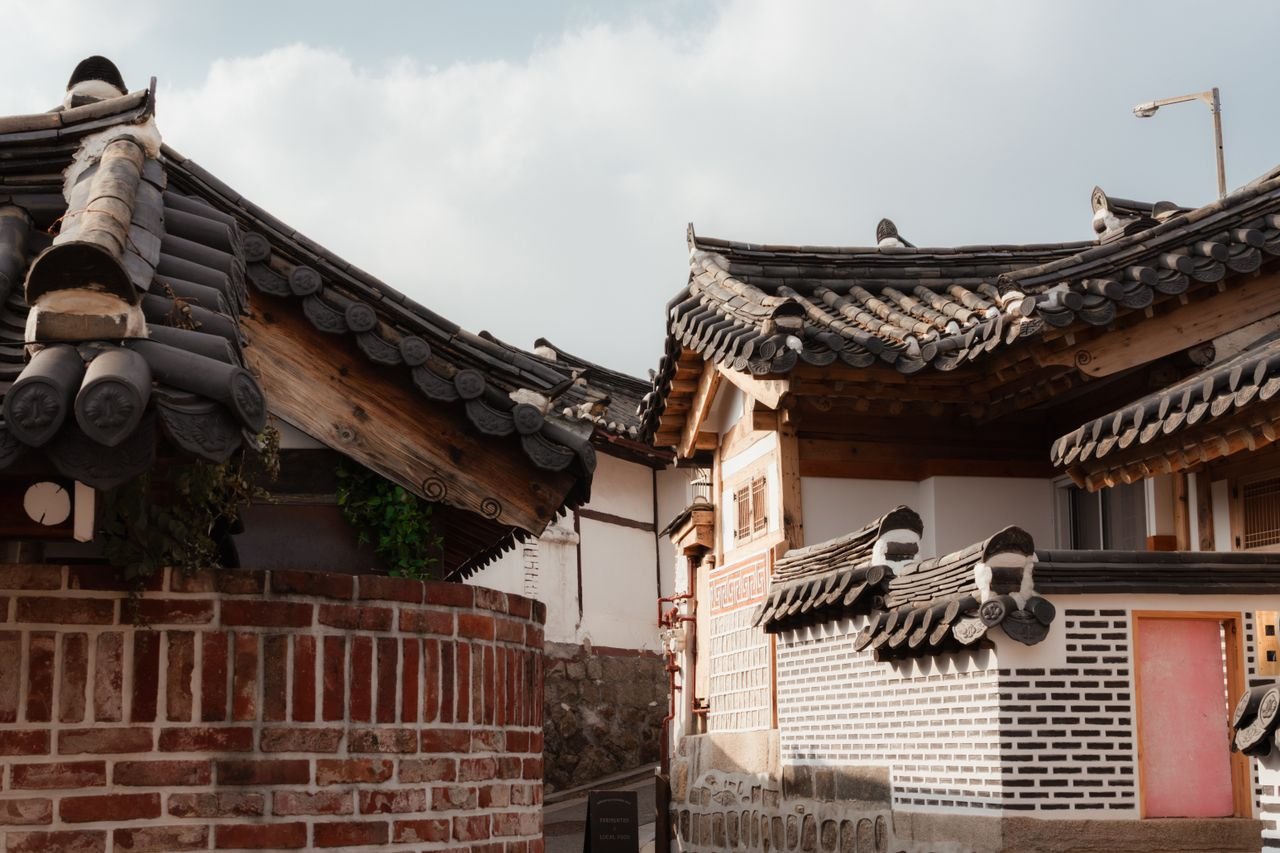
Five days is the most common length for a first trip to South Korea, and it fits two cities well: Seoul for palaces, markets and neighbourhood life, then Busan for beaches, hillside villages and seafood. This route spends two days in Seoul, one day on a DMZ or Nami Island excursion, a half-day KTX transfer south, and a final day on Busan’s coast. If you have a few more days, our 1 week in South Korea itinerary adds Gyeongju.
Prices below are approximate and current as of 2026. The Korea Tourism Organization’s official visit Korea site lists current opening hours and closures for palaces and attractions, which are worth checking before you fix your days.
The 5 Day Route at a Glance
| Day | Where | Main sights |
|---|---|---|
| 1 | Seoul | Gyeongbokgung, Bukchon, Insadong, Gwangjang Market |
| 2 | Seoul | Changdeokgung, Namsan Tower, Myeongdong or Hongdae |
| 3 | Seoul day trip | DMZ tour or Nami Island |
| 4 | Seoul to Busan | KTX, Jagalchi Market, Gamcheon Culture Village |
| 5 | Busan | Haedong Yonggungsa Temple, Haeundae, then KTX or flight home |
Before You Go
Arrive at Incheon and take the AREX train to Seoul Station (about 43 minutes); our Incheon airport transfer guide compares AREX, bus and taxi. Buy a T-money card at any convenience store for approximately KRW 4,000 and top up KRW 30,000-40,000, since it works on both cities’ metros and buses. A local eSIM saves hunting for Wi-Fi; see our South Korea eSIM guide or pick up an Airalo eSIM. Travel insurance is sensible for any trip, and you can compare cover here.
Where to stay: base yourself in Jongno or Myeongdong for Seoul (see our best hotels in Seoul), and near Busan Station, Seomyeon or Haeundae for Busan (our best hotels in Busan covers each). You can browse Seoul stays and Busan stays directly. Spring and autumn are the best seasons; see the best time to visit South Korea.
Day 1: Seoul’s Palaces, Bukchon and Gwangjang Market
Morning: Gyeongbokgung Palace. Start early at the largest Joseon-era palace. Entry is approximately KRW 3,000 as of 2026, and it is closed on Tuesdays. The royal guard changing ceremony takes place at the main gate at 10:00, so aim to arrive about 09:30. Walk through Geunjeongjeon (the throne hall) and the Gyeonghoeru pavilion over its lotus pond. Our Seoul palaces guide compares all five palaces if you want to choose between them. Hanbok rental near the gate gives free palace entry; see the hanbok rental guide.
Late morning: Bukchon Hanok Village. Walk 15 minutes east along the palace wall to the hillside of traditional houses. Stay on the main lanes, keep your voice low, and avoid entering side alleys marked as private. Entry is free.
Lunch and afternoon: Insadong. Walk south to Insadong for a tea house or a set lunch of temple food, around KRW 20,000-35,000 per person. Ssamziegil’s spiral of craft shops is a short stop, and Jogyesa Temple is five minutes away, free to enter. Our Insadong guide has more.
Evening: Gwangjang Market. Take the metro to Jongno 5-ga. Gwangjang is the best single street-food stop in the city: bindaetteok (mung bean pancakes) at approximately KRW 8,000 a plate, mayak gimbap (small seasoned rolls) at about KRW 5,000, and raw beef yukhoe at the stalls that specialise in it. Go hungry, bring cash as a backup, and expect to share a bench with strangers.
Day 2: Changdeokgung, Namsan and a Neighbourhood Evening
Morning: Changdeokgung and the Secret Garden. Changdeokgung is a UNESCO World Heritage palace and is closed on Mondays. The palace itself can be seen on a guided tour in English; the rear garden (Huwon) needs a separate timed ticket, around KRW 15,000 for the palace and garden combined as of 2026. Book online ahead in spring and autumn, as the garden tours fill.
Lunch: Eat in Ikseon-dong’s restored hanok alleys nearby, or at a kalguksu (knife-cut noodle) restaurant in Myeongdong for around KRW 10,000-13,000.
Afternoon: Namsan Tower. Ride the Namsan cable car (approximately KRW 11,000 return) or walk up through the forest from Myeongdong, about 30 minutes. The observation deck costs approximately KRW 16,000. Go before sunset and stay for the lights; the view over the Han River basin is the best orientation to the city’s scale you will get.
Evening: Choose Hongdae for live music, street performers and late-night food (see the Hongdae guide), or Myeongdong’s street stalls for egg bread, tornado potatoes and tteokbokki at KRW 2,000-5,000 each. Pack tonight: day 3 starts early.
Day 3: DMZ Tour or Nami Island
Pick one. Both are easy to do from Seoul in a day, and both are better booked ahead.
Option A: the DMZ (best for history). A half-day or full-day group tour takes you to the Third Tunnel, the Dora Observatory looking into North Korea, and Dorasan Station, the last stop on the southbound line. Passport is mandatory and is checked at military checkpoints. Group tours typically cost approximately KRW 65,000-100,000 depending on stops, as of 2026. Read our DMZ tour from Seoul guide before choosing an operator, and our DMZ day trip guide for what each stop involves. Most tours do not run on Mondays or public holidays, and JSA/Panmunjom tours must be booked well in advance. You can also browse Seoul tours to compare departure times.
Option B: Nami Island (best for scenery and a slower day). Take the ITX-Cheongchun train from Yongsan or Cheongnyangni to Gapyeong (about an hour), then a short taxi to the ferry terminal. Entry including the ferry is approximately KRW 16,000 for adults. The tree-lined paths are at their best in October and November and again for spring blossom; see our Nami Island day trip guide for the full plan.
Back in Seoul, go to bed early if you can: tomorrow’s train leaves in the morning.
Day 4: KTX to Busan, Jagalchi Market and Gamcheon
Morning: Seoul Station to Busan Station. The KTX runs from Seoul Station to Busan Station in approximately 2 hours 30 minutes, with departures roughly every 20-30 minutes. A standard-class ticket costs approximately KRW 54,400 as of 2026. Our book KTX tickets in Korea guide covers the Korail app and station machines, and the Seoul to Busan comparison weighs the KTX against the SRT, express bus and flights. Official timetables and fares are on Korail’s English site. Book a day or more ahead on weekends and national holidays, when trains sell out. If you leave Seoul by 09:00 you arrive in Busan before noon, leaving the whole afternoon.
Drop your bags at the hotel or the lockers at Busan Station (from around KRW 3,000). Busan Station has direct metro access on Line 1.
Lunch: Jagalchi Fish Market. Take the metro to Jagalchi station (Line 1). Choose fish from the tanks on the ground floor and have it prepared upstairs; a raw fish meal for two typically costs KRW 40,000 or more. If raw fish is not for you, the grilled-fish and hearty stew restaurants in the surrounding streets cost KRW 9,000-14,000 per bowl. Our Busan food guide goes deeper.
Afternoon: Gamcheon Culture Village. From Toseong station (Line 1), take local bus 1-1 or 2 for 15-20 minutes. The hillside of pastel houses is free to enter; a small map with a stamp trail costs approximately KRW 2,000. Allow 60-90 minutes, and wear shoes you can climb steep alleys in. Come back down to Nampo for BIFF Square snacks such as seed-filled hotteok at around KRW 2,000-3,000.
Evening: Cross to Gwangalli Beach for dinner with a view of the lit Gwangan Bridge. If you want a guided option, browse Busan tours.
Day 5: Haedong Yonggungsa Temple, Haeundae and the Journey Home
Morning: Haedong Yonggungsa Temple. This is one of the few Korean Buddhist temples built on a sea cliff, and it is free to enter. From Haeundae station (Line 2), a local bus to the temple takes about 30 minutes. Go as early as you can, since tour coaches arrive mid-morning and the light on the water is best at opening. Allow 60-90 minutes.
Late morning: Haeundae. Back at Haeundae Beach, walk the 1.5 km promenade, stop for coffee in the Marine City area, and have a late brunch. Outside July and August the beach is quiet. See our Busan things to do guide if you have spare time for Taejongdae or the sea cliffs.
Departure. You have two good options:
- KTX back to Seoul: Busan Station to Seoul Station takes the same 2 hours 30 minutes; allow 3 hours more for AREX and check-in at Incheon. Leave Busan by 12:00 for an evening international flight.
- Fly from Gimhae: if your flight departs Gimhae (PUS), take the Gimhae Light Rail and metro from the city; our Busan Gimhae airport transfer guide shows the 40-50 minute route and fares (about KRW 1,700 on light rail). Allow 2 hours at the airport.
Budget for 5 Days (Per Person, Mid-Range)
| Item | Approximate cost (KRW) |
|---|---|
| Hotels, 4 nights | 450,000-600,000 |
| KTX Seoul to Busan | 54,400 |
| DMZ tour or Nami Island | 16,000-100,000 |
| Palaces and attractions | 40,000 |
| Food (street food plus restaurants) | 200,000-250,000 |
| Local transport (T-money) | 40,000-60,000 |
Total approximately KRW 800,000-1,100,000 (USD 580-800) excluding flights. Cut it to about KRW 500,000 with guesthouses and market meals.
Tips for Making Five Days Work
- Check closing days. Gyeongbokgung is closed Tuesdays, Changdeokgung Mondays, and many DMZ tours do not run Mondays. Build day 1, 2 and 3 around those.
- Book the KTX early. On weekends and holidays, seats between Seoul and Busan are among the first to go.
- Pack light. You will be on trains and steep Busan hills; a single carry-on is easier than a large suitcase.
- Reverse the route if needed. If you fly into Gimhae, run it Busan first and end in Seoul with the AREX to Incheon. The days stay the same.
More South Korea Itineraries
- 3 Days in Seoul for a shorter Seoul-only trip
- 3 Days in Busan for a Busan-only break
- 1 Week in South Korea adds Gyeongju
- 10 Days in South Korea and 2 Weeks in South Korea for longer circuits
Looking for more to do across the country? Browse South Korea tours on GetYourGuide.