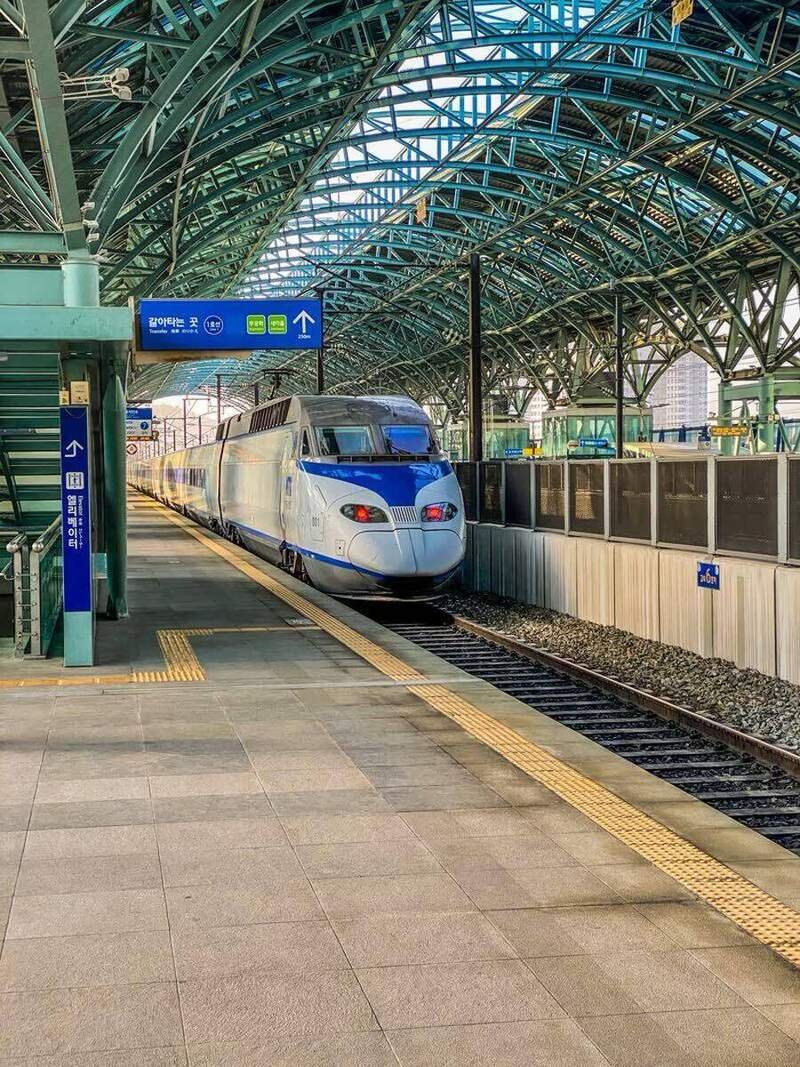
South Korea’s KTX (Korea Train eXpress) is one of the fastest and most reliable ways to travel between cities. Seoul to Busan takes around two and a half hours at speeds up to 305 km/h - far quicker than driving and cheaper than flying once airport time is factored in. This guide covers the main routes, current prices, and the clearest way to book.
The Three Routes Worth Knowing
Seoul to Busan
This is the KTX backbone - the Gyeongbu Line running south from Seoul Station to Busan’s Busan Station. Trains run roughly every 30 minutes from early morning to midnight. Journey time is approximately 2 hours 15 minutes on the fastest services. Standard-class tickets start from around 54,400 KRW (approximately USD 43) one way. First-class (Special Class) costs roughly 20% more and offers wider seats and a meal service on some services.
The train terminates at Busan Station in the centre of the city, which is far more convenient than flying into Gimhae Airport and taking a 30-minute taxi or bus into town.
Seoul to Gyeongju
The fastest option is the KTX to Singyeongju Station, which takes around 2 hours 10 minutes. Note that Singyeongju Station is not in the city centre - it sits about 8 km outside, and you will need a local bus (100, 100-1, 700) or taxi (approximately 10,000 KRW) to reach the historic core. Some travellers prefer to take the KTX to Dongdaegu Station and change onto a slower Mugunghwa train to the central Gyeongju Station, adding around 40 minutes but arriving much closer to Tumuli Park and Bulguksa. Tickets from Seoul to Singyeongju start at approximately 42,600 KRW (around USD 31).
Seoul to Jeonju
Jeonju is served by ITX-Saemaeul and Mugunghwa trains rather than full KTX, because the city is not on the Honam KTX main line - the nearest KTX station is Iksan, around 20 km from the Hanok Village. The fastest option is an ITX-Saemaeul from Seoul to Jeonju in about 2 hours 10 minutes; tickets cost approximately 22,600 KRW (around USD 16). Alternatively, KTX runs Seoul to Iksan in around 1 hour 20 minutes, then a regional bus or taxi covers the final stretch. For Jeonju, most travellers find the direct ITX-Saemaeul simpler.
Klook vs KORAIL Direct: Which to Use
Booking via Klook
Book your KTX and KR Pass tickets on Klook - the process takes about three minutes: search for your route, select a date, enter passenger details, and pay. You receive a mobile QR voucher immediately. Klook is particularly useful if you want to buy the Korea Rail Pass (KR Pass) in advance, which grants unlimited travel on KTX, ITX, and Mugunghwa services for a set number of consecutive days.
KR Pass prices (as of 2026, approximate):
- 3-day consecutive: approximately USD 95 per adult
- 5-day consecutive: approximately USD 135 per adult
- Flexible 3-day (within 10 days): approximately USD 110 per adult
The KR Pass makes financial sense if you plan at least three long-distance KTX journeys. A Seoul-Busan return alone costs around USD 86, so one additional leg roughly breaks even on the 3-day pass.
Booking via KORAIL Direct
The KORAIL website and app both have an English interface. Individual tickets often sell at the same price as Klook. The advantage of KORAIL direct is that seat selection is more granular - you can choose window or aisle on the booking screen, whereas Klook assigns seats automatically for some routes. International credit cards are accepted, though some visitors report occasional card declines, in which case Klook or a convenience store (GS25, CU) ticket purchase are reliable fallbacks.
KORAIL also accepts reservations at station kiosks; the machines have an English-language option and accept Visa and Mastercard.
Seat Classes on KTX
KTX trains have two classes:
Standard Class - rows of four seats (2+2) in most train generations, or 2+1 on the newer KTX-Eum and former SRT trains. Comfortable for journeys up to three hours. Legroom is adequate, and there is overhead storage for luggage.
Special Class (First Class) - fewer seats per row, more recline, and on some services a light meal is included. Worth it for Seoul-Busan if you are travelling during peak hours and prefer a quieter carriage.
Window seats on the right side heading south from Seoul (A and B seats in Standard) face inland; the left side (C and D seats) has more chance of catching mountain views. Neither side gives dramatic scenery on the Seoul-Busan line - most of the route is tunnels - but the Gyeongbu Line between Daejeon and Daegu passes through open agricultural land.
Practical Tips
Book early for public holidays. Chuseok (mid-autumn) and Seollal (Lunar New Year) see KTX tickets selling out within hours of release. Seats open 30 days in advance - set a reminder.
Seoul Station vs Suseo (former SRT). The SRT merged into KTX on 1 September 2026, and its trains now run as KTX-Sancheon from Suseo Station in Gangnam. Fares match Seoul Station (about KRW 54,400 Seoul-Busan as of 2026) and booking is through Korail+. If you are staying south of the Han River, Suseo may be the more convenient departure point. Whether the KR Pass is accepted on Suseo departures is unconfirmed, so check the train shows when you reserve.
Luggage storage. All major KTX stations have coin lockers and staffed luggage storage. Seoul Station lockers are near the main entrance; Busan Station lockers are on the lower ground floor. Rates start at approximately 3,000 KRW for a small locker.
Airport connections. Seoul Station has a direct AREX express train link to Incheon Airport (around 43 minutes, approximately 13,000 KRW). If your itinerary includes arriving at Incheon and heading straight to Busan, you can take the AREX to Seoul Station and board a KTX within the same building.
Korail app offline tickets. Download the official Korail app before arriving - tickets can be stored offline, which is useful on routes where mobile data coverage is intermittent.
Getting Around Korea Beyond KTX
For destinations not on the KTX network, intercity buses (고속버스) are often the fastest and cheapest option. Routes like Jeonju-Busan, Gyeongju-Gyeongsan, and Sokcho-Seoul are bus-first. The Korail network also includes:
- ITX-Saemaeul - semi-express on non-KTX lines; good for Jeonju and Masan
- Mugunghwa - slower intercity, stops at more stations; useful for Gyeongju central station and smaller towns
- ITX-Cheongchun - runs Seoul Cheongnyangni to Chuncheon; popular for Nami Island day trips
You can book all of these on the KORAIL website or app. Klook’s Korea Rail Pass covers KTX, ITX, and Mugunghwa services but not city subways.
What to Expect on Board
KTX trains are quiet and punctual. There is a café car (snack bar carriage) on most services selling instant ramyeon, coffee, sandwiches, and beer. Seats have power sockets on newer trains. Wi-Fi is available on KTX-Eum and former SRT trains; older KTX-I and KTX-Sancheon trains have more patchy coverage.
Announcements are made in Korean and English. Station names are displayed in Korean and English on platform boards. Arrival time is shown on an overhead display inside each carriage.
Plan around 10–15 minutes to get through the ticket gates and onto the platform at busy stations like Seoul and Busan. Trains depart on the second - missing your service means buying a new ticket or paying a rescheduling fee.
KTX is the clearest argument for building a multi-city South Korea itinerary: three cities in one week is straightforward when 2.5-hour intercity travel is the norm rather than the exception.
Hotels and Tours at the End of the Line
Once your tickets are booked, line up the other end: Busan hotels and Busan tours, Gyeongju hotels and Gyeongju tours, or Jeonju hotels and Jeonju tours. In Seoul, compare Seoul hotels near Seoul Station for early departures.