Busan’s food scene is built around the sea, the Korean War refugee period that created the city’s most distinctive dishes, and several concentrated dining districts that each have their own character. Rather than asking what to eat (covered in our Busan food guide), this guide covers where to eat — the specific neighbourhoods, markets, and restaurants to head to, with price ranges current as of 2026.
Nampodong and Jagalchi: Seafood and Street Food
The Nampodong area in central Busan holds Busan’s two most famous food landmarks within walking distance of each other: Jagalchi Fish Market and BIFF Square.
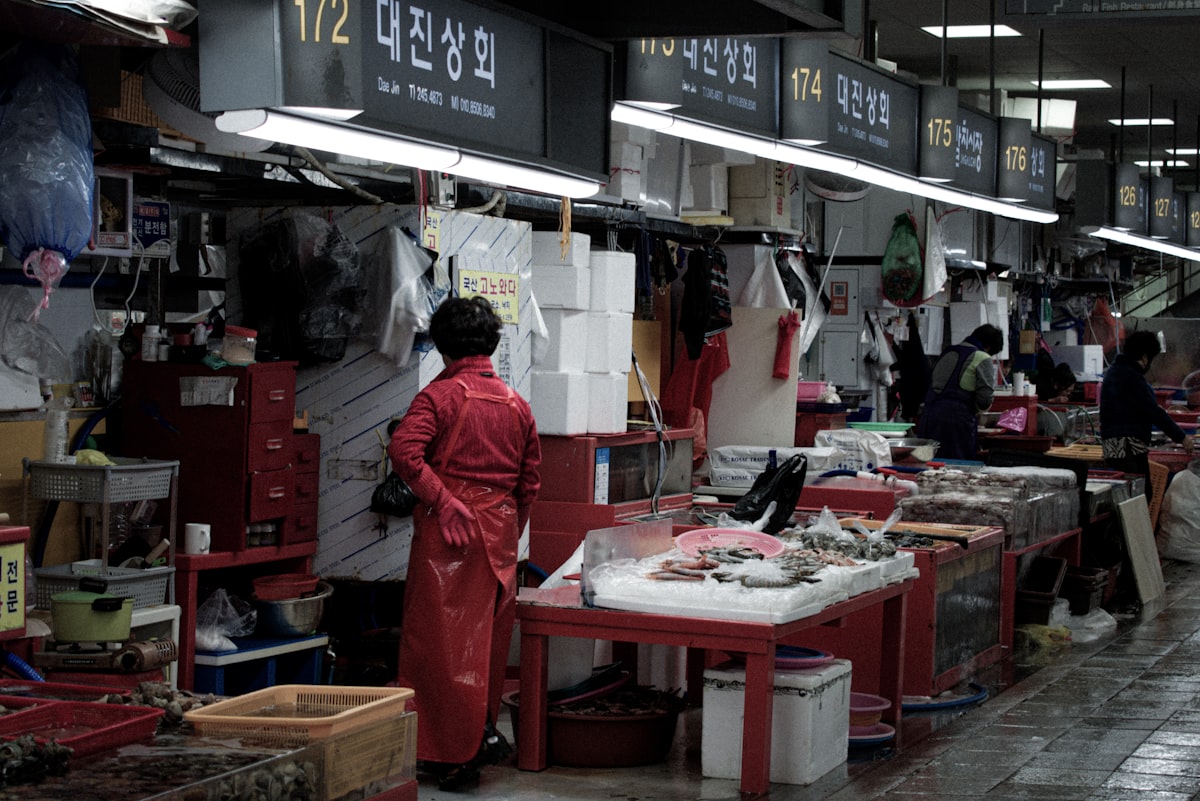
Jagalchi Fish Market runs along the waterfront near Nampo Port. The covered building has rows of vendor stalls on the ground floor selling live seafood — flatfish, sea urchin, crab, abalone, and shellfish in tanks. Buyers select from the stalls (priced by weight — flatfish runs approximately KRW 20,000–40,000 for a portion for two as of 2026) and take their selection upstairs to restaurant floors where the fish is prepared as sashimi or cooked. Add a preparation fee of approximately KRW 5,000–10,000 per restaurant visit. The market is open daily from approximately 05:00 to 22:00. Closest metro: Jagalchi (line 1).
BIFF Square (Busan International Film Festival Square) is a pedestrianised strip a 5-minute walk from Jagalchi that functions as Busan’s main street food zone. Key stalls:
- Ssiat hotteok: The original vendor near the BIFF Square entrance on weekends draws queues, but there are multiple stalls selling the seed-filled sweet pancakes at approximately KRW 2,000–3,000 each.
- Korean corn dogs: Thick-battered sausage and mozzarella sticks, KRW 3,000–5,000 each.
- Tteokbokki: Spicy rice cakes, available at multiple stalls for KRW 3,000–6,000 per portion.
- Odeng: Fish cake skewers in warm broth, KRW 500–1,000 each.
Gukje Market (International Market) is adjacent to BIFF Square and worth walking through for ureong-ttang (sea urchin soup, approximately KRW 8,000–10,000) and bindaetteok (mung bean pancakes, KRW 4,000–6,000 per portion) at the food stalls in its covered alleys.
Seomyeon: The Main Dining District
Seomyeon is the commercial heart of Busan and its most concentrated restaurant district. The streets east of Seomyeon metro station (lines 1 and 2) have the highest density of restaurants in the city, covering every budget from KRW 8,000 local lunch spots to KRW 60,000+ Korean BBQ restaurants.
Dwaeji gukbap (pork soup): Seomyeon has Busan’s best known concentration of dwaeji gukbap restaurants, many of which open from early morning (06:00–07:00) and run through the night. A full bowl with rice and banchan costs approximately KRW 10,000–14,000.
- Haji Dwaeji Gukbap (하지 돼지국밥, near Seomyeon station exit 1): one of Seomyeon’s most recommended gukbap specialists, known for its clean broth and consistent quality. Open from early morning.
- Songjeong 3-Daegi Gukbap (송정3대기국밥): around KRW 11,000 per bowl, long-running neighbourhood institution in the Seomyeon area.
Milmyeon (cold noodles): Specialist milmyeon restaurants are concentrated around the Seomyeon and Gaegeum areas.
- Ojung Milmyeon (오정 밀면, near Gaegeum station): frequently cited as one of the best in Busan. A standard bowl is approximately KRW 9,000–11,000 as of 2026.
- Gaya Milmyeon (가야 밀면, near Seomyeon): another long-established specialist open for lunch and dinner.
Korean BBQ: The streets around Seomyeon have dozens of BBQ restaurants. Expect to pay approximately KRW 15,000–25,000 per person for pork belly (samgyeopsal) or beef short ribs (galbi) with unlimited banchan refills, as of 2026.
Haeundae: Upscale Seafood and Hotel Dining
Haeundae is the most tourist-oriented of Busan’s dining areas, with pricing that reflects the international hotel district surrounding the beach.
Busan Raw Fish Centre (부산 횟집, on Beach Road near the Haeundae promenade): a multi-floor building with multiple seafood restaurants offering freshly prepared raw fish. Expect to pay KRW 30,000–80,000 for a meal for two depending on fish type and quantity. Less atmospheric than Jagalchi but more convenient if you are staying in Haeundae.
Marine City dining: The Marine City district behind the western end of Haeundae is the city’s most upscale restaurant neighbourhood, with modern Korean restaurants, Japanese, and international options. Main courses range from approximately KRW 22,000–55,000 as of 2026.
Dongbaek Island promenade: The strip of cafés and restaurants on the Dongbaek Island walkway (between Haeundae beach’s eastern end and Nurimaru APEC House) offers sea views at moderate prices — coffee KRW 5,000–8,000, light meals KRW 12,000–22,000.
Gwangalli: Views and Seafood
Gwangalli’s promenade has a strong mix of seafood, Korean BBQ, and café culture, with the Gwangan Bridge as backdrop. The dining options here are generally a step more local in character than Haeundae.
Millak Raw Fish Town (민락 수변공원 횟집): a complex of approximately 30 raw fish restaurants at the eastern end of Gwangalli beach promenade. Select live fish from tanks at the entrance and pay by weight before being seated. Pricing is competitive: a flatfish (gwang-eo) portion sufficient for two runs approximately KRW 25,000–50,000 as of 2026, depending on size. The restaurants cook (as well as serve raw) and provide banchan and rice.
Gwangalli beach promenade: The promenade has numerous seafood restaurants, many with terrace seating facing the bridge. Mid-range options with bridge views charge approximately KRW 15,000–35,000 per main as of 2026.
Fried chicken: Busan’s fried chicken restaurants (치킨집) are a budget evening option throughout Gwangalli’s side streets — a full chicken with sides and beer costs approximately KRW 25,000–35,000 as of 2026 and most restaurants deliver until 01:00 or later.
Budget Eating Tips
- 편의점 (convenience stores): GS25, CU, and 7-Eleven stores throughout Busan stock prepared meals — triangular kimbap (KRW 900–1,500), sandwiches, cup noodles, and hot foods at the counter — for under KRW 5,000 total.
- 찜 (jjim) restaurants: Braised seafood dishes (steamed crab, braised spicy octopus) served family-style are good value — approximately KRW 20,000–40,000 for a pot sufficient for two people.
- University areas: The areas around Pusan National University (PNU) and Dong-A University have dense concentrations of student-priced restaurants and cafés. A full meal rarely exceeds KRW 9,000.
Book a Busan food tour through GetYourGuide. Pick up an eSIM before you travel to stay connected while navigating menus and restaurants — Airalo has South Korea coverage plans.