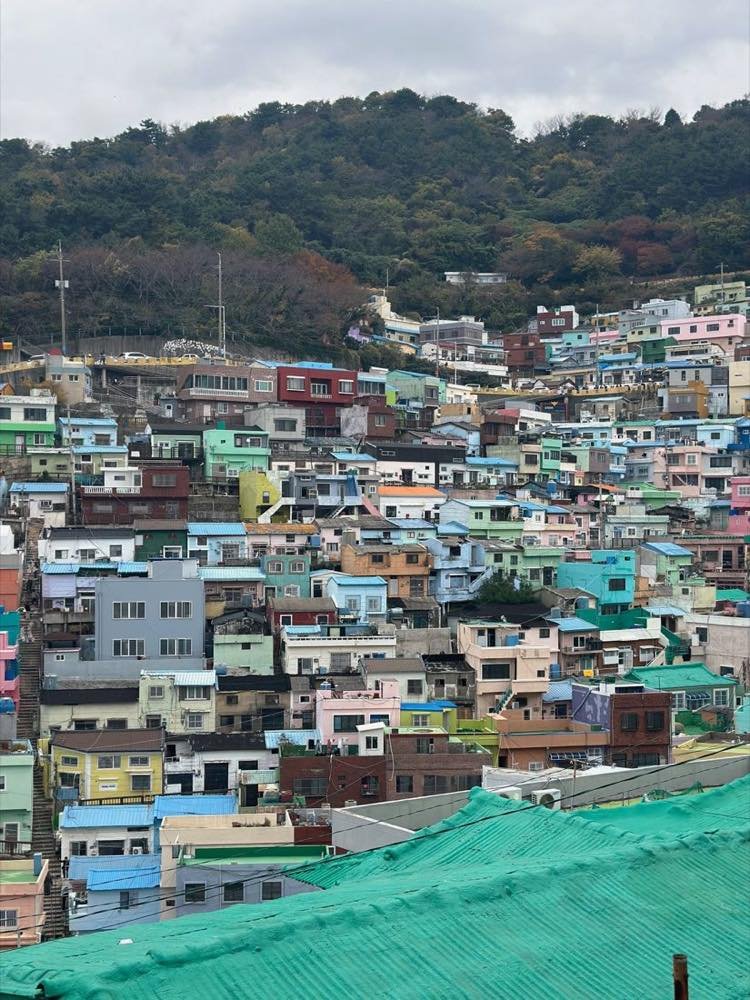
Gamcheon Culture Village (감천문화마을) is a steep hillside district in Saha-gu, on Busan’s western side, where terraced houses in blue, green, pink and yellow step down toward the harbour. It started as a settlement for Korean War refugees and followers of the Taegukdo religion in the 1950s, and a public art project from 2009 repainted the lanes, added murals and turned empty houses into galleries and cafes. It is free to walk, it is genuinely hilly, and it is far better with a plan. This page covers the route, the stamp map and how to link it with the rest of Busan; the shorter write-up in our things to do in Busan guide covers the other major sights.
Getting there from Toseong Station
The most reliable route is the metro plus a village bus:
- Take Busan Metro Line 1 to Toseong Station (about 15 minutes from Nampo or Jagalchi, roughly 30 minutes from Seomyeon).
- Leave by exit 6 and look for the small green village (maeul) buses. The Saha 1-1 and Seogu 2 are commonly used. Confirm the current number on Naver Maps or Kakao Maps, because route numbers get reorganised.
- The ride takes roughly 10-15 minutes and costs a standard city bus fare, about KRW 1,500 with T-money as of 2026. Some riders get off at the village stop, others at Gamcheon Elementary School and walk about 5 minutes uphill.
A taxi from Toseong or Busan Station is about 15-20 minutes. Do not try to drive in: the alleys are narrow and parking is minimal. See our Busan getting-around guide for T-money and metro fares.
The stamp map and what it covers
The village information centre near the entrance sells a stamp-tour map at approximately KRW 2,000 as of 2026. It marks the main murals, galleries and viewpoints, and each stop has a small stamp station. Maps sell out on busy weekends, so ask early. The centre keeps office hours (roughly 09:00-18:00), but the lanes themselves are open to walk at any time. Keep to the marked paths: these are people’s homes.
A two-hour route
- Start at the information centre and buy the map. Follow the marked route downhill from the top viewpoint, so the steepest climbs are done first.
- Little Prince and fox statue: a hillside wall viewpoint with a panorama over the rooftops. This is the busiest photo stop, with queues after about 11:00.
- Murals and “Fish” alley art: the lanes and stairways between the main viewpoints hold most of the painted walls and installations, plus small shops selling postcards and crafts.
- Galleries and cafes: several are free to enter, and some resident-run exhibitions charge approximately KRW 1,000-3,000. A cafe terrace is the best place for the harbour view and a rest.
Wear flat shoes with grip. The route is steep and stepped, so it is not ideal with a pushchair or wheelchair.
Best time to visit
Weekday mornings, before about 10:30, are quietest. Weekends and school holidays bring tour groups from midday. Bright weather matters: the colours look flat on grey days. Summer is hot and humid on the slope, and winter wind can be sharp. For month-by-month weather see best time to visit Busan.
Combining Gamcheon with Jagalchi and BIFF Square
Gamcheon fits neatly into an old-Busan day. Start at the village by about 09:30, back at Toseong by 11:30, then ride Line 1 to Jagalchi Station for a seafood lunch at Korea’s largest fish market (our Jagalchi Fish Market guide explains the upstairs system). From there it is a short walk to BIFF Square, Gukje Market and the Nampo-dong shopping streets. Our 3-day Busan itinerary lays out this day with timings.
Tours and where to stay
If you prefer context, a guided walk explains the village’s history and handles the route for you. Browse Busan tours on GetYourGuide or see our best Busan tours guide for combos that include Haedong Yonggungsa and Taejongdae. For a base within easy reach of Toseong and Jagalchi, Nampo and Busan Station suit best, while Haeundae is further east. Compare Busan hotels on Booking.com and read our best hotels in Busan guide.
Official visitor information is at Visit Busan.