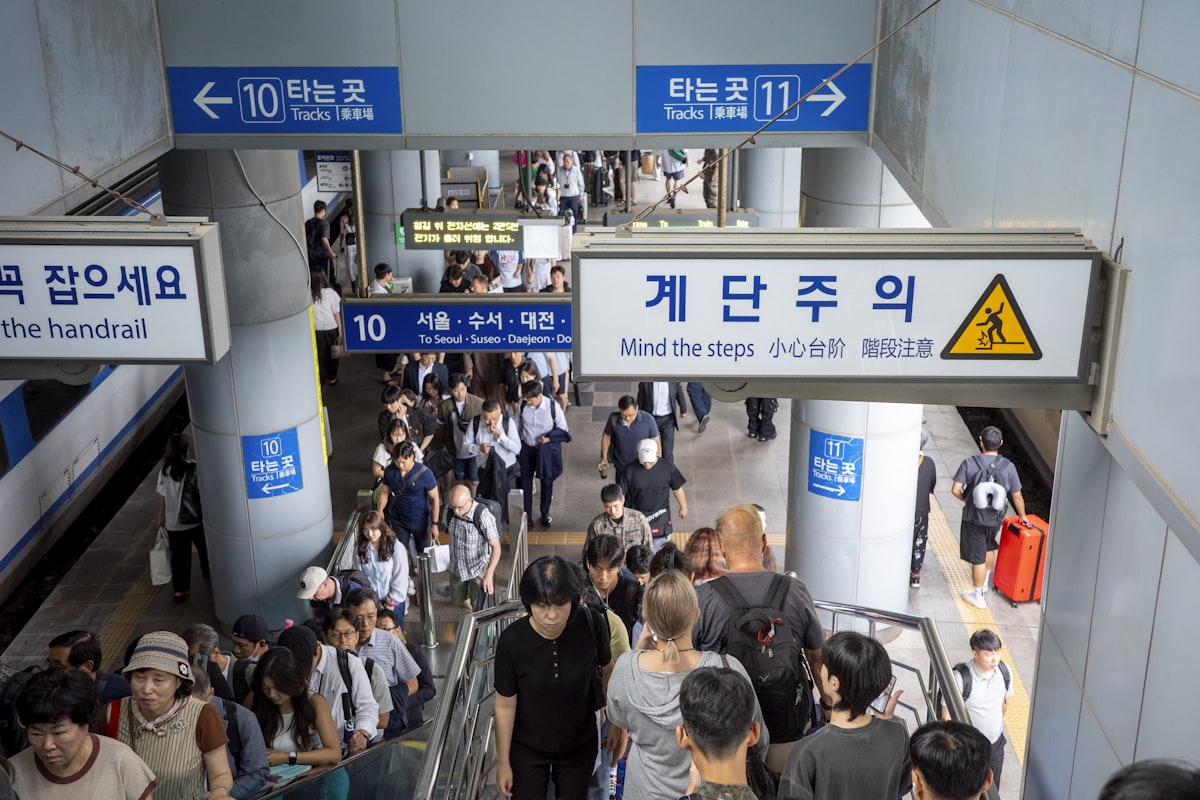
Busan is South Korea’s second largest city and has a well-developed public transport network covering its coastline, hilly neighbourhoods, and port districts. The metro is the fastest way to navigate between major areas, while buses fill in the gaps and taxis are affordable for short distances. Here is a practical guide to getting around Busan, with fares current as of 2026.
Busan Metro
The Busan Metro runs four main lines plus the Busan-Gimhae Light Rail Transit (BGLRT) connecting the airport. The four city lines are:
- Line 1 (Orange): Runs north-south through the city centre, connecting Nopo in the north to Dadaepo Beach in the south-west. Key stops include Seomyeon, Busan Station, Nampo, and Toseong (for Gamcheon Village).
- Line 2 (Green): The longest line, running east-west from Jangsan (near Haeundae) through Seomyeon to Yangsan in the north. Key stops include Haeundae, Gwangalli, and Sasang.
- Line 3 (Brown): A shorter line running through northern Busan, connecting to the BGLRT at Daejeo for Gimhae Airport.
- Line 4 (Blue): A short stub line in the Minam area of eastern Busan.
Single-journey fares are approximately KRW 1,600–1,900 as of 2026 depending on distance. Paying with a T-money card costs around KRW 100 less per journey than purchasing a single-use paper ticket at the machine.
The metro runs from approximately 05:20 to 00:20, with trains every 3–7 minutes during peak hours.
T-Money Card
The T-money card (or its Busan equivalent, Hanpay) is a reloadable transit card that works on the metro, city buses, and most intercity buses throughout South Korea. It can be purchased at metro station convenience stores (GS25 or CU) for around KRW 2,500–3,000, then loaded with credit in any amount.
The card provides approximately KRW 100 discount per metro trip and around KRW 100 discount on bus fares compared to cash. It also allows free transfers between metro and bus when used within a set time window — a significant saving if you are making journeys that require both.
T-money cards can be purchased and topped up at station vending machines, convenience stores inside stations, and most convenience stores throughout the city.
City Buses
Busan’s city bus network is extensive and covers many areas not served by the metro, including the hillier residential districts. There are several bus types:
- Regular buses (일반버스): The most common type, operating throughout the city. Fares are approximately KRW 1,500 with a T-money card (KRW 1,600 cash) as of 2026.
- Express buses (급행버스): Faster, with fewer stops. Fares are slightly higher at approximately KRW 1,900–2,000.
- Maul buses (마을버스): Small community buses serving steep hillside areas. Slightly cheaper at around KRW 1,100–1,200.
Bus numbers and routes can be found in the Naver Maps or Kakao Maps apps, both of which provide real-time bus tracking in Korean and English. Google Maps is less reliable for Busan bus routing.
Busan City Tour Bus
The Busan City Tour Bus (도시관광버스) is a hop-on, hop-off sightseeing bus with two main routes: the coastal route and the theme route. Day tickets cost approximately KRW 15,000–18,000 as of 2026. Key stops include Haeundae Beach, Gwangalli Beach, Jagalchi Market, BIFF Square, Gamcheon Culture Village, and the UN Memorial Cemetery.
This is a practical option for first-time visitors who want to cover multiple tourist sites in a day without navigating the local bus network. The coastal route in particular links Haeundae and Gwangalli beaches in a single loop.
Taxis
Taxis in Busan are metered and relatively affordable by international standards. The base fare for a regular taxi is approximately KRW 4,800 for the initial distance as of 2026, with the meter increasing in increments after that. A short journey of 2–3 km typically costs KRW 6,000–8,000.
Kakao T is the main taxi-hailing app in South Korea and works throughout Busan. It displays estimated fares before booking and allows payment by card. Most Busan taxi drivers accept card payment, though this is worth confirming before getting in.
Taxis are particularly useful for journeys to hillside areas like Gamcheon Culture Village that require multiple bus changes, or for late-night travel after the metro closes.
Getting to Busan from Seoul
By KTX: Seoul Station to Busan Station takes approximately 2 hours 30 minutes on the KTX high-speed rail. Fares are approximately KRW 59,800 for a standard seat, rising to around KRW 86,600 for KTX-1 business class as of 2026. Book through the Korail website (letskorail.com) or the Korail app. Services run frequently throughout the day — early and late trains book up on weekends.
By plane: Budget airlines (Jin Air, Air Busan, Jeju Air) fly from Gimpo Airport (GMP) or Incheon Airport (ICN) to Gimhae Airport (PUS) in approximately 50–60 minutes. Fares can be cheaper than KTX for advance bookings but total travel time including airport check-in is similar.
By intercity bus: Buses from Seoul to Busan run from several terminals and take 4–5 hours. Fares are around KRW 23,000–36,000. This is the slowest option and generally only makes sense if you want to travel overnight.
Gimhae Airport (PUS)
Busan’s international airport is located in Gimhae, west of the city. The Busan-Gimhae Light Rail Transit (BGLRT) connects the airport to two metro stations: Sasang (line 2) and Daejeo (line 3). From there, you can continue by metro to anywhere in Busan. The BGLRT journey from the airport to Sasang takes approximately 25 minutes and costs around KRW 2,300 as of 2026.
Airport taxis run directly into Busan city centre and take 25–40 minutes depending on destination and traffic. The metered fare to central Busan (Seomyeon or Nampo) is approximately KRW 20,000–35,000. Limousine airport buses also run to major hotels and bus terminals, costing around KRW 7,000–9,000.
Ferry Terminals
Busan is South Korea’s main ferry port for international services:
Busan International Ferry Terminal (부산항 국제여객터미널) near Jungang station operates services to Japan. JR Kyushu Jetfoil runs a high-speed service to Fukuoka (Hakata) in approximately 3 hours; fares start around KRW 85,000–120,000 one-way as of 2026 and must be booked in advance. The Camellia Line operates an overnight ferry to Osaka (approximately 18 hours), with cabin-class fares starting around KRW 70,000–100,000 for a reclining seat.
The ferry terminal is about 10 minutes’ walk from Jungang metro station (line 1).
For Jeju Island, domestic ferries run from Busan Port (near Busan Station on line 1) or Busan North Port. The ferry crossing to Jeju takes approximately 11–13 hours overnight. Domestic flights from Gimhae Airport to Jeju take under an hour and are often cheaper.
For accommodation across Busan’s neighbourhoods, see our Busan hotels guide. For what to do once you arrive, see things to do in Busan.