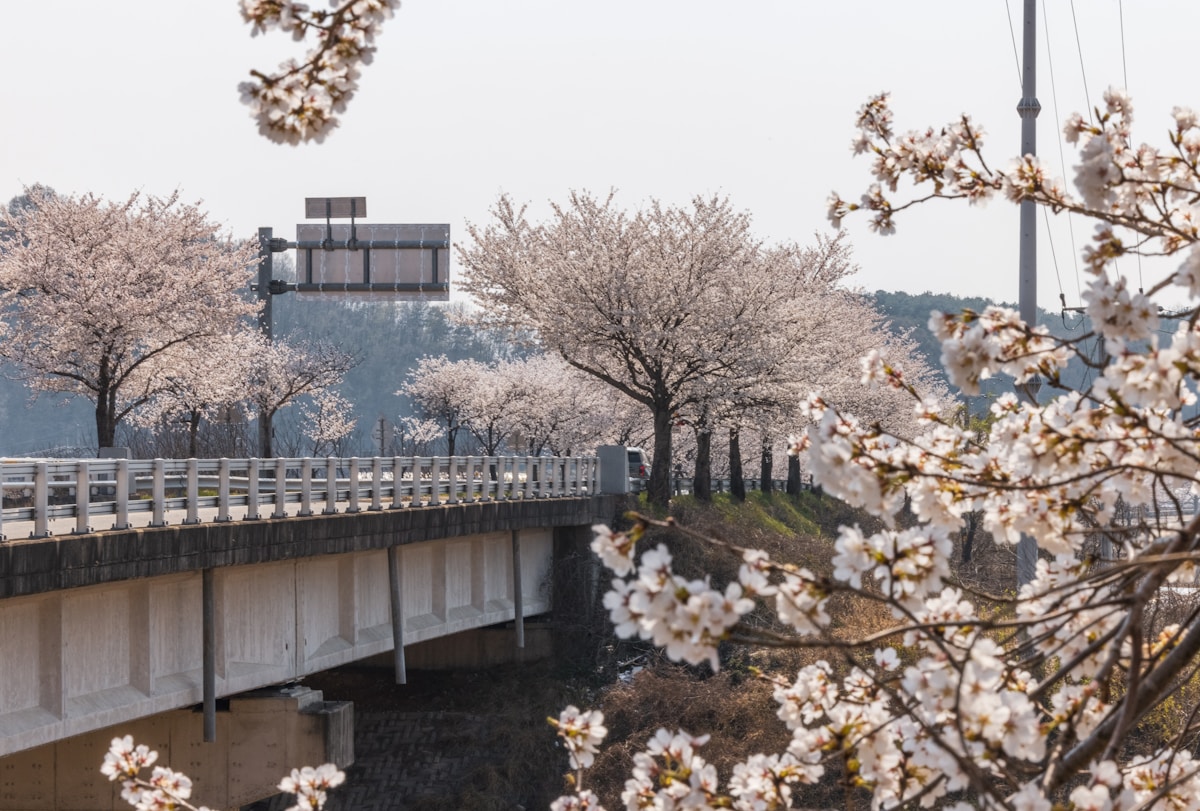
Busan’s cherry blossom season arrives earlier than anywhere else on the mainland, typically 5–7 days ahead of Seoul, which makes it a practical starting point for anyone planning a spring trip through Korea. The city’s blossom spots range from a hillside coastal road in Haeundae to a 4km stream corridor popular with local families, and the Jinhae festival — Korea’s largest cherry blossom event — is a 40-minute bus ride away.
For the full South Korea blossom forecast by region, see our Korea cherry blossom guide.
2027 Bloom Dates for Busan
Busan’s Yoshino cherry trees (왕벚나무 on roadsides, 벚꽃 in general) typically reach first bloom between March 26 and April 1, with peak bloom (roughly 70% of trees fully open) arriving late March to early April. Peak bloom in Busan usually precedes Seoul’s peak by 5–7 days.
The Korea Meteorological Administration (KMA) publishes city-specific forecasts at weather.go.kr from mid-February 2027 onwards. Third-party aggregator sites compile these into map formats that are easier to read — search “Korea cherry blossom forecast 2027” from February onwards.
Bloom window: Peak lasts 7–10 days under stable conditions. Rain or strong wind during peak can strip petals in 2–3 days. Monitor the KMA forecast in the week before your trip.
Best Cherry Blossom Spots in Busan
Dalmaji Hill (달맞이길), Haeundae
Dalmaji Hill is Busan’s signature blossom location. The winding road climbs above Haeundae Beach through a corridor of Yoshino cherry trees, and at peak bloom the branches form a nearly continuous canopy overhead. The hill also offers elevated views across Haeundae and청사포 (Cheongsa-po) coast — an unusual combination of blossom and ocean scenery.
Walking the route: The main blossom road runs approximately 2km from the Haeundae side up to the ridge. A walking path called the Moonside Road (달맞이길 산책로) connects the hill to the beach below. Allow 1.5–2 hours for the walk up and back.
Getting there: From Haeundae Metro Station (line 2), the start of Dalmaji Hill is a 15-minute walk or 5-minute taxi. Parking fills quickly during peak bloom — arriving on foot via the beach walk is more reliable on weekend mornings.
Timing: Weekday mornings before 10:00 have notably less crowding. On peak weekend afternoons the road becomes very slow due to pedestrian volume.
Oncheoncheon Stream (온천천)
Oncheoncheon Stream is the local Busan favourite that most visitors miss. The stream runs through central Busan for approximately 4km from Oncheoncheon Station southward, lined on both banks with Yoshino cherry trees. At peak bloom the branches meet overhead in places, creating a tunnel effect above the stream.
This is a neighbourhood spot rather than a tourist circuit — you will find mostly local families and cyclists, which means significantly less crowding than Dalmaji on the same peak weekend.
Getting there: Metro line 1 to Oncheoncheon Station (exit 4). Walk down to the stream bank — the blossom corridor begins almost immediately and runs south for 4km to Dongnae. You can walk the full length in 1–1.5 hours.
Best section: The stretch between Oncheoncheon Station and Dongnae Station has the densest tree cover. Cycling is possible along the stream path; rental bikes are available near the station.
Nakdonggang River, Hwamyeong (화명)
The riverside cycling path along the Nakdonggang at Hwamyeong (north Busan) is lined with cherry trees that bloom around the same time as Dalmaji. This spot works best if you have a bike or are willing to hire one — the path is 5–8km of riverside blossom and is flat throughout.
Getting there: Metro line 2 to Hwamyeong Station. The riverside path is a 10-minute walk from the station. Bike hire is available near the station entrance.
Jinhae Day Trip from Busan (필수)
Jinhae (진해) — now administratively part of Changwon — is the single most spectacular cherry blossom destination in all of Korea. The city contains an estimated 360,000 Yoshino cherry trees originally planted during the Japanese colonial period, when it was a major naval base. The roads, riverbanks, and the long railway corridor at Gyeonghwa Station are blanketed in blossoms for the 10-day Gunhangje Festival (군항제).
Gyeonghwa Station (경화역): The station itself is the most photographed location — petals fall across vintage railway carriages, and the track is surrounded by dense cherry trees. This is the defining image of Korean spring.
Romance Bridge (로망스 다리) and Yeojwa Stream: The canal-side walk along Yeojwa Stream passes under a continuous canopy of cherry branches for several hundred metres — a calmer alternative to the main festival crowds.
Getting there from Busan: Bus from Seobu Intercity Bus Terminal (서부시외버스터미널) to Jinhae takes approximately 40 minutes; fare approximately KRW 3,500 as of 2026. The bus runs frequently. From Masan you can also take a local bus.
Practical points:
- Arrive before 09:00 — the main areas become very crowded by mid-morning on peak days
- Accommodation in Jinhae books 6–8 weeks ahead during the festival; Changwon (15 minutes away) is the practical overflow base
- The Gunhangje Festival includes naval vessel open days, food stalls, and performances — check the official dates (released annually around February) as they shift to align with actual bloom
When to Visit for the Fewest Crowds
| Day/Time | Crowd Level |
|---|---|
| Weekday before 10:00 | Low |
| Weekday 10:00–17:00 | Moderate |
| Weekend before 09:00 | Low–moderate |
| Weekend 10:00–18:00 | High (Dalmaji especially) |
| Weekday evening (18:00–20:00) | Low |
Oncheoncheon Stream stays less crowded throughout because it is not on tourist itineraries. Jinhae on peak festival weekends is extremely crowded at all hours — the weekday option is much more comfortable.
Practical Details
Accommodation in Busan during blossom season: Book 4–6 weeks ahead. Haeundae and Gwangalli are the most convenient bases for blossom spots. Hotels within walking distance of Haeundae Station fill fastest.
Guided options: Guided Jinhae day trips from Busan are available and handle the transport logistics. See our cherry blossom tours guide for current options and pricing, or browse available tours through GetYourGuide.
eSIM for Korea: Stay connected for maps and KMA forecast checks — pick up a data SIM through Airalo before or on arrival.