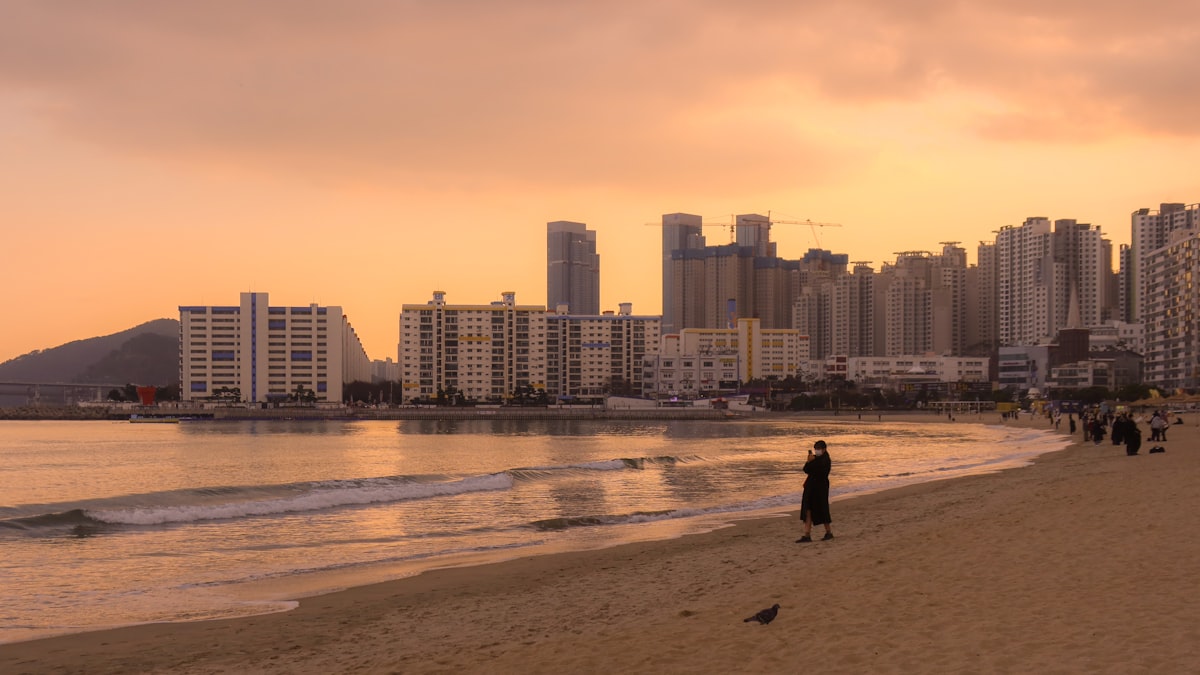
Busan is South Korea’s main beach city, with a coastline that stretches from the city’s southern edge around to its north-eastern suburbs. The three main beaches — Haeundae, Gwangalli, and Songdo — each have a distinct character, and all are reachable by metro or bus. A fourth option, Songjeong, suits those after a quieter stretch of sand. Here is what to know about each.
Haeundae Beach
Haeundae is South Korea’s most visited beach — a 1.5 km stretch of sandy shore backed by a dense promenade of hotels, restaurants, cafés, and shops. The beach faces south-east into the Korea Strait, which means relatively calm conditions and gentle waves, making it suitable for families and casual swimmers.
Swimming season: Lifeguards are stationed from late June through late August. The sea is warmest in July and August at around 23–26°C. In high summer, Haeundae becomes genuinely crowded — the beach can accommodate hundreds of thousands of visitors on peak weekends in late July and early August.
Getting there: Metro line 2 to Haeundae station. The beach is a 10-minute walk south from exits 3 or 5.
When to go: Weekday mornings in July are manageable. Weekends in late July and early August see the maximum crowds and beachside stall prices tend to rise accordingly. Late June and September have far fewer visitors and the sea is still swimmable.
Nearby food: The strip of restaurants east of the beach (in the direction of the Dongbaek Island walkway) tends to have better quality than the beachfront stalls. Busan Raw Fish Centre near the Beach Road promenade has multiple seafood restaurants. For a more upscale meal, the Marine City district behind the western end of Haeundae has modern Korean and international restaurants with Gwangan Bridge views, with main courses typically KRW 18,000–45,000 as of 2026.
Gwangalli Beach
Gwangalli is a 900-metre beach in the Suyeong district, approximately 5 km south-west of Haeundae. It is smaller, less crowded, and defined by its view of the illuminated Gwangan Bridge — a 7.4 km cable-stayed bridge that forms the backdrop to the beach at night.
The promenade behind Gwangalli has a strong café and bar scene and is particularly lively on weekend evenings when the bridge is lit up. The area has a young, local atmosphere compared to the more tourist-dense Haeundae strip.
Swimming season: Same as Haeundae — late June through late August. The beach is shallower than Haeundae, which makes it more suitable for children in the water but means the ocean here can feel a little more enclosed.
Getting there: Metro line 2 to Gwangan station, then a 10-minute walk to the beach. Alternatively, metro to Geumnyeonsan station.
Nearby food: The Gwangalli promenade has a concentrated stretch of seafood restaurants, Korean BBQ, and Western-style cafés. Millak Raw Fish Town — a dedicated complex of approximately 30 seafood restaurants — sits at the eastern end of the beach promenade and offers raw fish (hoe) at slightly lower prices than Haeundae, with main portions for two running approximately KRW 30,000–60,000 as of 2026. For late-night food and drinks, the bars and fried chicken shops behind the promenade stay open until the early hours.
Songdo Beach
Songdo Beach is in the Seo district on Busan’s western coast, separated from the main tourist cluster by the ridge behind Nampo. It is the city’s oldest coastal resort area and has a quieter, more neighbourhood character than Haeundae.
The main draw beyond the beach itself is the Songdo Coastal Walkway — a set of suspended marine walkways built along the cliff face that offer views back over the beach and out to the Oryukdo islets. The walk takes about 20–30 minutes one way.
Songdo Beach Cable Car (송도해상케이블카): A gondola cable car runs from the cliffs above the Songdo beach area to a point on Amnam Park, crossing the bay. The round-trip fare is approximately KRW 15,000 for a regular cabin, KRW 20,000 for a glass-floor cabin as of 2026. The ride takes about 8 minutes each way and offers the best elevated views of Busan’s western coastline and harbour. The cable car operates from 09:00 to 20:00 daily (later in summer), with last boarding around 19:00. Book tickets on arrival — queues can be long in summer but move reasonably quickly.
Getting there: The closest metro station is Jagalchi (line 1), from which buses 7, 71, or 508 run to Songdo Beach in approximately 15–20 minutes. Alternatively, taxi from Nampo takes around 10 minutes.
Nearby food: Songdo has a row of seafood restaurants and snack stalls along the beach road. The area is known for freshly grilled clam skewers (KRW 5,000–8,000) and raw fish at moderate prices. Less commercial than Haeundae — most stalls are local operations rather than tourist-facing chains.
Songjeong Beach
Songjeong is a 250-metre beach in the far east of Busan, near the border with Gijang county. It is the least crowded of Busan’s main beaches and is popular with local surfers — the east-facing orientation means it picks up swells that don’t reach Haeundae.
There are several surf shops along the beach road offering board rental (approximately KRW 20,000–30,000 per hour as of 2026) and lessons. The beach has a relaxed atmosphere year-round and far fewer visitors than Haeundae even on summer weekends.
Getting there: Metro line 2 to Songjeong station. The beach is a 5-minute walk from the station.
Best time: Late May to June and September to October for surfing. Swimming in July and August when the sea is warmest, though Songjeong remains far quieter than Haeundae throughout summer.
Practical Notes for All Beaches
Sunscreen: Korean SPF products are widely available at convenience stores and pharmacies near all three main beaches and are generally well-priced — a large tube of SPF 50 sunscreen costs approximately KRW 8,000–15,000.
Facilities: Haeundae has the most comprehensive beach facilities including showers, changing rooms, sunbed rental (approximately KRW 5,000–10,000 per chair as of 2026), and lifeguard stations. Gwangalli and Songdo have basic shower facilities but fewer amenities on the beach itself.
Crowds: Peak crowd times across all Busan beaches are Saturday and Sunday afternoons in late July and the first two weeks of August. For a beach visit without the summer peak, aim for June or September — sea temperatures are still comfortable (around 21–23°C) and visitor numbers are significantly lower.
Book guided tours and water activities in Busan through GetYourGuide. For Busan transport options, see our getting around Busan guide.