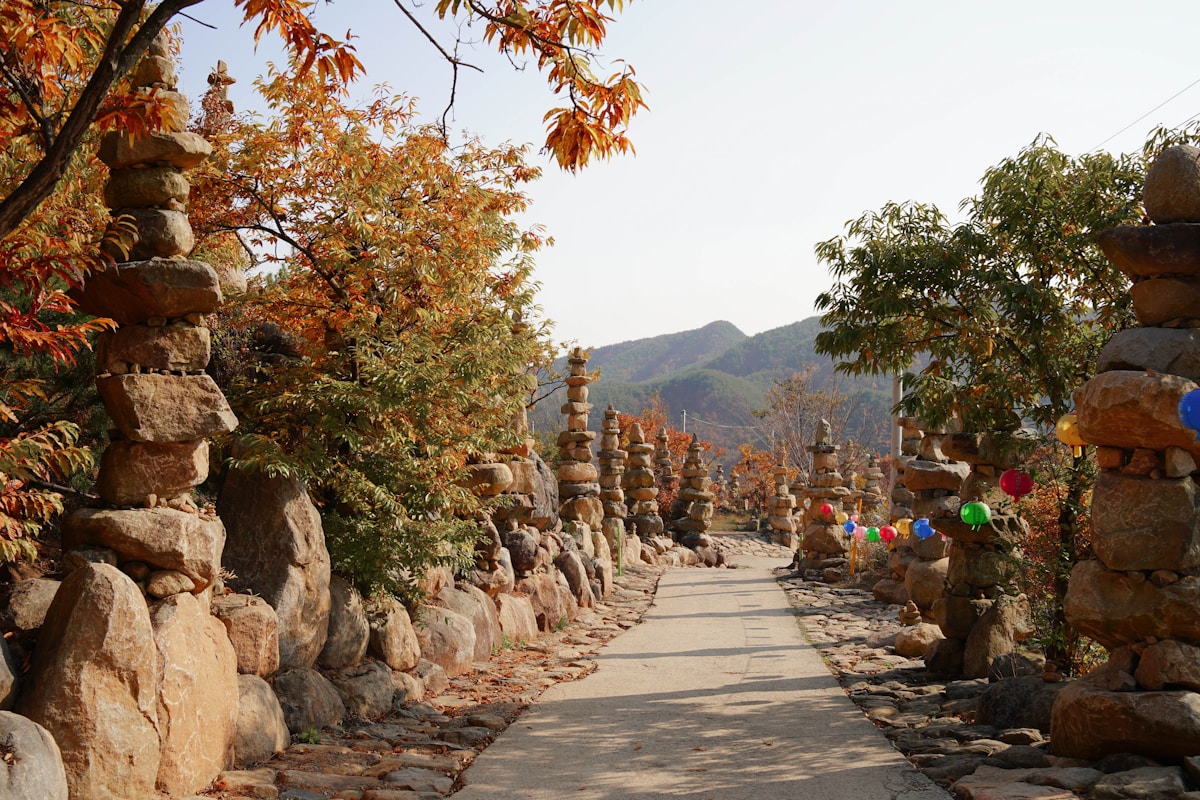
Naejangsan (내장산) in North Jeolla Province is South Korea’s most celebrated autumn foliage destination. Unlike Seoraksan, which draws visitors for its granite peaks, Naejangsan’s reputation rests entirely on its maples (단풍나무). The park’s main valley is lined with trees that form a complete overhead canopy by early November, turning the approach trail into the most photographed autumn scene in the country.
Peak colour at Naejangsan arrives later than anywhere else in Korea — typically late October to mid-November, with the maple tunnel usually at its best in the first two weeks of November. This makes it the natural final stop on Korea’s six-week autumn colour wave, which begins at Seoraksan in late September and works its way south over six weeks.
The Maple Tunnel
The park’s defining feature is the maple tunnel (단풍 터널), a half-kilometre corridor along the main valley path where the maple canopy forms a complete arch overhead. On a calm November morning, light filtering through red leaves onto the stone path and stream below is extraordinary — the kind of scene that genuinely matches the photographs that have made Naejangsan famous.
The tunnel begins approximately 800 metres from the main gate and extends to the foot of the valley. The trail is flat and paved for most of its length, with the stream running alongside. Weekdays in early November see a fraction of the weekend crowds and allow a far more atmospheric experience.
A shuttle bus operates from the main parking area to the trail entrance (KRW 1,000 one way, KRW 2,000 return). It saves 20 minutes of walking along the access road and is worth taking on busy autumn weekends when the shuttle queue is shorter than walking alongside buses.
Entry fee: KRW 3,000 per adult, KRW 1,000 for children (as of 2026). Parking costs KRW 3,000 additional for car visitors.
Uhwajeong Pavilion
At the far end of the maple tunnel sits Uhwajeong Pavilion (우화정), a traditional wooden structure on the bank of a small reservoir. The pavilion reflected in still water, framed by red maples overhead, is one of Korea’s most recognisable autumn images — and earns its reputation on a clear, windless morning when the reflection is mirror-perfect.
The pavilion dates to the Joseon Dynasty and has been rebuilt several times. Entry is included in the general park ticket. From Uhwajeong, a path continues uphill toward the main hiking trails and the Naejangsa Temple complex. Many visitors turn back at the pavilion; those continuing will find the trails above progressively quieter.
Hiking Trails
Naejangsan’s ridge system connects eight named peaks, the highest being Sinseonjae at 763m. The trails are less technically demanding than Seoraksan but are steep in places and require proper footwear.
Naejangsa Temple Trail (1.2km from park entrance, one way) — the easiest option. A mostly flat path leads to Naejangsa Temple, the main Buddhist complex inside the park. The temple grounds are surrounded by old maples and are striking in their own right. Entry donation requested; the walk takes under an hour return.
Sinseonjae Ridge Route (8km loop, 4–5 hours) — the main full-day option. The trail gains the ridge, traverses above the valley giving views down into the maple canopy, then descends back to the entrance. Moderate difficulty; trail is marked but requires careful footing on exposed ridge sections. Best done in the morning before afternoon cloud moves in.
Geumseondae via Naejangsa (6km round trip, approximately 3 hours) — a mid-level route reaching a viewpoint above the valley without committing to the full ridge traverse. A good choice for those who want something beyond the tunnel walk but lack a full day.
Trail conditions change with season. Check the Korea National Park Service website (knps.or.kr) before visiting for any closures.
Naejangsan Autumn Foliage Festival
The Naejangsan Autumn Foliage Festival (내장산 단풍축제) runs in late October to early November, timed to the maple peak. The headline event is evening illumination of the maple tunnel — LED lighting transforms the leaf canopy after dark, producing a different visual entirely from the daytime visit.
The festival includes traditional performances, local food stalls (hotteok, bindaetteok, jeon), and a photography competition. A separate night entry ticket is required for the illumination sessions, typically running 18:00–21:00 (approximately KRW 2,000 additional in recent years).
Festival dates are published annually by Jeongeup City in September. Check jeongeup.go.kr for confirmed dates each year.
Go on a Tuesday or Wednesday if possible. Naejangsan on peak autumn weekends is among the most congested parks in the country — shuttle bus queues of 30 minutes are not unusual and the tunnel itself fills with visitors. Mid-week mornings offer a genuinely different experience: quieter paths, better light, and the satisfaction of seeing it properly.
Getting to Naejangsan
From Seoul (recommended):
- KTX from Seoul Station to Jeongeup: approximately 1 hour 30 minutes, from KRW 35,000 each way
- Local bus 171 or 171-1 from Jeongeup Station to Naejangsan Bus Terminal: 30 minutes, KRW 1,200
- Shuttle bus or walk from the terminal to the park gate: 10–20 minutes
A 07:00 KTX departure from Seoul arrives in Jeongeup by around 08:30, putting you at the park entrance by 09:30.
From Gwangju: Gwangju is the nearest large city — intercity buses run regularly to Jeongeup (approximately 40 minutes, KRW 3,000). Gwangju has a wider range of accommodation than Jeongeup if you want a comfortable base for two days in the region.
From Jeonju: KTX or intercity bus from Jeonju to Jeongeup takes around 30 minutes (bus from approximately KRW 2,600). Jeonju is the most popular overnight base for combining Naejangsan with the Hanok Village.
Where to Stay
Jeonju (30 minutes from Jeongeup) is the best overnight base. It combines Naejangsan day trips with the Jeonju Hanok Village — arguably the best hanok district in Korea — and has excellent jeonju bibimbap restaurants. Hotels in Jeonju from KRW 50,000 per night.
Jeongeup city has budget guesthouses from approximately KRW 35,000 (USD 26) per night, clustered near the train station. Limited dining and atmosphere compared to Jeonju, but 15 minutes closer to the park.
Naejangsan Village (at the park entrance) has a handful of pensions and guesthouses priced KRW 60,000–100,000 per night. Convenient for early morning access before crowds arrive, and for the evening illumination festival without needing to worry about the last bus back.
Planning Your Visit
Naejangsan is the natural final stop on a North-to-South Korea autumn itinerary: start at Seoraksan in early October, move to Seoul and Nami Island in mid-October, and end at Naejangsan in late October to early November for the maple peak.
See the full South Korea autumn foliage guide for a regional timing breakdown and multi-destination planning. Guided day trips from Seoul to Naejangsan are available for those who prefer not to manage the KTX connections independently — small-group options typically depart early and cover transport, park entry, and a guided valley walk.