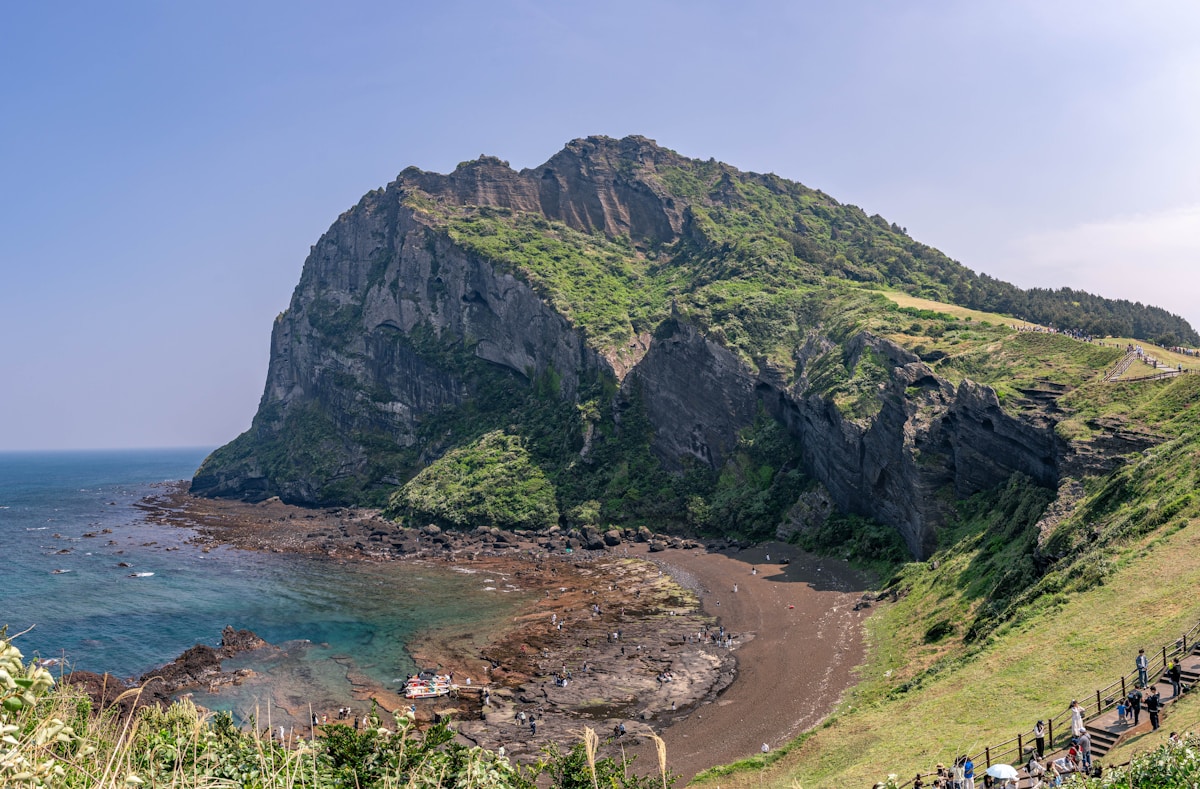
Jeju’s most rewarding day trips take you to three fundamentally different landscapes: the volcanic sea crater of Seongsan Ilchulbong, the underground lava world of Manjanggul Cave, and the cloud-clearing heights of Hallasan. All three are UNESCO World Heritage sites or within the same designation area. A rental car gives you the most flexibility, but buses serve all three from Jeju City if you plan the schedule carefully.
Seongsan Ilchulbong (성산일출봉)
Entry fee: KRW 5,000 per adult | Opening hours: 07:00–20:00 (last entry 19:00) in summer; 07:30–19:00 in winter Distance from Jeju City: 70 km east — approximately 1 hour 20 minutes by intercity bus (KRW 3,600), 1 hour by car Bus: Intercity buses from Jeju City Bus Terminal toward Seongsan; stop at Seongsan Ilchulbong entrance
Seongsan Ilchulbong (Sunrise Peak) is the most visited attraction on Jeju Island. The 182-metre tuff cone formed 5,000 years ago by an underwater volcanic eruption, and the result is a near-perfect circular crater sitting right on the ocean’s edge. The 99 rocky peaks around the crater rim give it a distinctive crown-like profile recognisable from every angle.
The climb from the entrance takes 20–25 minutes on a paved and stepped path. The crater rim opens onto a wide green bowl — Jeju’s version of a volcanic caldera — and on clear days the view extends across the ocean to Udo Island and the mainland coastline on the horizon. A haenyeo (female diver) demonstration typically runs at the base of the cliff below the crater, usually around 13:00 and 14:00 — check the board at the entrance for the day’s schedule.
For sunrise: The crater is most famous at dawn when the sun rises directly behind the peak from the sea. Sunrise viewing draws large crowds, particularly during the national Sunrise Festival on New Year’s Day. The access gate opens before official hours for sunrise visitors — arrive at the base 30–40 minutes before sunrise to allow for the climb. Exact opening times for sunrise entry are posted at hallasan.go.kr and seongsan.jeju.go.kr.
Seopjikoji: If you have a car, the Seopjikoji headland is 10 minutes east of Seongsan. The 2.4-km coastal walk along the cliffs (free entry) passes rapeseed flower fields in spring and offers views back toward Seongsan across the sea. The café and accommodation cluster here was used as a film set for multiple Korean dramas.
Manjanggul Cave (만장굴)
Entry fee: KRW 4,000 per adult, KRW 2,000 children | Opening hours: 09:00–18:00, closed Tuesdays Distance from Jeju City: 30 km northeast — approximately 40 minutes by car, 1 hour by bus Bus: Intercity bus Route 701 from Jeju City, stop at Gimnyeong or Manjanggul
Manjanggul is part of the Geomunoreum Lava Tube System, a network of interlocking lava tunnels formed roughly 300,000 years ago when lava flows from Geomunoreum volcano cooled on the outside while continuing to flow inside, eventually draining to leave hollow tubes. The full system runs 7.4 km, but the public section is the 1 km section from the cave’s second entrance.
The cave is large — up to 23 metres wide and 30 metres high in places. The path is mostly flat with some uneven sections. Bring a layer: the cave maintains approximately 11°C year-round regardless of outside temperature, which is refreshing in summer but cold if you are in summer clothing. Most visitors take 45–60 minutes for the out-and-back walk, though a slower pace to look at formations adds time.
Geological highlights along the route:
- Lava formations along the walls and ceiling, including “lava benches” left by successive flow levels
- Roof collapses creating portholes of daylight midway through the tunnel
- The lava column at the far end: 7.6 metres tall, the world’s tallest known lava stalagmite, formed by dripping calcium-rich water over thousands of years
The first entrance (closest to the car park) leads to a section closed to the public. Walk to the second entrance — signposted and about 400 metres from the car park. Torches are not needed; the 1-km public section is lit throughout.
Nearby: Bijarim Forest (비자림), 8 km southwest of Manjanggul, is a dense grove of 2,800-year-old bijarim (nutmeg yew) trees — the largest such grove in Korea. Entry KRW 1,000 per adult. The shaded path takes about 45 minutes to walk. A reasonable half-day pairs Manjanggul Cave in the morning with Bijarim Forest before lunch.
Hallasan National Park (한라산국립공원)
Entry fee: Free | Summit trail reservation: Required via hallasan.go.kr (summit routes only) Distance from Jeju City: Seongpanak trailhead is 24 km from Jeju City; Gwaneumsa is 26 km
Hallasan at 1,950m is the highest mountain in South Korea, and a full summit hike to the crater lake Baengnokdam is one of the most rewarding day hikes in the country. The mountain’s shield volcano profile rises gradually from the island’s coastal lowlands through five vegetation zones — tropical forest at the base, deciduous mixed forest in the middle elevations, subalpine dwarf forest near the summit, and bare rock and alpine shrubs at the top.
Trail options:
Seongpanak Trail: 9.6 km each way, 4–5 hours up, 3–4 hours down. The gentler, longer route. Well-paved for most of its length. Summit entry cutoff is 12:00 (no entry after noon to ensure hikers are off the mountain before dark). Start no later than 07:00 for a comfortable day.
Gwaneumsa Trail: 8.7 km each way, 4–5 hours up, 3–4 hours down. Steeper, more technical in the upper sections. Rocky scrambling near the crater rim. Summit entry cutoff is 13:00. Arguably the more dramatic scenery, particularly the valley section through Tamna Valley.
One-way traverse (most popular option): Up Seongpanak, down Gwaneumsa. Requires two separate transport arrangements — the trailheads are on opposite sides of the mountain. Total walking distance approximately 18 km.
Eorimok and Yeongsil Trails: These two mid-elevation trails do not reach the crater. They are walk-up, no reservation needed. Eorimok (5.1 km one-way) reaches Witse Oreum at 1,713m with views of the summit but not the crater. Yeongsil (5.8 km one-way) reaches the same area. Both can be combined in a loop. These are the right choice for visitors who want mountain scenery without the commitment of a full summit hike.
Equipment: Layers are essential regardless of season — the summit is typically 8–12°C cooler than the coast. Trail shoes or hiking boots required for Gwaneumsa; trail runners are adequate for Seongpanak. Water and snacks from Jeju City — there are no vendors beyond the shelter at the Witse Oreum junction. The Baengnokdam crater shelter sells limited drinks.
Other Recommended Day Trips
Cheonjiyeon Waterfall (천지연폭포): 22-metre waterfall on the outskirts of Seogwipo. Entry KRW 2,000 per adult. Open 09:00–22:00. The evening illuminations make it one of the few waterfalls in Korea worth visiting after dark. The path to the falls (10-minute walk each way) passes through subtropical vegetation including Jeju’s native needle palm.
Jeongbang Waterfall (정방폭포): The only waterfall in East Asia that falls directly into the ocean, 1 km east of Seogwipo city centre. Entry KRW 2,000 per adult. Open 09:00–18:00. Shorter walk than Cheonjiyeon, and the falls themselves are more dramatic — 23 metres of water dropping straight into the sea.
Udo Island (우도): A small island 3.8 km off Seongsan accessible by ferry (approximately KRW 7,700 round trip as of 2026, plus KRW 5,000 boarding fee for Jeju residents, foreigners pay KRW 7,700). Rent an electric scooter on the island (KRW 15,000 per hour) to cover its perimeter in 2–3 hours. Udo peanuts and ice cream are the local specialty — stalls along the main path sell both.
Day Trip from Jeju City: Logistics
By car: all east coast sites (Seongsan, Manjanggul, Udo) are 1–1.5 hours from Jeju City. The drive around the north coast on Route 12 is scenic and rarely congested outside summer weekends.
By bus: Jeju City Bus Terminal serves Seongsan directly (Route 701, 1 hour 20 minutes, KRW 3,600) and Manjanggul requires one transfer. Plan 2 hours travel each way for bus-based itineraries and limit yourself to one major attraction per direction.
See also: Hallasan hiking in detail | Getting around Jeju