Jeju Island is roughly 73 km east-to-west and 41 km north-to-south — compact enough to drive around in a day, but awkward to cover entirely by public transport. The right choice depends on how many attractions you plan to hit and how much of the island’s rural interior you want to see.
Public Bus
Jeju operates two types of bus service: intercity express buses and local village buses. Both run on a fixed schedule and use a tap-in tap-out system — load credit onto a T-money or Cashbee transit card at any convenience store before you start.
Intercity express buses (간선버스) connect Jeju City with major destinations:
- Jeju City to Seongsan: approximately 1 hour 20 minutes, KRW 3,600 one-way (as of 2026)
- Jeju City to Seogwipo: approximately 1 hour, KRW 3,000 one-way
- Jeju City to Hyeopjae Beach: approximately 50 minutes, KRW 2,500 one-way
Local village buses (지선버스) run between towns and smaller settlements with shorter routes. These cost KRW 1,200–1,800 per trip and supplement the express network for getting to trailheads, smaller beaches, and rural areas not served by express lines.
Bus frequency varies. On the main Jeju City–Seogwipo and Jeju City–Seongsan corridors, you can expect a bus every 15–30 minutes during daylight hours. On village routes, the gap can be 60–90 minutes — always check the schedule at the stop or via the Jeju Bus app (available in English).
Practical limitations: buses stop at the roadside closest to an attraction, not the entrance itself. Manjanggul Cave, for example, requires a 10-minute walk from the bus stop. Seongsan Ilchulbong is similarly a short walk from the main road. Factor this in when planning timing.
Car Rental
Renting a car is the most practical way to see Jeju efficiently, particularly if you plan to combine east and west coast attractions in the same day. Most visitors who rent report that flexibility alone is worth the cost.
Typical daily rates as of 2026:
- Economy car (Hyundai Morning or similar): KRW 40,000–55,000 per day
- Mid-size sedan (Avante/K3): KRW 55,000–75,000 per day
- SUV (Tucson/Sportage): KRW 80,000–120,000 per day
- Electric vehicles (Ioniq 5, EV6): KRW 90,000–130,000 per day — charging stations are well-distributed across the island
Main rental companies at Jeju Airport:
- Lotte Rent-a-Car — large fleet, English-language booking online
- SK Rent-a-Car — competitive pricing on economy vehicles
- Jeju Car — local operator, sometimes cheaper, less English support
- Global rental brands (Hertz, Avis, Enterprise) — available but typically more expensive than Korean operators
Requirements: a valid driving licence from your home country plus an International Driving Permit issued before travel. Minimum driver age is 21 at most companies. Fuel is petrol (gasoline) unless you specifically book diesel or EV; petrol costs approximately KRW 1,650–1,750 per litre at Jeju stations as of 2026.
Parking: most major attractions charge KRW 1,000–3,000 per entry. Seongsan Ilchulbong has a large paid car park. Hyeopjae and Hamdeok beaches charge KRW 2,000–3,000 during peak summer months (July–August). Roadside parking near Jeju City is limited — use designated car parks.
Taxi
Taxis in Jeju operate on the standard Korean metered system. The base fare is KRW 4,000 (as of 2026) and increases by KRW 100 per 132 metres after that. Night surcharges of 20% apply from midnight to 04:00.
Typical fares for common routes:
- Jeju Airport to central Jeju City: KRW 6,000–9,000 (15–20 minutes)
- Jeju City to Yongduam Rock: KRW 5,000–7,000 (10 minutes)
- Jeju Airport to Jungmun Resort area: KRW 35,000–45,000 (45 minutes)
- Seongsan town to Seongsan Ilchulbong entrance: KRW 3,500–5,000 (5 minutes)
For longer cross-island journeys, negotiate a fixed charter rate before setting off — many drivers will agree to a half-day or full-day charter for KRW 80,000–120,000. This gives you a driver who knows the roads and eliminates metered uncertainty. Ask your hotel reception to call ahead or use the Kakao T app, which lists charter options in some areas.
Taxi availability is good in Jeju City and around major attractions. In rural areas and on the east coast beyond Seongsan, taxis become scarce — do not rely on hailing one at the roadside. Book via app or have your accommodation call one.
Scooter and Bicycle Rental
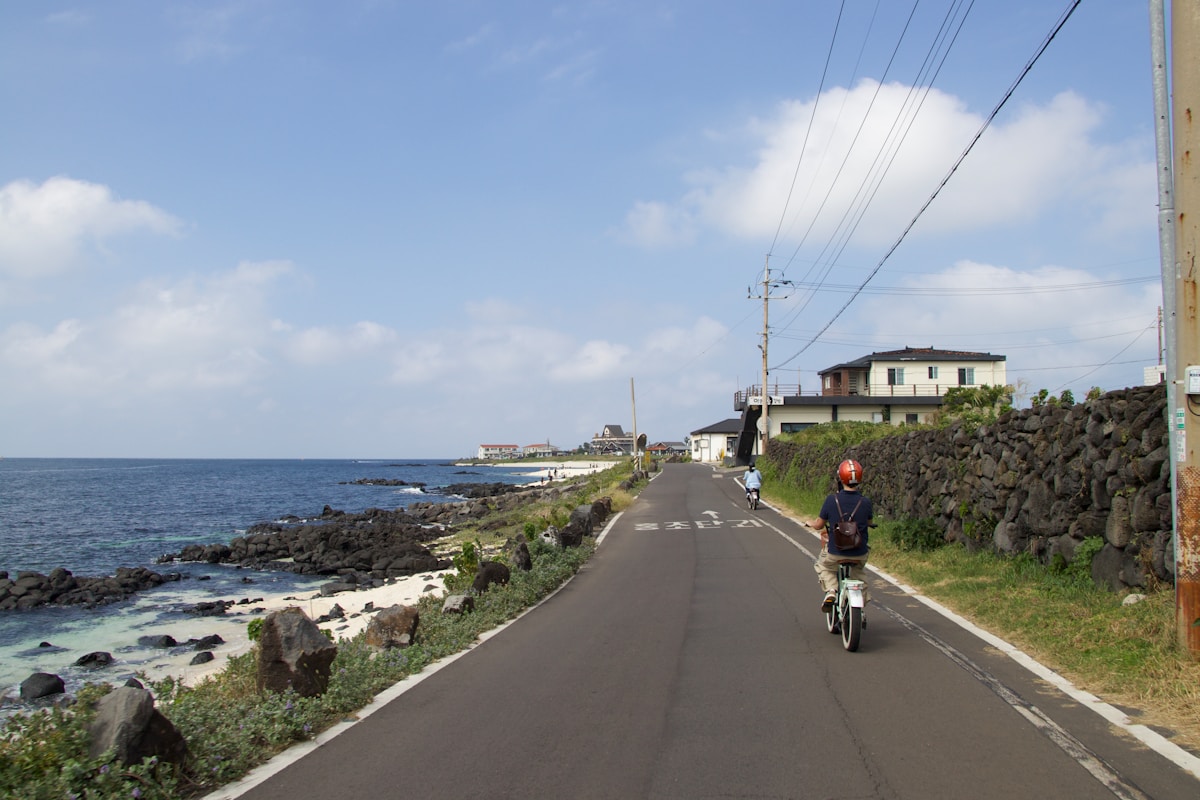
Electric scooters and bicycles are available near Jeju City and at resort areas. E-bikes are popular for the Jeju Olle Trail sections near the coast. Rental rates:
- Manual bicycle: KRW 15,000–20,000 per day
- Electric bicycle: KRW 25,000–35,000 per day
- 50cc scooter: KRW 30,000–40,000 per day (requires motorcycle licence)
- Electric scooter (under 50cc, no licence required): KRW 25,000–35,000 per day
The coastal road around Jeju (Route 12) is well-maintained and flat enough for cycling in sections. Riding the entire 255 km perimeter is a multi-day endeavour — most visitors cycle one or two sections and use buses or taxis for transfers.
Planning Your Route
A typical efficient approach for a 3–4 day Jeju visit:
- Day 1: Rent a car at the airport and drive east — Seongsan Ilchulbong, Manjanggul Cave, Seopjikoji cliff walk
- Day 2: West coast — Hyeopjae Beach, Biyangdo ferry, Hallim Park, Cheonjeyeon Waterfall
- Day 3: South coast — Seogwipo city, Jeongbang Waterfall, Yakcheonsa Temple, Jungmun Beach
- Day 4: Return car, Jeju City sightseeing by taxi/bus — Dongmun Market, Yongduam Rock, Samseonghyeol
For a one or two day visit, a guided day tour covers the highlights without the stress of driving — Jeju Island tours typically run KRW 35,000–65,000 per person including transport.
For where to stay during your visit, see our Jeju accommodation guide.