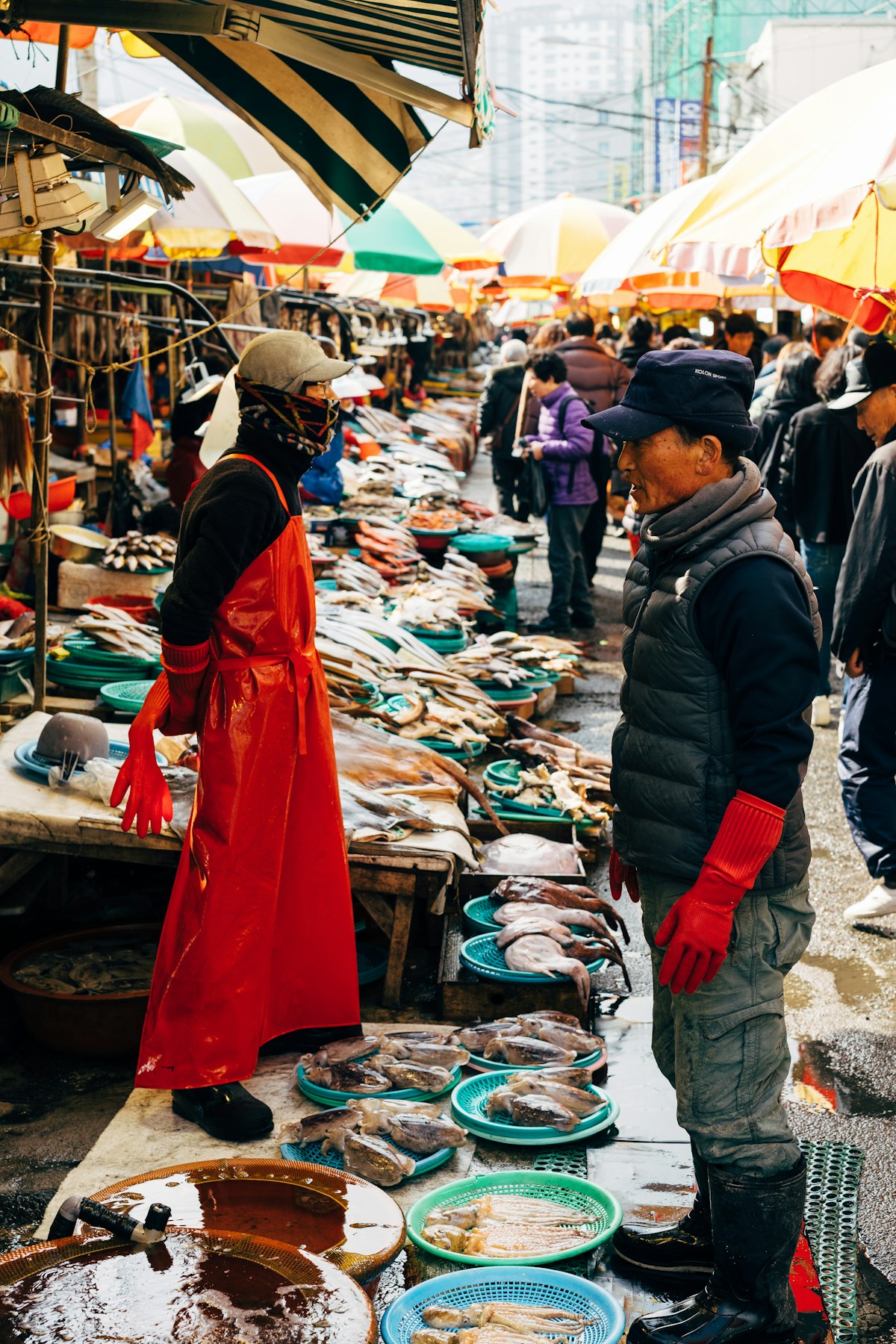
Busan’s food identity is built more firmly around the sea than any other major Korean city. Decades of fishing port culture have produced a cuisine that emphasises fresh seafood, briny broths, and robust flavours. The city also gave Korea two of its most distinctive regional dishes - milmyeon and dwaeji gukbap - both of which trace their origins to the Korean War period. Here is a guide to what to eat in Busan and where to find it, with prices current as of 2026.
Milmyeon (Cold Wheat Noodles)
Milmyeon is Busan’s signature cold noodle dish - thin wheat noodles served in an icy beef broth, typically with sliced beef, cucumber, a boiled egg, and mustard on the side. The dish was developed during the Korean War period when buckwheat (normally used for naengmyeon) was scarce and wheat flour was substituted.
The noodles have a firm, almost chewy texture and the broth is deeply savoury. It is traditionally eaten cold or with ice, even in winter, which distinguishes Busan milmyeon culture from other Korean cold noodle traditions.
Good milmyeon is found at specialist restaurants around the Seomyeon and Gaegeum areas. A standard bowl costs approximately KRW 9,000–12,000 as of 2026. Ojung Milmyeon (near Gaegeum station) is frequently cited as one of the best, though there are strong local contenders in every Busan neighbourhood.
Dwaeji Gukbap (Pork and Rice Soup)
Dwaeji gukbap is a pork bone broth soup served with rice, which can be added directly to the broth. It is a Busan morning staple - the dish is commonly eaten for breakfast by locals and is available from early morning at specialist restaurants, most of which open by 06:00 or 07:00.
The broth is opaque and rich, made from long-simmered pork bones, and the meal comes with an array of banchan (side dishes) including kimchi, sliced green onion, and fermented shrimp paste for seasoning to taste. A full bowl with rice and sides costs approximately KRW 10,000–14,000 as of 2026.
The Seomyeon area has a strong concentration of dwaeji gukbap restaurants, particularly along the streets east of Seomyeon metro station. Some restaurants have operated continuously for decades and open through the night.
Raw Fish (Hoe) at Jagalchi Market
Jagalchi Fish Market is Busan’s largest and most famous seafood market, operating daily from approximately 05:00 to 22:00. The ground floor holds stalls with tanks of live seafood - flatfish, sea urchin, octopus, crab, abalone, various shellfish - which buyers select and take upstairs to the restaurant area to be prepared as hoe (raw fish, similar to sashimi).
Prices depend on the type of fish and market conditions. Flatfish (gwang-eo) is the most common choice and is priced by weight - expect approximately KRW 20,000–40,000 for a portion sufficient for two people as of 2026. Add the restaurant preparation fee (approximately KRW 5,000–10,000) and banchan side dishes for the full cost.
The best time to visit is early morning or late afternoon when stall selection is at its broadest. The fish market is busiest with locals on weekday mornings; tourist numbers peak on weekend afternoons.
Millak Raw Fish Town, near Gwangalli Beach, is a less touristy alternative with about 30 seafood restaurants in a dedicated building. The atmosphere is more local and prices are competitive.
Ssiat Hotteok (Seed-Filled Sweet Pancakes)
Ssiat hotteok is a Busan-origin street food - a variation of the standard Korean hotteok (sweet filled pancake) that uses a mixture of seeds (sunflower, sesame, pumpkin) instead of the traditional brown sugar and cinnamon filling. The version from Busan’s BIFF Square is particularly famous.
The pancakes are fried on a griddle and served in a paper cup, crispy on the outside and slightly chewy within. A single ssiat hotteok costs approximately KRW 2,000–3,000 as of 2026. The original vendor at BIFF Square (in Nampodong) draws long queues on weekends.
Ganjang Gejang (Soy-Marinated Raw Crab)
Ganjang gejang is raw crab marinated in soy sauce, garlic, sesame, and chilli - served cold, eaten as a side dish or with rice. It is intensely savoury and the texture is unique: the raw crab meat is soft and almost liquid in the claws after marinating. It is sometimes called “rice thief” (bap doduk) in Korean because it makes people eat more rice than they intend to.
It is widely available at traditional Korean restaurants throughout Busan. Expect to pay approximately KRW 15,000–25,000 for a portion as a shared dish as of 2026. Quality varies significantly - the best versions use fresh local crab. Haeundae’s restaurant strip has several specialists.
Dongrae Pajeon (Green Onion Pancake)
Pajeon (green onion pancake) is made throughout Korea, but the Dongrae district of northern Busan has a specific tradition of thick, rich pajeon made with a more generous egg-to-batter ratio and packed with green onion. Dongrae pajeon is typically eaten with막걸리 (makgeolli, milky rice wine).
Specialist restaurants in the Dongrae area serve the dish, which costs approximately KRW 12,000–20,000 per pancake as of 2026. The pancakes are substantial - a single one typically serves two to three people as a shared starter or side dish.
Corn Dogs and Street Food at BIFF Square
BIFF Square (Busan International Film Festival Square) in Nampodong is a pedestrianised strip most associated with the annual October film festival, but functions year-round as a street food zone. The area’s corn dog vendors - selling battered sausage and mozzarella sticks - have developed a following beyond the ssiat hotteok original.
Korean-style corn dogs (hotdog-style but in a thicker, breadcrumb-coated batter) from BIFF Square vendors cost approximately KRW 3,000–5,000 each as of 2026. Options include plain, mozzarella-filled, rice cake-wrapped, and potato-coated variants.
The surrounding Nampodong streets have a dense concentration of street food stalls selling tteokbokki, odeng (fish cake on a skewer), and sundae (blood sausage).
Gukje Market Food Section
Gukje Market (International Market) in Nampodong is Busan’s oldest traditional market, dating to the Korean War period when displaced people set up stalls to sell whatever they had. The food section occupies covered alleys and offers a wide range of snacks and light meals.
Key things to try here include:
- Ureong ttang - a traditional Busan soup made with sea urchin and seaweed, available at a handful of stalls. Approximately KRW 8,000–10,000 as of 2026.
- Kkanpunggi - crispy fried chicken with a spicy garlic sauce, usually available at several stalls
- Hotteok - standard version alongside the Busan ssiat variation
- Bindaetteok (mung bean pancakes): KRW 4,000–6,000 per portion
Book guided tours and activities in Busan through GetYourGuide.
Pick up an eSIM for South Korea to stay connected throughout your trip - Airalo offers easy top-up plans.
Seafood at Gwangalli Beach
The restaurants along Gwangalli Beach promenade serve a broader range of food than Jagalchi - seafood, Korean BBQ, and western-influenced café food - at generally more moderate prices than the Haeundae restaurant strip. A few specialist raw fish restaurants face the beach directly.
For a straightforward seafood dinner near Gwangalli, look for the small restaurants on the side streets directly behind the beach promenade rather than the more prominent seafront units, which tend to charge a premium for the view.
For the full picture of Busan’s neighbourhoods and attractions, see things to do in Busan. For accommodation, read our Busan where to stay guide.