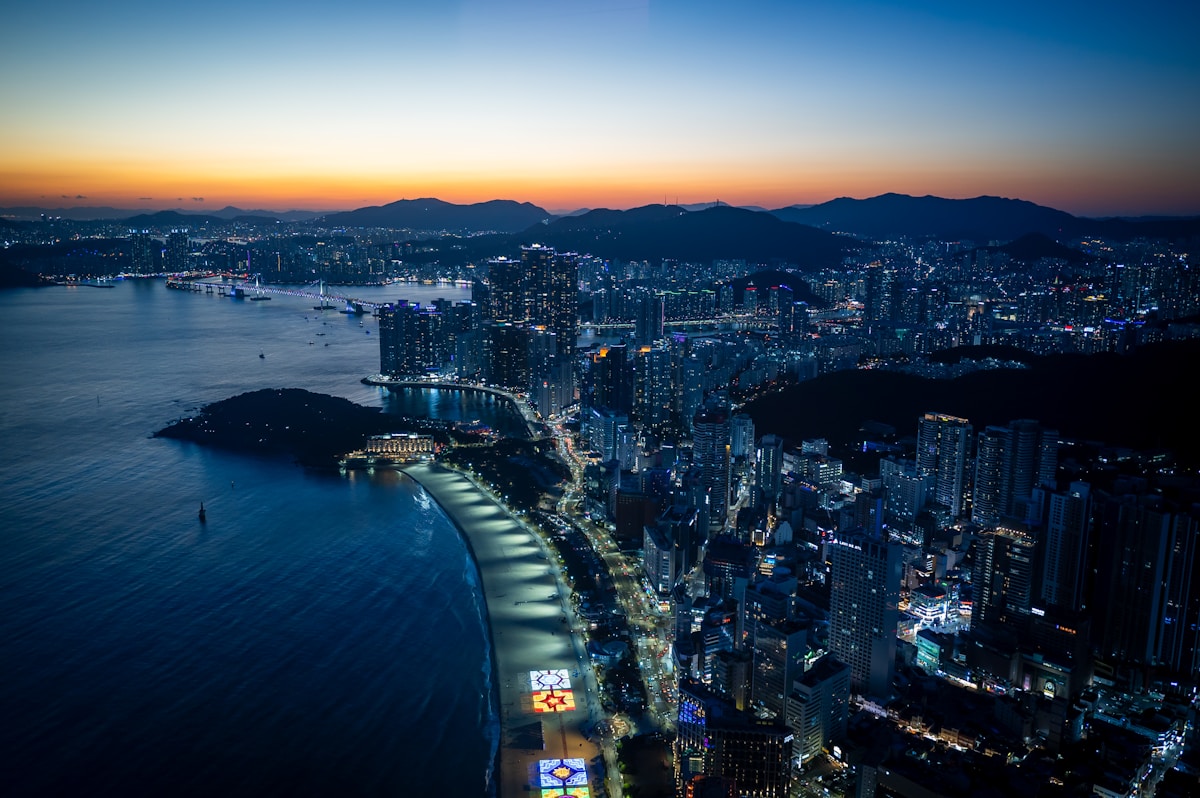
Busan is Korea’s second city and its largest port — a genuinely different travel experience from Seoul, with a coastline, mountains, and a street-food culture anchored by the sea. Accommodation spreads across several distinct districts, each with a different character and a different relationship to the city’s main attractions.
Busan’s Main Accommodation Zones
Haeundae is Busan’s most famous beach district and its luxury hotel corridor. The 1.5km Haeundae Beach is flanked by high-rise hotels, and on summer weekends it draws enormous domestic crowds. Outside peak season — September to November and April to June — it is a genuinely scenic base, with the APEC Naru Park, Dongbaekseom Island, and the Aquarium all walkable. The Haeundae subway station (Line 2) connects to the rest of Busan in approximately 30-40 minutes.
Gwangalli sits about 15 minutes west of Haeundae along the coast and has a noticeably younger, more independent character. The beach is slightly smaller but the Gwangandaegyo (Diamond Bridge) illuminations are an evening spectacle. The café and bar strip along the beachfront road attracts Busan’s creative and university crowd. Accommodation ranges from guesthouses to boutique hotels; mid-range options here often undercut equivalent Haeundae properties.
Seomyeon is Busan’s central commercial and transport hub, roughly equidistant between the port area and Haeundae. Lines 1 and 2 intersect here, making it the most connected base in the city. Department stores, a dense restaurant district, and a strong underground food market are all within walking distance. It is the most practical base for visitors who want to cover multiple districts in a short trip.
Nampo-dong and Gwangbok cover Busan’s old downtown, near the Jagalchi Seafood Market, BIFF Square (Busan’s cinema heritage district), and the ferry terminal for Yeongdo Island. This is the most atmospheric and budget-friendly core area — guesthouses and smaller hotels are common, and the street food density is the highest in the city.
Centum City is a modern commercial district between Seomyeon and Haeundae, home to Shinsegae Centum City (one of the world’s largest department stores), the BEXCO convention centre, and the Busan Cinema Centre. It suits travellers attending events, conferences, or business meetings, and is an increasingly popular mid-range hotel zone.
Budget Hotels: Approximately KRW 40,000–120,000 Per Night (USD 30–90)
Ibis Ambassador Busan City Centre — A reliable Accor budget hotel in the Bujeon area of Seomyeon, directly across from Exit 1 of Bujeon Subway Station (Lines 1 and 2). Compact, clean rooms with consistent brand standards. A sensible base for transit-heavy itineraries or short city stays. From approximately KRW 65,000–120,000 per night as of 2026.
Ibis Ambassador Busan Haeundae — The Haeundae-positioned Ibis property, within walking distance of the beach. Sea-view premiums make this slightly pricier than the city-centre equivalent, but it gives access to the beach without full resort pricing. From approximately KRW 80,000–140,000 per night as of 2026.
What to Expect at the Budget End
Budget guesthouses and jimjilbang-adjacent accommodation are common in Nampo-dong and Seomyeon. Independent guesthouses in these areas typically offer private rooms from KRW 35,000-70,000 per night, with shared bathrooms and basic breakfasts. Standards vary — guest reviews on Booking.com are the most reliable current indicator for smaller properties.
Mid-Range Hotels: Approximately KRW 120,000–280,000 Per Night (USD 90–210)
Novotel Ambassador Busan — A solid upper-mid-range property in the Seomyeon district, part of the Accor group. Well-placed for the subway network and the Seomyeon commercial strip. Multiple dining options, an indoor pool, and professional service. Consistently strong ratings from business and leisure travellers alike. From approximately KRW 140,000–260,000 per night as of 2026.
Commodore Hotel Busan — A long-established hotel near Busan Station and the port, with views of Busan Bay. An indoor pool, sauna facilities, and a relaxed standard that suits travellers exploring the Jagalchi and Nampo-dong area on foot. The location near the main KTX rail station (Busan Station, connecting to Seoul) makes it practical for one-night stopovers. From approximately KRW 120,000–220,000 per night as of 2026.
Grand Josun Busan — A relatively newer five-star property positioned between Haeundae and Centum City. Modern architecture, a rooftop pool, strong dining options, and a polished service standard. Rates occasionally fall into upper-mid-range territory outside of peak season, making it one of the better-value entries in Busan’s luxury tier. From approximately KRW 200,000–400,000 per night as of 2026.
Luxury Hotels: Approximately KRW 300,000–700,000+ Per Night (USD 225–525+)
The Westin Josun Busan (Haeundae) — The Westin Josun sits directly on the Haeundae beachfront and is consistently rated as one of Busan’s finest hotels. An indoor pool, children’s pool, fitness centre, and multiple dining venues. Sea-facing rooms offer direct Haeundae views; couples rate the location particularly highly. From approximately KRW 350,000–650,000 per night as of 2026.
Park Hyatt Busan (Haeundae Marina) — A striking architectural tower above Busan Marina, approximately 1.2km from Haeundae Beach. An indoor pool, Lumi Spa and Fitness (seven treatment rooms), and a design-forward aesthetic distinguish it from the larger resort competitors. Free private parking is available, and the marina views are among the most dramatic in the city. From approximately KRW 380,000–700,000 per night as of 2026.
Lotte Hotel Busan (Seomyeon) — Attached to Lotte Department Store and a five-minute walk from Seomyeon Subway Station, this is the flagship luxury option for the city-centre location. An indoor and outdoor pool, sauna, fitness centre, and an on-site duty-free store and cinema complex. More urban than the Haeundae beach hotels, but well-positioned for the transport network and the BIFF Square evening scene. From approximately KRW 320,000–600,000 per night as of 2026.
Getting to Your Hotel from Busan Gimhae Airport
The Busan–Gimhae Light Railway (BGL) connects Gimhae Airport to Sasang Station on Metro Line 2. From Sasang, the journey to Seomyeon Station takes approximately 15 minutes; to Haeundae Station approximately 40-45 minutes. The full BGL and metro journey costs approximately KRW 2,500-3,500 as of 2026.
Airport limousine buses offer direct services to Haeundae (approximately 40 minutes, KRW 6,000 as of 2026) and to Seomyeon and the city centre (approximately 30 minutes, KRW 5,000 as of 2026). These are the most luggage-friendly option.
Taxis from the airport to Seomyeon cost approximately KRW 18,000-25,000; to Haeundae approximately KRW 35,000-55,000 as of 2026. Kakao Taxi works in Busan and accepts international cards.
For more detail, see our Busan Gimhae Airport transfer guide.
Getting Around Busan
Busan Metro has two main lines relevant to most visitors: Line 1 (red) runs north-south through the city, connecting Nopo in the north to Dadaepo Beach in the southwest, passing through Seomyeon and Nampo-dong. Line 2 (green) runs east-west, connecting Haeundae through Seomyeon to the airport-interchange at Sasang. A T-money card (used across Korea) covers all metro trips from approximately KRW 1,400-1,600 per ride as of 2026.
Busan City Tour Bus offers circular routes covering Haeundae, Gwangalli, BIFF Square, and Nampo-dong — useful for first-day orientation without navigating the metro.
The Gamcheon Culture Village is most easily reached by bus or taxi from Toseong Station (Line 1); the approach road is steep and walking from the main road adds 20-30 minutes. Kakao Maps is the most reliable navigation tool in Busan.
Booking Tips
Book Haeundae beach-adjacent hotels at least six to eight weeks ahead for late July to mid-August — this is the most demand-compressed period of the year in Busan. The Busan International Film Festival (BIFF, typically early October) fills Centum City and central hotels rapidly; if visiting during the festival, book two to three months ahead.
Shoulder season in Busan is genuinely excellent: April-June offers reliable weather and significantly lower rates than summer, with far thinner crowds on Haeundae Beach. October after BIFF gives similar conditions. Winter (December-February) is mild compared to Seoul — jacket weather, but beach walks remain pleasant.
For things to do in Busan — Gamcheon Culture Village, Haedong Yonggungsa Temple, seafood market experiences, and day trips to Tongyeong — see our Busan activities guide.