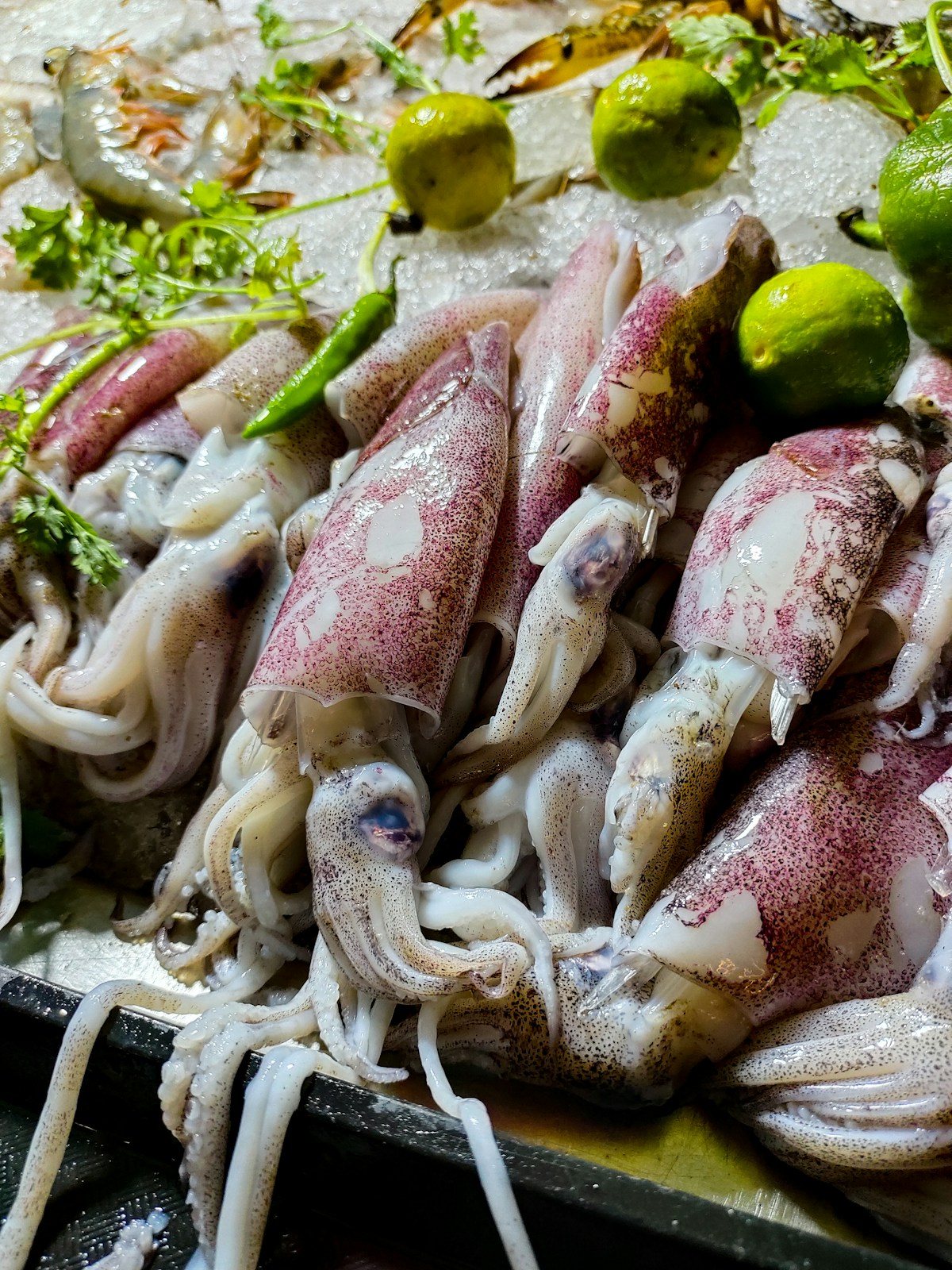
Sokcho’s food scene is defined by its relationship with the East Sea. The city is a fishing port before it is a tourism town, and that shows on the plate - the seafood here is exceptional in freshness and variety. The city also carries culinary traces of its unusual history: the Abai Village community, originally North Korean refugees, brought food traditions from the Hamgyeong region that produced dishes rarely seen anywhere else in the south.
Ojingeo Sundae (Squid Sundae)
Ojingeo sundae is Sokcho’s most distinctive local food - a stuffed squid sundae that has no real equivalent elsewhere in Korea. Whole squid are stuffed with a mixture of glutinous rice, barley, vegetables, and seasoning, then steamed or lightly pan-fried until firm. The texture is substantially different from standard Korean sundae (which uses pig intestine as the casing) - the squid provides a chewier, more toothsome wrapper with its own mild flavour.
The dish originated in Abai Village through the food traditions of the Hamgyeong region of North Korea. It has since become synonymous with Sokcho and is the first thing many Korean visitors eat when they arrive.
Street food stalls near the Sokcho beach area and along the waterfront sell ojingeo sundae at approximately KRW 7,000–10,000 as of 2026. Abai Village itself has several restaurants that serve it as part of a fuller meal. Eat it hot - it loses character quickly as it cools.
Snow Crab (Daege)
Snow crab (대게 - daege) is the prestige seafood of the East Sea and Sokcho is one of the best places in Korea to eat it. The crab is named for its long legs resembling bamboo covered in snow, and is caught in the cold deep waters off the east coast.
The best season runs from October through February, when supply is highest and flavour is at its peak. Summer snow crab is available but less impressive. Prices are quoted per kilogram at Dongmyeong Port market - a medium-sized crab typically comes to approximately KRW 25,000–50,000 as of 2026, with premium large specimens costing considerably more.
Snow crab is served steamed, with the legs cracked at the table and dipped in a salt and sesame oil mixture. It is sweet, delicate, and rich - a very different experience from the stronger, more iodine-forward flavour of blue crab. The Dongmyeong Port market is the best place to compare prices across vendors before committing to a crab.
Raw Fish (Hoe) at Dongmyeong Port
Dongmyeong Port’s raw fish market allows you to select fresh fish from live tanks, have them sliced to order (hoe - Korean-style sashimi), and eat at tables set up in the market itself or at an adjacent restaurant. The most common fish for hoe include flounder (광어 - gwangeо), rockfish (우럭 - ureok), and various seasonal catches.
Korean hoe is served with lettuce wraps, sliced garlic, perilla leaves, gochujang dipping sauce, and doenjang paste. Unlike Japanese sashimi, the Korean tradition pairs the raw fish with strongly flavoured accompaniments - the combination creates a different eating experience.
A modest shared platter for two costs approximately KRW 25,000–40,000 at the port market as of 2026. The cutting and serving fee at market-side eating spots is typically included in the fish purchase price. Arrive in the morning for the best selection.
Grilled Eel at Abai Village
Abai Village’s restaurants serve jangeo-gui - whole eel scored and grilled over charcoal, served with ssam wrapping ingredients and a rich, slightly sweet eel sauce. The dish is common on Korea’s east coast but has a particularly strong association with Abai Village.
Grilled eel is richer and fattier than most Korean seafood, with a texture that takes well to the charcoal cooking method. A single portion typically costs approximately KRW 20,000–35,000 as of 2026 depending on size and the quality of the restaurant.
The Abai Village restaurants are small, often family-operated, and have a genuinely local atmosphere rather than a tourist restaurant feel. The hand-pulled ferry crossing to reach the village adds to the experience. Eat early in the evening - many of the smaller restaurants close by 20:00 or run out of eel before then.
Odeng (Fish Cake) Street Snacks
Odeng (어묵 - also called eomuk) are processed fish cake skewers served in hot anchovy or kelp broth from street carts and stalls. They are a universal Korean street food but are particularly satisfying in Sokcho in cooler weather, given the walking involved in visiting the beach, lake, and port area.
Skewers cost KRW 500–1,000 each and come with a free cup of the hot broth. Street stalls near the beach front and along the market streets operate from late morning through early evening. The broth is replenished throughout the day - fish and skewers replaced as they sell - so the quality stays consistent.
Makgeolli with Pajeon
Sokcho’s makgeolli (traditional Korean rice wine) culture is less developed than in major cities but present, particularly at the seafood restaurants around Dongmyeong Port where pajeon (thick savoury pancakes with spring onion and seafood) are a standard accompaniment.
A liter jug of makgeolli costs approximately KRW 3,000–5,000. Haemul pajeon (seafood pancake) with fresh East Sea seafood additions costs KRW 10,000–15,000 at port-area restaurants. The combination with the sound of the harbour nearby makes for a satisfying early evening meal.
Book guided tours and activities in Sokcho through GetYourGuide.
Pick up an eSIM for South Korea to stay connected throughout your trip - Airalo offers easy top-up plans.
Seoraksan Area Mountain Restaurants
The restaurants around the Seorakdong park entrance area serve the practical needs of hikers - dosirak (packed lunch boxes), bibimbap, and doenjang jjigae (fermented soybean paste stew), typically at prices of KRW 8,000–15,000 per person. These are not destination restaurants, but they are reliable and filling after a long hike.
Some restaurants near the park entrance also serve maeuntang (spicy fish soup) using local East Sea catches, which makes a good post-hike warm-up meal in autumn or spring.
For where to sleep while you eat your way through Sokcho, see our Sokcho where to stay guide. For hiking and sightseeing, read our Sokcho things to do guide.