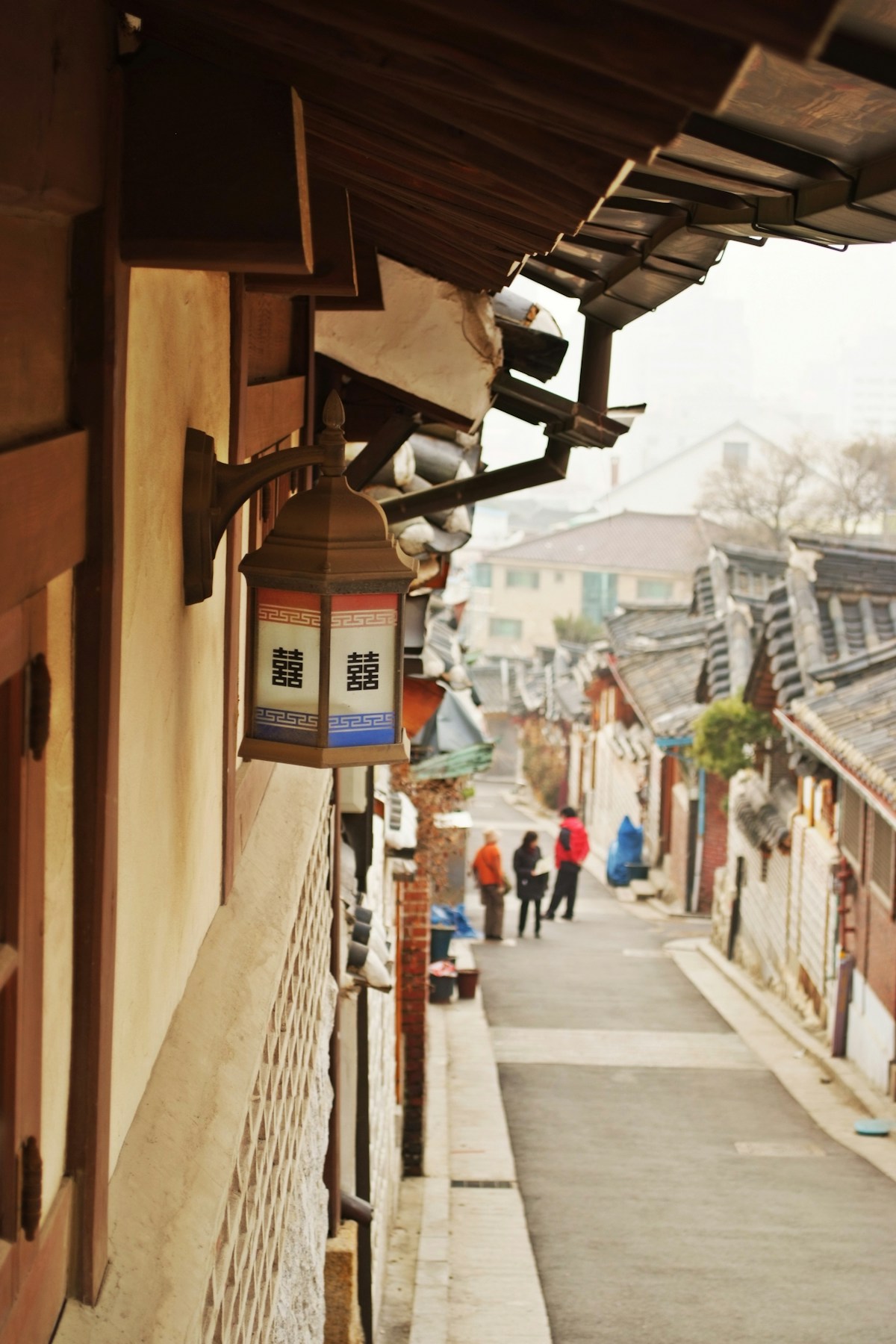
Jeonju’s Hanok Village is the most lived-in traditional Korean residential quarter in the country - around 800 traditional tile-roofed houses, still in active residential use alongside guesthouses, restaurants, craft studios, and cultural centres. The city has a food reputation that is national in scale: it claims the original bibimbap recipe and has a makgeolli culture that draws Korean food writers and tourists in roughly equal numbers.
For accommodation in the city, see our where to stay in Jeonju guide. For the full city overview, see the Jeonju travel guide.
Jeonju Hanok Village
The village - centred on the streets around Jeonju Hyanggyo (the Confucian school) and stretching outward for several blocks - is the reason most visitors come to Jeonju. It is not a theme park or a reconstruction. The houses here are genuine traditional Korean structures (hanok), and the neighbourhood functions as an actual residential area.
Entry: Free for the village itself. Individual attractions charge separately.
The main streets (Eunhaengno and the lanes running off it near the Hyanggyo) are where the highest concentration of cafés, hanbok rental shops, craft studios, and food vendors are located. These are busy on weekends between approximately 10:00 and 16:00 - if you have any flexibility, a weekday morning or an evening after 18:00 changes the experience substantially.
What to do in the village:
- Walk the main streets and explore the quieter lanes off the main circuit
- Rent a hanbok (traditional Korean costume) - rental shops charge approximately KRW 15,000–25,000 for a few hours; includes help with dressing
- Eat: the village and surrounding streets have Jeonju bibimbap restaurants, kongnamul gukbap stalls, makgeolli bars, and street food across all price ranges
- Visit the Hyanggyo (Confucian school) - a calm, rarely crowded building in the traditional style. Free entry.
- Enter craft studios for traditional paper, pottery, or fan-making workshops (prices vary by studio, typically KRW 10,000–25,000)
Gyeonggijeon Shrine
A royal shrine complex built in 1410 to house a portrait of King Taejo, the founder of the Joseon dynasty. The shrine is set in a walled garden with large old trees - one of the quieter and more contemplative sites in the village area.
- Entry fee: approximately KRW 3,000 for adults (as of 2026)
- Opening hours: 09:00–20:00 (June–August); 09:00–19:00 (March–May, September–October); 09:00–18:00 (November–February)
The main gate (Hongsalmun) and the shrine hall (Jeongejeon) are the key structures. The surrounding garden has old ginkgo and zelkova trees that are several hundred years old. The sound of the village drops noticeably once inside.
An adjacent area contains the Jeondong Historical Museum, which covers the Joseon dynasty connection to Jeonju, and the site of the Wansan Confucian School.
Jeonju Hanji Paper Museum
Hanji is traditional Korean mulberry paper, produced in the Jeonju region for over 1,000 years. It is used in traditional architecture, bookbinding, paintings, crafts, and clothing applications.
- Entry fee: approximately KRW 2,000 for adults (as of 2026)
- Opening hours: 10:00–18:00; closed Mondays
- Workshop bookings: separate fee, typically KRW 10,000–15,000 for a hands-on paper-making session; book ahead for weekend visits
The museum covers hanji’s history and production methods. The hands-on workshop allows visitors to make a simple sheet of hanji using the traditional float-and-lift technique - a genuine craft skill that takes patience and produces satisfying results.
Omokdae Hill
A small hilltop pavilion above the Hanok Village offering elevated views over the tile rooftops and the surrounding city. Short walk - approximately 10–15 minutes on foot from the main village streets.
- Entry: Free
The climb is manageable in 10 minutes. The view is best in the morning light and gives a good sense of the scale of the hanok district. The Imokdae pavilion, a short walk further, has a similar outlook and is slightly less visited.
Jeondong Cathedral
A red-brick French Gothic church completed in 1914 and visible from the hill above the Hanok Village. Architecturally unusual in the Korean context - the French-style brickwork contrasts sharply with the surrounding traditional rooflines.
- Entry: Free (check current visitor access times)
- Location: on the hill east of the Hanok Village, a 10-minute walk from the main village streets
The cathedral site has significance in Korean Catholic history - it was built on the site of executions of Korean Catholics during 19th-century persecutions. The interior is open for viewing outside of service times.
Wubuk-ro Food Street
A street adjacent to the Hanok Village where a concentration of bibimbap restaurants, makgeolli bars, and Jeonju-style food establishments operate side by side. Less tourist-branded than the main village streets, more oriented toward local diners.
Lunch on Wubuk-ro runs approximately KRW 10,000–18,000 per person for a bibimbap or ssambap set. In the evening the street transitions to a makgeolli and anju atmosphere.
Jeonju Cinema Street (Chungjeong-ro)
Jeonju hosts the Jeonju International Film Festival every May - one of Korea’s major independent film festivals. The area around Chungjeong-ro in the city centre has a cluster of independent cinemas and film-related cafés that operate year-round.
If your visit overlaps with the festival (usually late April to early May), the screenings and outdoor events in and around the village make for a very different atmosphere than a standard weekend visit. Tickets are available through the festival website.
Traditional Craft Workshops
The Hanok Village and surrounding streets have numerous workshops offering hands-on craft sessions:
- Hanji paper-making: at the Hanji Museum and at several independent studios (approximately KRW 10,000–20,000)
- Traditional fan (합죽선, habjukson) making: Jeonju is historically associated with folding fan production. Several studios in the village offer introductory sessions.
- Pottery (ceramic): multiple studios in and around the village
- Hanbok wearing experience: widespread across the village; not a craft class but an experience in its own right
Workshop availability and pricing change seasonally and by operator - check current listings at the Jeonju Tourism Visitor Centre on the main village street.
For guided food tours and cultural experiences in Jeonju, including craft sessions and market tours with English-speaking guides, advance booking is recommended.