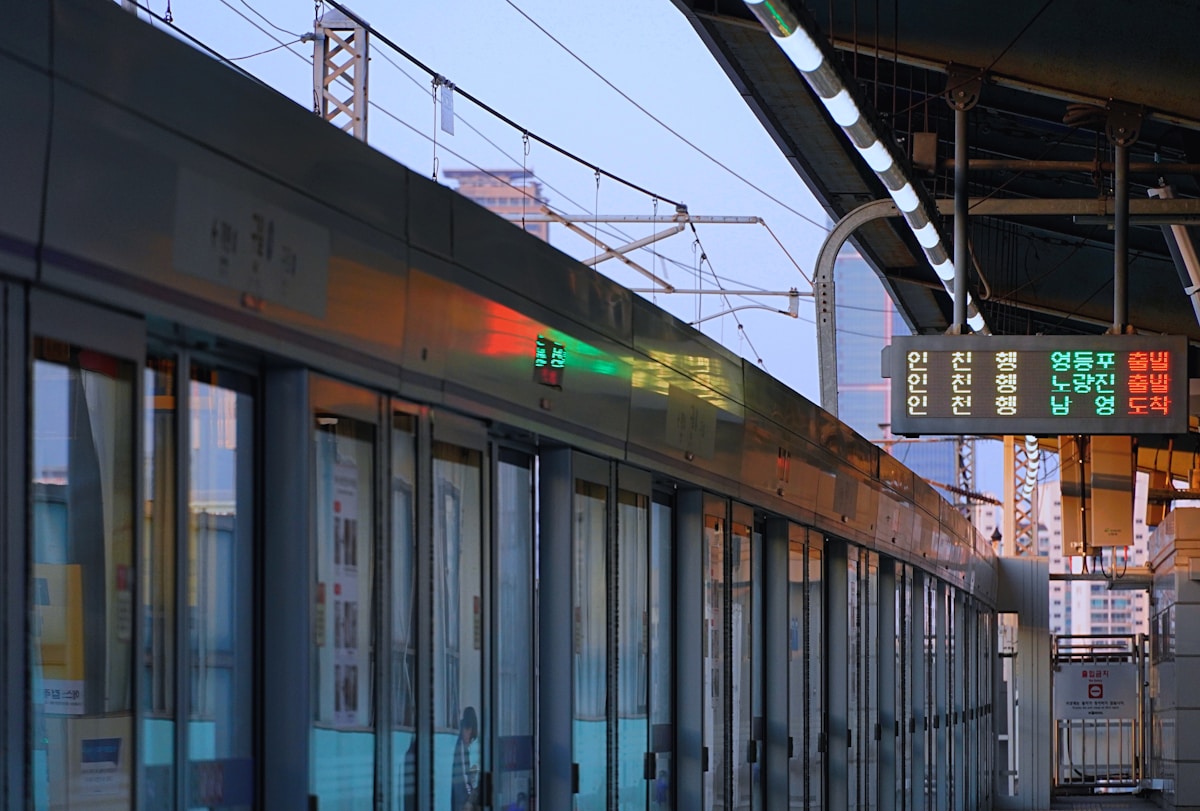
South Korea has six major international and domestic airports, each with its own transfer options into the nearest city. Incheon is the main gateway for international flights; Gimpo, Busan, Jeju, Daegu, and Cheongju are primarily domestic hubs with some international routes. This guide covers transfer options, journey times, and approximate costs for every airport.
For a deep-dive on the Incheon to Seoul journey specifically - including full route breakdowns, night bus schedules, and late-arrival tips - see the Incheon Airport to Seoul transport guide.
Incheon International Airport (ICN) → Seoul
Incheon sits on Yeongjong Island, approximately 60 km west of central Seoul. It handles the vast majority of Korea’s international traffic and is one of Asia’s most efficiently connected airports.
| Option | Journey Time | Approx. Cost |
|---|---|---|
| AREX Express train | 43 min | KRW 9,500 (~USD 7) |
| AREX All-Stop train | 66 min | KRW 4,150 (~USD 3) |
| Limousine Bus | 60–90 min | KRW 14,000–18,000 (~USD 10–13) |
| Standard Metered Taxi | 60–90 min | KRW 60,000–80,000 (~USD 43–57) |
| Private Transfer | 60–90 min | from KRW 80,000 (~USD 57) |
Prices as of 2026.
AREX Express is the fastest option - non-stop to Seoul Station in 43 minutes, connecting to Metro Lines 1 and 4 and KTX services. AREX All-Stop serves intermediate stations including Hongik University (Hongdae), Digital Media City, and Cheongna - useful if your accommodation is in those areas. Limousine buses serve hotel zones in Gangnam, Myeongdong, Itaewon, and Yeouido directly, without a metro transfer. Taxis provide door-to-door service but cost significantly more; they are most useful late at night when the AREX has stopped (last train approximately 22:40 from T1).
For full route details, schedules, night bus options, and advice on which option suits which traveller, see the Incheon Airport to Seoul guide.
Gimpo International Airport (GMP) → Seoul
Gimpo is Seoul’s second airport - a domestic hub handling flights to Jeju, Busan, Daegu, and some short-haul international routes to Tokyo Haneda and Osaka Itami. It sits within the Seoul city limits, roughly 18 km west of central Seoul.
| Option | Journey Time | Approx. Cost |
|---|---|---|
| Metro (Line 5 or Line 9) | 20–40 min | KRW 1,450–1,750 (~USD 1–1.25) |
| AREX All-Stop (to Incheon or Seoul Station) | 40–60 min | KRW varies |
| Taxi to central Seoul | 30–50 min | KRW 15,000–25,000 (~USD 11–18) |
Metro Line 5 connects Gimpo Airport station to Yeouido, Gwanghwamun, and central Seoul in about 30 minutes - among the cheapest airport connections in Korea. Metro Line 9 offers a faster express service to Yeouido and Gangnam in roughly 20–25 minutes (limited-stop service). Both lines are accessible directly from the arrivals level.
Gimpo is also served by the AREX all-stop line, connecting it to both Seoul Station (eastbound) and Incheon Airport (westbound) - useful for passengers connecting between the two airports.
Taxis from Gimpo to central Seoul cost approximately KRW 15,000–25,000, making them a reasonable option for groups or those with heavy luggage. The T-money card works on both metro lines and buses from Gimpo.
Gimhae International Airport (PUS) → Busan
Busan’s airport sits in the Gangseo district, approximately 16 km west of central Busan. It handles both domestic flights and a growing number of international routes.
| Option | Journey Time | Approx. Cost |
|---|---|---|
| Busan-Gimhae LRT + Metro | 35–45 min (to Seomyeon/Haeundae) | KRW 1,500–2,000 (~USD 1.10–1.45) |
| Limousine Bus | 30–60 min | KRW 6,000–8,000 (~USD 4.30–5.75) |
| Taxi to central Busan | 20–40 min | KRW 15,000–25,000 (~USD 11–18) |
| Private Transfer | 25–50 min | from KRW 30,000 (~USD 21) |
Prices as of 2026.
The Busan-Gimhae LRT (Light Rail Transit) is the most cost-effective option. The line connects the airport directly to Sasang Station (Metro Line 2), from where you can reach Seomyeon (city centre) in roughly 35 minutes total, or Haeundae beach in approximately 45 minutes. The LRT runs from approximately 05:15 to 23:15.
Limousine buses serve Busan Station, Seomyeon, Haeundae, and other key areas - comfortable with luggage storage, and costing approximately KRW 6,000–8,000 depending on destination. Journey time is 30–60 minutes depending on traffic.
Taxis are metered and available from the arrivals ground level. To central Busan (Seomyeon area), expect approximately KRW 15,000–20,000 in normal traffic. To Haeundae, budget KRW 30,000–40,000.
For those connecting to Incheon or Seoul after landing in Busan, the KTX operates from Busan Station (approximately 25 minutes from the airport by metro or taxi) to Seoul Station in roughly 2 hours 15 minutes.
Jeju International Airport (CJU) → Jeju City
Jeju Airport is the busiest domestic airport in Korea and handles some international flights to Japan and China. It sits on the northwest coast of Jeju Island, about 3 km from central Jeju City.
| Option | Journey Time | Approx. Cost |
|---|---|---|
| City Bus (Route 100/600) | 25–60 min | KRW 1,500–2,000 (~USD 1.10–1.45) |
| Taxi to Jeju City | 10–15 min | KRW 5,000–8,000 (~USD 3.60–5.75) |
| Taxi to Seogwipo (south coast) | 50–70 min | KRW 35,000–45,000 (~USD 25–32) |
| Rental Car (recommended for island exploration) | self-drive | from approx. KRW 35,000/day (~USD 25) |
Prices as of 2026.
Jeju has no metro or rail network. City buses are the cheapest option - Routes 100 and 600 are the main airport services, connecting to Jeju City bus terminal and Seogwipo respectively. Buses depart from outside the arrivals exit; fares are paid with T-money card or cash.
Taxis are plentiful and cheap for the short trip to central Jeju City (roughly 10–15 minutes). For the south coast (Seogwipo, Jungmun Resort), a taxi is possible but expensive at approximately KRW 35,000–45,000. Most visitors renting a car in Jeju pick it up directly at the airport, as driving is far the most practical way to explore the island.
Rent a car in Jeju - most rental companies have counters in the arrivals hall and in the car hire centre connected to T1.
Daegu International Airport (TAE) → Daegu City
Daegu Airport handles domestic routes and a small number of international flights, mainly to China and Japan. It sits about 8 km northeast of central Daegu.
| Option | Journey Time | Approx. Cost |
|---|---|---|
| City Bus (Route 101, 401, others) | 30–40 min | KRW 1,500–1,750 (~USD 1.10–1.25) |
| Taxi to central Daegu | 15–25 min | KRW 10,000–18,000 (~USD 7–13) |
Prices as of 2026.
Daegu Airport has no direct metro connection. City buses are the main public transport option - Routes 101, 401, and others pass the airport and connect to central Daegu. Journey time to Dongdaegu Station (Daegu’s KTX stop) is approximately 30–40 minutes. Fares are paid with T-money card or cash.
Taxis to central Daegu cost approximately KRW 10,000–18,000 in normal traffic. Daegu is compact - most accommodation in the city centre is within 20 minutes of the airport by taxi.
Daegu is also accessible from Seoul by KTX from Dongdaegu Station (approximately 1 hour 40 minutes from Seoul Station), which may be a practical alternative to flying for travellers arriving at Incheon.
Cheongju International Airport (CJJ) → Cheongju / Seoul
Cheongju Airport serves Chungcheong Province, handling some international routes and domestic connections. It sits approximately 12 km north of central Cheongju.
| Option | Journey Time | Approx. Cost |
|---|---|---|
| Limousine Bus to Cheongju City | 25–35 min | KRW 2,500–4,000 (~USD 1.80–2.90) |
| Limousine Bus to Seoul (Express Bus Terminal) | 90–120 min | KRW 9,900–12,000 (~USD 7–8.60) |
| Taxi to Cheongju City | 20–30 min | KRW 12,000–18,000 (~USD 8.60–13) |
Prices as of 2026.
Cheongju Airport has no rail connection. Limousine buses serve central Cheongju and - notably - direct express bus services run to Seoul’s Express Bus Terminal (Gangnam) in approximately 90–120 minutes. This makes Cheongju a convenient alternative entry point for travellers heading to southern Seoul without needing to transit through Incheon.
Taxis to central Cheongju cost approximately KRW 12,000–18,000. For groups, taxis are often the most practical option given the airport’s size and the relatively short distance to the city.
Practical Notes for All Korean Airports
T-money card: A single T-money card works across all public buses and metro systems in Korea - including at Incheon, Gimpo, Busan, Jeju, and Daegu. Pick one up at any GS25 or CU convenience store inside any airport terminal. Top it up at ticket machines or convenience store counters.
Data: Naver Maps is the most reliable navigation app for Korean public transit - more accurate for bus ETAs and metro routes than Google Maps inside Korea. Activate an eSIM or pick up a SIM card in the arrivals hall of any major airport.
Currency: Airport ATMs dispense KRW. Most transit fares, taxis, and limousine buses accept foreign cards, but having KRW 20,000–30,000 cash is useful on arrival.
Rental cars: For exploring Jeju or rural areas, picking up a car at the airport is the most practical option. For Seoul and Busan, public transit is faster and avoids parking costs.
Plan Your Trip
✈️ Book your flights to South Korea 🛡️ Get travel insurance 📱 Stay connected with an eSIM 🚗 Rent a car