Incheon has one of the more distinctive food identities of any Korean city. Its history as a treaty port - where Chinese, Japanese, and Western influences mixed - produced a local cuisine that sits slightly apart from mainstream Korean food culture. Chinatown’s Korean-Chinese dishes are the obvious starting point, but the seafood at Wolmido and the market food culture across the city add real depth.
Jajangmyeon (Black Bean Noodles)
Jajangmyeon is Korea’s most iconic Korean-Chinese dish and Incheon is its spiritual home. The dish - wheat noodles topped with a thick, dark sauce of fermented black soybean paste, diced pork, and vegetables - was adapted from the Chinese zhajiangmian by the Chinese community living in Incheon from the 1880s onwards. The Korean version is sweeter and thicker than its Chinese ancestor.
Eating jajangmyeon in Incheon Chinatown is genuinely worth doing. The restaurants on the main commercial strip have been serving it for decades, and the dish here has a different quality from the identical-tasting delivery version that appears in every Korean city.
Prices run KRW 7,000–10,000 for a standard bowl as of 2026. Most restaurants also serve jjamppong (spicy seafood noodle soup, KRW 8,000–12,000) and tangsuyuk (sweet and sour pork, KRW 15,000–25,000 per portion). The standard combination is jajangmyeon for one person and jjamppong for the other, sharing tangsuyuk between two.
Jjamppong (Spicy Seafood Noodle Soup)
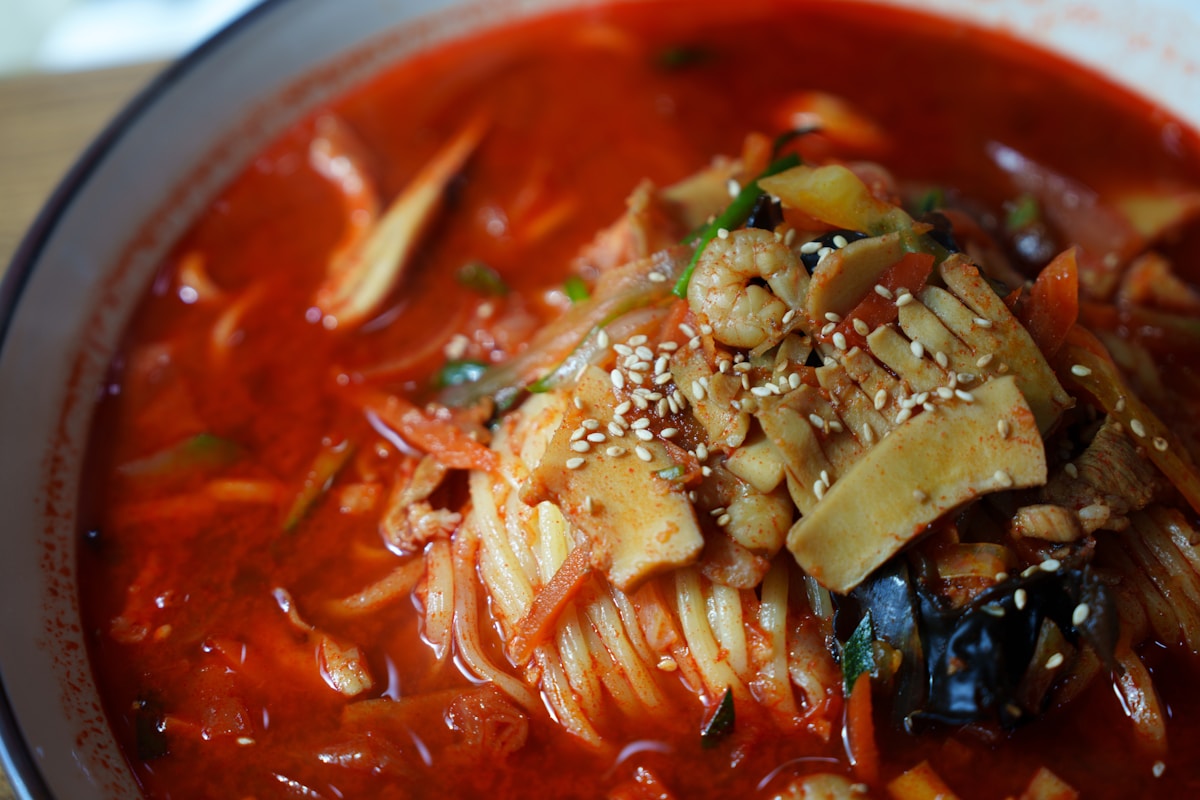
Jjamppong is jajangmyeon’s constant companion on Korean-Chinese menus - a fiery red soup loaded with shellfish, squid, vegetables, and thick wheat noodles. It is substantially more complex in flavour than a standard Korean ramyeon soup, with the chilli heat balanced by deep seafood stock.
In Incheon, the proximity to the Yellow Sea means the seafood in jjamppong tends to be fresher than in inland restaurants. Order it alongside jajangmyeon for a complete Korean-Chinese meal.
Seafood at Wolmido Island
Wolmido Island’s boardwalk is lined with seafood restaurants serving Yellow Sea catches. The standard offering includes raw fish platters (모듬회 - modum hoe), steamed crab (게찜 - ge jjim), grilled shellfish, and various stewed preparations.
Raw fish in Korea is typically served with lettuce wraps, doenjang (fermented soybean paste), sliced garlic, and a dipping sauce of vinegared gochujang. The ritual of assembling each bite is part of the experience.
Prices at Wolmido’s seafood restaurants are higher than inland Korean seafood - expect to pay KRW 20,000–35,000 per person for a modest shared platter as of 2026. Live crab dishes cost more depending on weight and species. The restaurants post prices by the gram for live seafood, so it is worth checking before you order.
Korean-Chinese Fusion Dishes (Korean-Chinese Cuisine)
Beyond jajangmyeon and jjamppong, Incheon’s Chinatown area has developed a distinct Korean-Chinese fusion food culture. Dishes such as ganjajang (dry jajangmyeon, tossed rather than sauced) and various dumpling preparations (mandu) show Chinese influence adapted through Korean hands.
Street food vendors in Chinatown sell Chinese-style steamed buns (찐빵 - jjinppang) filled with sweet red bean paste or pork, walnut cakes (호두과자), and fried snacks. Prices for street snacks run KRW 1,000–3,000 per item.
Ssambap
Ssambap is not unique to Incheon - it is eaten across Korea - but it appears on many menus in the city. The concept is grilled or braised meat (typically pork or beef) wrapped in fresh lettuce or perilla leaves with rice, garlic, kimchi, and doenjang paste. The flavour balance is achieved by the diner, not the kitchen.
In Incheon, ssambap restaurants in the commercial districts around Bupyeong and the central area serve decent versions at KRW 12,000–20,000 per person for a full set. It is a filling and interactive meal that suits groups.
Galbi Tang (Short Rib Soup)
Galbitang is a slow-cooked soup of beef short ribs, clear broth, radish, and glass noodles. It is one of Korea’s more refined soups - the broth is light but deeply flavoured from hours of simmering. It appears on many Korean restaurant menus in Incheon’s central areas.
A bowl of galbitang costs approximately KRW 15,000–20,000 as of 2026. It is a good choice for lunch if you want something warming without the chilli heat of many Korean soups.
Book guided tours and activities in Incheon through GetYourGuide.
Pick up an eSIM for South Korea to stay connected throughout your trip - Airalo offers easy top-up plans.
Market Food
Incheon does not have a food market with the profile of Seoul’s Gwangjang Market, but the city has a functioning network of traditional markets (시장 - sijang) where local produce, prepared foods, and street snacks are sold.
The areas around Bupyeong Station and the traditional commercial streets near Incheon Station have morning market stalls selling hotteok (sweet pancakes, KRW 1,000–2,000), tteokbokki (spicy rice cakes, KRW 3,000–5,000), and odeng (fish cake skewers in broth, KRW 500–1,000 per skewer). These are low-cost, high-quality options for a quick breakfast or afternoon snack.
For practical guidance on where to sleep while you eat your way through the city, see our Incheon where to stay guide. For the full city overview, visit the Incheon travel guide.