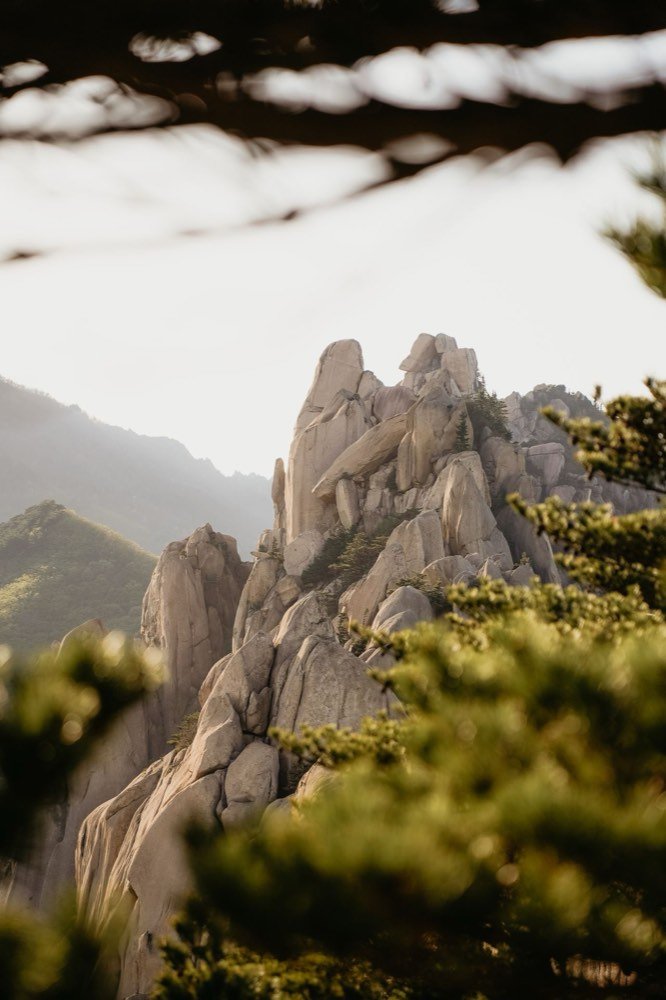
Gangneung faces the East Sea on Korea’s central coast, with the Taebaek mountain range rising immediately to the west. This geography gives it an unusual set of day-trip options: a UNESCO-listed national park with granite peaks an hour north, a seafood city at the edge of those peaks, and a cluster of small coastal villages along the shoreline. None require long travel times.
For hotels and guesthouses in Gangneung, see our accommodation guide. For local Gangneung food - coffee, sundae, and the regional specialities - see the food guide.
Seoraksan National Park: Granite Peaks and Mountain Trails
Seoraksan is one of Korea’s three major national parks and the most visited on the east coast. It covers a range of granite mountains that rise sharply from the coastal plain - the characteristic rock formations are dramatic in any season but particularly striking in autumn when the forest turns red and gold (typically mid to late October).
Getting there from Gangneung:
- Express bus + local bus (recommended): Express buses from Gangneung Intercity Bus Terminal to Sokcho Bus Terminal run frequently throughout the day, taking approximately 50–60 minutes for around KRW 5,000–7,000 as of 2026. From Sokcho Bus Terminal, local bus 7 or 7-1 runs to the Seorakdong park entrance in approximately 30–40 minutes for KRW 1,700 as of 2026.
- Taxi from Sokcho: More convenient if you miss the bus connection; 15–20 minutes from Sokcho Bus Terminal, approximately KRW 10,000–15,000 as of 2026.
- Total journey time: approximately 90 minutes from Gangneung to the park entrance.
At Seoraksan:
- Entry fee: approximately KRW 3,500 for adults as of 2026
- Opening hours: Gates open at 07:00; closing varies by season (last entry typically 14:00–15:00 for summit trails)
- The park entrance at Seorakdong (Outer Seorak area) is the most accessible and heavily visited section. Key sites from the entrance:
- Sinheungsa Temple: A 7th-century Buddhist temple 15 minutes’ walk from the entrance. The giant bronze Buddha statue (14 m tall) in the approach is visible from a distance. Free to visit.
- Ulsan Rock (Ulsanbawi): A cluster of six granite peaks forming the park’s most recognisable skyline feature. The trail to Ulsanbawi is 4 km return from Sinheungsa, with significant staircases near the top. Allow 3–4 hours return. The view from the base of the peaks looks back across the valley and out to the East Sea.
- Biryong Falls: A waterfall 2.5 km from the entrance. The trail is shorter and less strenuous than the Ulsanbawi route; allow 90 minutes return. Good option if you’re not planning a full hike.
- Cable car (Seorak Cable Car): A gondola rising 1.1 km to near the top of Gwongeumseong fortress ruins, saving significant elevation gain. Approximate fare: KRW 12,000 round trip as of 2026. Queues are long on weekends in autumn.
A day trip from Gangneung to Seoraksan is best managed with an early start - park trails become crowded from 10:00 onward in peak season, and trails above 1,000 m have early closing cutoffs.
Sokcho: Seafood Market and Coastal Base
Sokcho is a small coastal city of around 80,000 people, set between Seoraksan National Park and the East Sea. It’s not a large tourist destination in itself, but it has a strong seafood market, a historic fishing community, and a beach, making it a good half-day stop alongside a Seoraksan visit.
Getting there:
- Express bus: From Gangneung Intercity Bus Terminal, express buses to Sokcho Bus Terminal run frequently throughout the day. Journey time approximately 50–60 minutes; fares approximately KRW 5,000–7,000 as of 2026.
What to see in Sokcho:
- Abai Village: A small peninsula settlement connected to the Sokcho town centre by a hand-pulled ferry (approximately KRW 500 as of 2026, cash only). The village was originally settled by North Korean refugees who arrived during the Korean War and couldn’t return north. It remains a distinct community with its own dialect influences. The local speciality is Abai sundae (blood sausage with sticky rice stuffing, grilled or steamed) and grilled squid, available from street stalls at the ferry landing. Prices approximately KRW 3,000–6,000 per item as of 2026.
- Sokcho Beach (Sokcho Haesuyokjang): A long, quiet beach north of the city centre. Less crowded than Gangneung’s Gyeongpo or Jeongdongjin and better for a walk than a swimming spot. The view north toward Seoraksan’s silhouette is one of the better coastal panoramas on this stretch.
- Sokcho Central Market: A covered traditional market near the bus terminal with raw seafood, smoked fish, and dried seaweed - good for buying East Sea seafood products to take back. Prices lower than the tourist-facing stalls near the beach.
Sokcho and Seoraksan together make a full day from Gangneung: park in the morning, Sokcho for lunch and a walk in the afternoon, bus back by early evening.
For tours combining Seoraksan and Sokcho, browse GetYourGuide options from Gangneung or see GetYourGuide options from Sokcho.
Jeongdongjin: East Sea Sunrise Village
Jeongdongjin is a small village 18 km south of Gangneung along the East Sea coast, known as the sunniest sunrise point on the Korean mainland - the sun rises directly from the open sea with no intervening islands or headlands. The village became famous after featuring in a popular 1990s Korean drama, which brought attention to its unusual geography and peculiar Hotel Haebaragi, a large hotel built to resemble a cruise ship on a clifftop.
Getting there:
- Train (recommended): Commuter trains from Gangneung Station to Jeongdongjin Station run several times daily and take approximately 20–25 minutes. Fares are approximately KRW 2,500–3,500 as of 2026. The station is one of the world’s closest train stations to the sea - the track runs immediately beside the beach. Trains are infrequent on this line; check the Korail timetable before going and confirm the return schedule.
- Bus: Local buses from Gangneung Bus Terminal also reach Jeongdongjin in about 40–50 minutes; less convenient than the train but available if trains don’t align.
What to see:
- Hourglass Park (Jeongdongjin Moraesgiri Park): A clifftop park containing a giant hourglass sculpture - reportedly the world’s largest - turned over at midnight on New Year’s Day to mark the new year. The park has coastal walking paths and views south down the rocky shoreline. Free entry.
- Jeongdongjin Beach: A narrow sand and stone beach directly below the train station, with the railway passing at the edge of the sand. Good for an early morning walk. Sunrise here in December and January is around 07:30; in summer, closer to 05:30.
- Hotel Haebaragi Ship: The unusual hotel built on a clifftop to look like an ocean liner - worth a look from the outside as a curiosity. There is a café inside open to non-guests.
- Fossil Museum (Sunrise Park Fossil Museum): A small museum within the park showing geological specimens found in the East Sea cliffs. Entry approximately KRW 3,000–5,000 as of 2026.
Jeongdongjin is a half-day trip rather than a full-day destination - most visitors spend 2–3 hours there. It works well as a morning excursion (sunrise) or an afternoon add-on after Gangneung’s coffee-street district.
For guided tours along the East Sea coast from a Gangneung base, browse GetYourGuide options.
Returning each evening? See our Gangneung hotels guide for where to base yourself.
This page is part of our Gangneung travel guide, and our guide to things to do in Gangneung pairs well with it.